answer.
Ask question
Login Signup
Ask question
All categories
  • English
  • Mathematics
  • Social Studies
  • Business
  • History
  • Health
  • Geography
  • Biology
  • Physics
  • Chemistry
  • Computers and Technology
  • Arts
  • World Languages
  • Spanish
  • French
  • German
  • Advanced Placement (AP)
  • SAT
  • Medicine
  • Law
  • Engineering
ozzi
6 days ago
10

A cart of mass M is attached to an ideal spring that can stretch and compress equally well. The cart and spring rest on a smooth

horizontal track. The cart is pulled to position A and released. The cart then moves toward position E, where it reverses direction and returns again to position A.
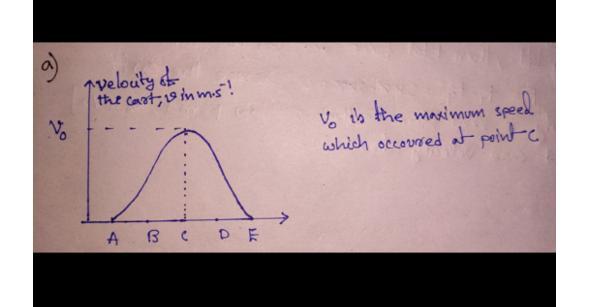
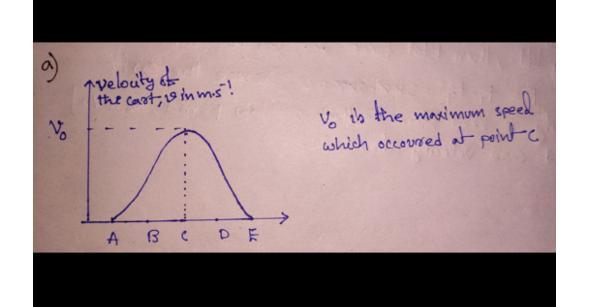
a) show with the sketch of a position diagram how the velocity of the cart changes between the points indicated
b) The dots below represent the cart at different labeled positions. Draw free body diagrams showing and labeling all the forces exerted on the cart at each labeled position. Draw the relative lengths of all vectors to reflect the relative magnitude of all forces. You will create one set of sketches for when the cart is moving to the right and a second set for when the car is moving to the left.
c) do the diagrams above indicate whether the cart is moving left or right? Justify your claim with evidence.
d) at each position, compare the direction of the net force exerted by the spring on the cart and the carts displacement from equilibrium when at that position. Note that this question is not asking whether the cart is moving right or left. Use these results to briefly explain why your claim in part C makes sense.

Physics
1 answer:
Maru [2.3K]6 days ago
4 0

It’s important to note that ‘the cart or spring is situated on a frictionless horizontal track’, which means there are no frictional forces acting on them.

Explanation:

a) Per the scenario, when the cart is drawn to position A and then let go, its initial speed at A (at time t=0) is 0 m/s. The cart travels toward position E, reaches a point where it reverses direction, and then heads back to position A. During this second phase, as the cart travels from A to E, its speed increases until it becomes zero again at point E, at which point it changes direction again, thus

( File has been attached)

b) Let’s assume the distance between two successive points is x meters and the spring constant is k N/m

c) ( File has been attached)

d) Moving to the right

e) Moving to the left

You might be interested in
In space, astronauts don’t have gravity to keep them in place. That makes doing even simple tasks difficult. Gene Cernan was the
Keith_Richards [2256]

Newton's First Law: A body remains in its current state of motion or at rest unless a force acts upon it.

Newton's Second Law: Motion changes are proportional to the applied force and oriented in the same direction.

Newton's Third Law: Every action has a corresponding and opposite reaction.

Tasks that would be challenging to perform in orbit include:

-operating a valve

-navigating on foot

-attempting to take a shower

-remaining still


4 0
6 days ago
Read 2 more answers
When a mass of 25 g is attached to a certain spring, it makes 20 complete vibrations in 4.0 s. what is the spring constant of th
kicyunya [2264]

Response: The spring constant is 25 N/m.

Details:

The body’s mass is 25 g, which converts to 0.025 kg (since 1 kg = 1000 g).

The total oscillations are 20 in 4 seconds.

Oscillations per second = \frac{20}{4}=5

Spring's frequency of vibration is = 5 s^{-1}=5 Hz

The spring constant 'k' can be derived from the relationship involving frequency, mass, and spring constant.

Frequency=\frac{1}{2\pi}\times \sqrt{\frac{k}{m}}

5 s^{-1}=\frac{1}{2\times 3.14}\times \sqrt{\frac{k}{0.025 kg}}

k=24.649 N/m\approx 25 N/m

The spring constant is 25 N/m.

3 0
28 days ago
Read 2 more answers
A vector A is added to B=6i-8j. The resultant vector is in the positive x direction and has a magnitude equal to A . What is the
Yuliya22 [2420]

The answer is letter d, 8.3.


Here’s a solution for the given problem:


We have:

B = 6i - 8j 


Let A be unknown; we'll denote A as = mi + nj 


The resultant A+B lies along the x-axis (which implies A+B = Ki + 0j, where K is yet to be determined,


and we also know the magnitude of A+B is equivalent to the magnitude of A,


therefore, mag(A+B)=K=sqrt(m^2+n^2), or K^2 = m^2+n^2. 


Using vector addition, A+B becomes (m+6)i + (n-8)j.


Since we know A+B = Ki + 0j, we can establish that: 

m + 6 = K 


n - 8 = 0, which gives n=8. 

Thus, K^2=m^2+n^2 means (m+6)^2 = m^2 +8^2 


= m^2 + 12m + 36 = m^2 + 64 


which gives us 12m = 28 


m = 2.33333... 

Consequently, the magnitude of A is sqrt[(2.333...)^2 + 8^2] = 8.3333.

5 0
23 days ago
Read 2 more answers
Below you are given data about a wave in three different substances.
inna [2205]

1) The wave's period remains constant across different media

2) The wave's velocity varies depending on the medium it travels through

3) As a wave transitions between media, its speed, direction, and wavelength can change, while its frequency stays unchanged

Clarification:

1)

The period of a wave signifies the duration it takes for one full oscillation.

The wave's period is the inverse of its frequency:

T=\frac{1}{f}

where

T denotes the period

f is the frequency

The provided table illustrates that the frequency remains consistent across the three media; hence, the period is unchanged as it solely relies on frequency. We can compute it as we know that

f = 350 Hz

thus the period equals

T=\frac{1}{350}=2.86\cdot 10^{-3} s = 2.86 ms

2)

The velocity of a wave can be derived from the wave equation:

v=f \lambda

where

f indicates the frequency

\lambda is the wavelength

<pin the="" first="" medium="">

f=350 Hz, \lambda = 0.75 m, resulting in a speed of

v_1 = (350)(0.75)=262.5 m/s

In the second medium,

f=350 Hz, \lambda = 0.70 m, leading to a speed of

v_2 = (350)(0.70)=245 m/s

In the third medium,

f=350 Hz, \lambda = 0.65 m, showing a speed of

v_3 = (350)(0.65)=227.5 m/s

As a result, we conclude that the wave's speed varies with the medium.

3)

<pwhen a="" wave="" shifts="" from="" one="" medium="" to="" another="" the="" following="" occurs:="">

- The wave's direction alters. Specifically, if the subsequent medium is of greater optical density, the wave bends towards the normal; conversely, it bends away if the second medium is of lesser optical density.

- The wave's speed is affected. The wave decelerates in media with higher optical density and accelerates in those with lower optical density.

- The wave's frequency remains unchanged.

- Ultimately, the wave's wavelength is modified. If moving into a medium of greater optical density, the wavelength decreases, while it increases in one of lower optical density.

Discover more about waves here:

</pwhen></pin>
7 0
15 days ago
A helicopter travels west at 80 mph. It is moving above a car traveling on a highway at 80 mph. Given this information, you can
serg [2593]
d. at the same velocity. Explanation: I'll assume the car is also moving west since the helicopter is stated to be above it. From the perspective of someone in the car, the helicopter will appear stationary as they share the same velocity. Viewed from along the roadside, both are traveling at the same speed. Remember that velocity is a vector quantity, which includes direction, while speed measures the rate at which an object covers distance without direction. Hence, velocity is the appropriate term here.
5 0
9 hours ago
Other questions:
  • A closed system of mass 10 kg undergoes a process during which there is energy transfer by work from the system of 0.147 kJ per
    15·1 answer
  • A baseball thrown at an angle of 60.0° above the horizontal strikes a building 16.0 m away at a point 8.00 m above the point fro
    6·1 answer
  • The Hall effect can be used to calculate the charge-carrier number density in a conductor. If a conductor carrying a current of
    5·1 answer
  • The magnitude of the electrical force acting between a +2.4 × 10⁻⁸ C charge and a +1.8 × 10⁻⁶ C charge that are separated by 0.0
    5·2 answers
  • "If E = 7.50V and r=0.45Ω, find the minimum value of the voltmeter resistance RV for which the voltmeter reading is within 1.0%
    10·1 answer
  • At a football game, an air gun fires T-shirts into the crowd. The gun is fired at an angle of 46 degree from the horizontal with
    14·1 answer
  • If Pete ( mass=90.0kg) weights himself and finds that he weighs 30.0 pounds, how far away from the surface of the earth is he
    9·1 answer
  • An astronaut is standing on the surface of a planet that has a mass of 6.42×10²³ kg and a radius of 3397 km. The astronaut fires
    12·1 answer
  • Which statement is always false for athletes participating in team sports?
    14·1 answer
  • What’s the force of a pitching machine on a baseball?
    5·2 answers
Add answer
Login
Not registered? Fast signup
Signup
Login Signup
Ask question!