answer.
Ask question
Login Signup
Ask question
All categories
  • English
  • Mathematics
  • Social Studies
  • Business
  • History
  • Health
  • Geography
  • Biology
  • Physics
  • Chemistry
  • Computers and Technology
  • Arts
  • World Languages
  • Spanish
  • French
  • German
  • Advanced Placement (AP)
  • SAT
  • Medicine
  • Law
  • Engineering
Ber
11 days ago
14

How do I interpret this equation 5+1x10= is the answer 15 or 60?

Mathematics
2 answers:
Zina [3.9K]11 days ago
8 0

5 + 1 × 10 = 15

Additional Explanation

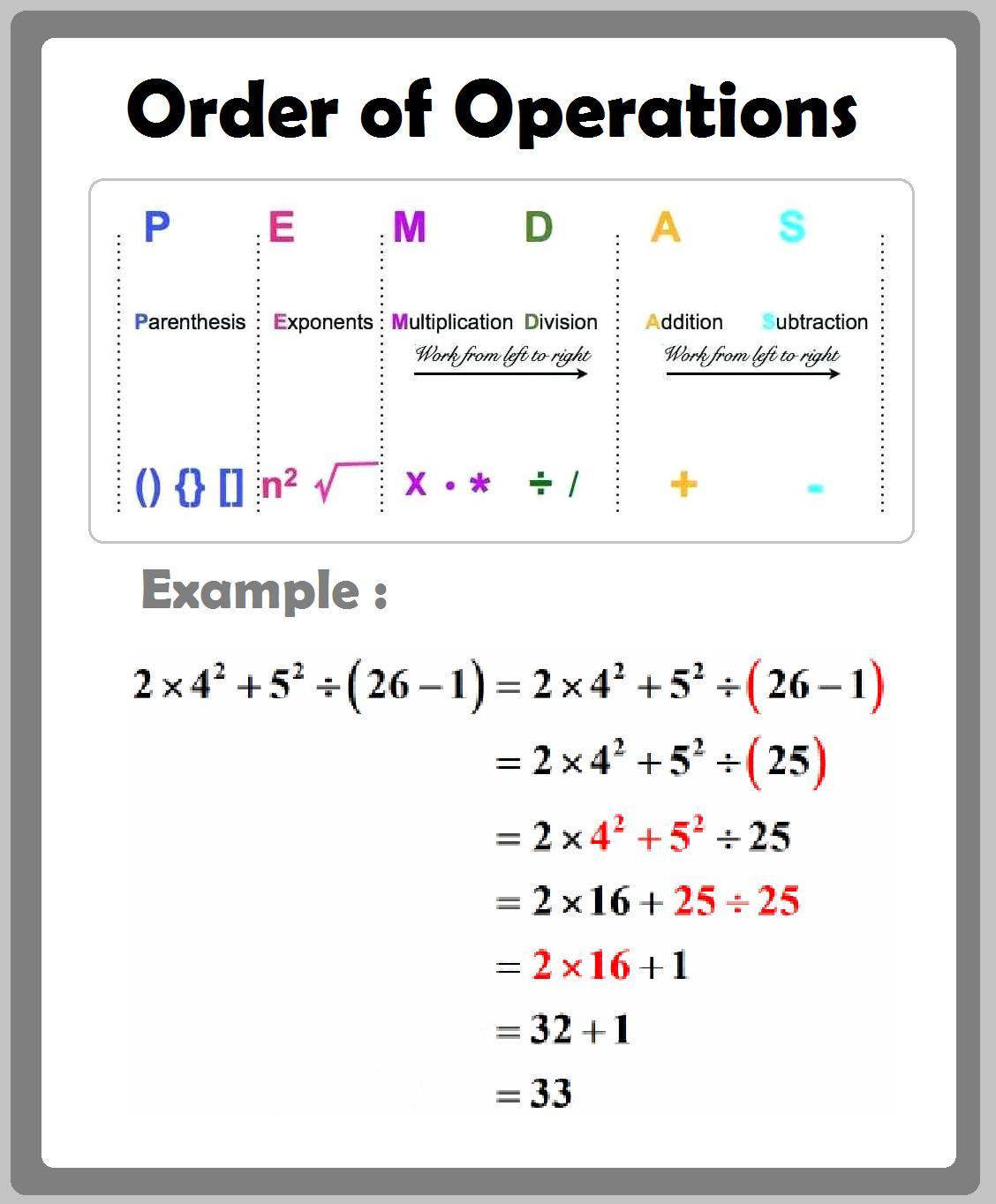
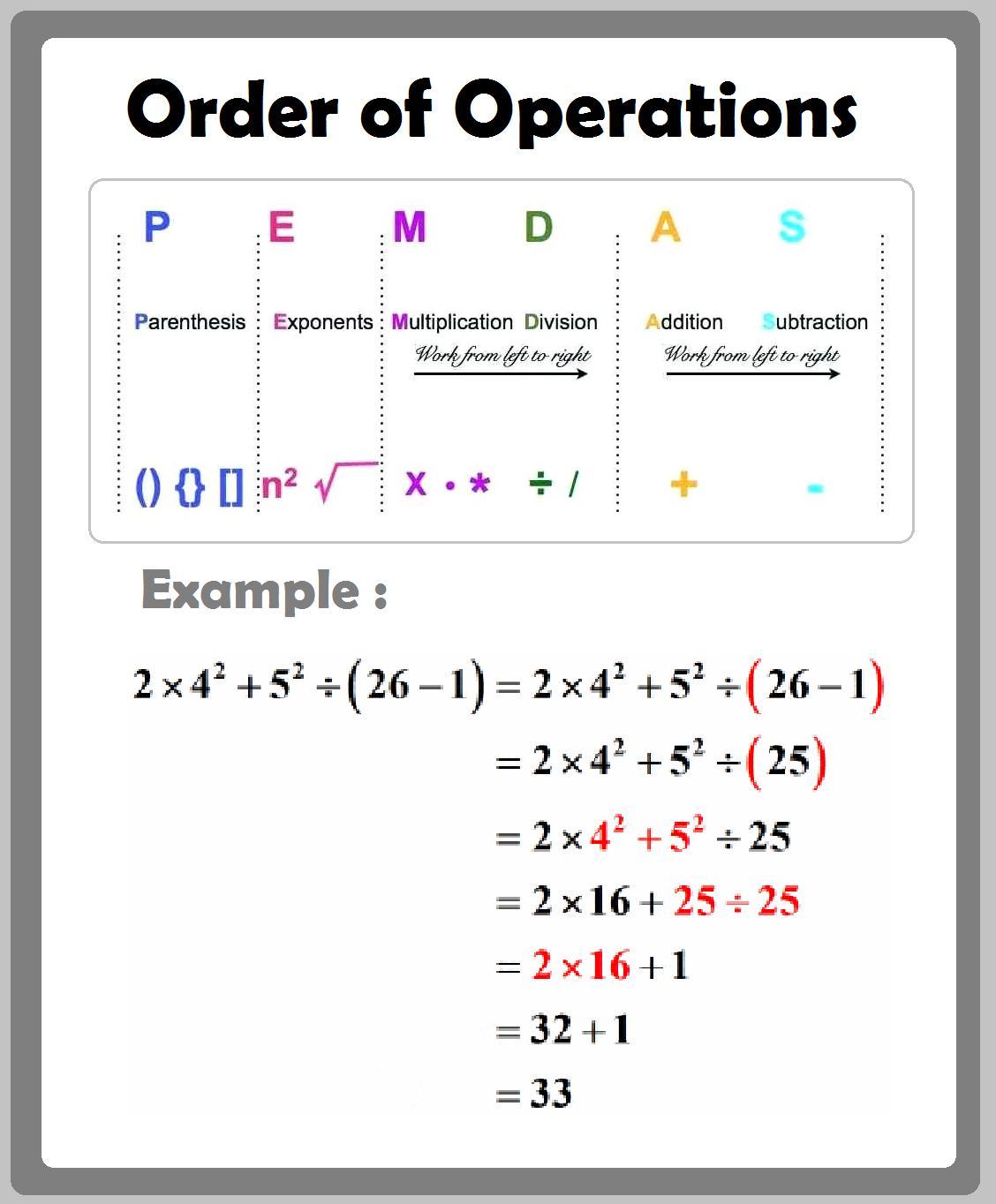
The order of operations in mathematics adheres to the following hierarchy:

  1. Parentheses
  2. Exponents
  3. Multiplication and Division
  4. Addition and Subtraction

This principle is known as the PEMDAS method.

In any mathematical calculations, we commence with operations in parentheses, go on to exponents, then tackle multiplication or division, followed by addition or subtraction.

Now, let's examine the equation.

Here’s the equation we need to solve:

\large {\boxed {5 + 1 \times 10 = 5 + 10 = 15} }

Following the PEMDAS guidelines, when both addition and multiplication are present, multiplication should be prioritized. In this equation, we multiply 1 by 10 first, and then add 5.

Final Result:

5 + 1 × 10 = 5 + (1 x 10) = 5 + 10 = 15

Further Learning

  • Infinite Number of Solutions
  • System of Equations
  • System of Linear Equations

Answer Details

Grade: Middle School

Subject: Mathematics

Chapter: Order of Operations

Keywords: Linear, Equations, 1, Variable, Line, Gradient, Point, Multiplication, Division, Exponent, PEMDAS, Interpretation

Leona [4.1K]11 days ago
6 0
To solve simple equations like this, it's essential to apply the order of operations defined by PEMDAS. This acronym represents the sequential operations needed for solving equations.
PEMDAS indicates Parentheses, Exponents, Multiplication, Division, Addition, and Subtraction.
According to PEMDAS, multiplication takes precedence over addition, leading us to:
5 + [1*10] = 5 + 10 = 15.
You might be interested in
Which steps can be used to solve StartFraction 6 Over 7 EndFraction x + one-half = StartFraction 7 Over 8 EndFraction for x? Che
lawyer [4039]

Response:

First, subtract one-half from each side of the equation.

Next, divide both sides by 6/7.

Then, multiply each side by 7/6.

Detailed explanation:

I simply took the question on ed.

8 0
8 days ago
Read 2 more answers
casey bought sandwiches and a bag of chips. Each sandwich cost three times as much as bag of chips. She bought 5 sandwiches for
AnnZ [3900]

Answer:

4

Step-by-step explanation:

Each sandwich costs 6 dollars, while chips sell for 3 dollars. She purchased 5 sandwiches at 6 dollars each, amounting to 30 dollars (5*6=30). This leaves her with 12 dollars to use since her total expenditure was 42 dollars. Given that chips are 3 dollars each, with 12 dollars left, 4 bags could be bought (4 * 3 = 12).

3 0
3 days ago
Read 2 more answers
NASA is sending a probe to Alpha Centauri and then to Sirius. A problem with the probe is noticed while it is at Alpha Centauri,
zzz [4035]
Total time taken = 9.0252 *10^12 s. Step-by-step explanation: Data provided: - Distance from Earth to Alpha Centauri: 4.3 light years. - Distance from Earth to Sirius: 8.6 light years. - Probe speed: V = 18.03 km/s. - 1 AU equals 1.58125 x 10^-5 light-years. Objective: Determine the total time the probe has been in motion from leaving Earth to reaching Sirius. Solution: - Journey is tracked for each destination sequentially:                      Earth ------> Alpha Centauri: d_1 = 4.3 light years                      Alpha Centauri ------> Earth: d_2 =4.3 light years                      Earth ------> Sirius: d_3 = 8.6 light years                      Sum of distances = D = 17.2 light years. - Now, we convert the total distance into kilometers (SI units):                             1 AU  ----------> 1.58125 x 10^-5 light-years                             x AU  ----------> 17.2 light years. - By proportions:                              x = 17.2 / (1.58125 x 10^-5) = 1087747.036 AU. Also,                             1 AU  ---------------------> 149597870700 m                              1087747.036 AU  ----> D m. - Using proportions:                              D =  1087747.036*149597870700  = 1.62725*10^17 m. - Finally, applying the speed-distance-time formula:                               Time = Distance traveled (D) / V                               Time = 1.62725*10^17 / (18.03*10^3). Final answer: Time = 9.0252 *10^12 s.
7 0
13 days ago
A 5 1/2 quart pot is filled 2/3 of the way with water. How many more quarts of water can the pot hold?
Inessa [3926]

The pot has the capability to hold 1/3 more than its current level. Therefore, 1/3 of 5 1/2 quarts equals:

(1/3)(11/2) = 11/6 quarts. Thus, the total capacity of the pot is 11/6 quarts.

8 0
7 days ago
Read 2 more answers
A random sample of 16 students selected from the student body of a large university had an average age of 25 years and a standar
PIT_PIT [3949]

Answer:

The P-value ranges between 2.5% and 5% according to the t-table.

Step-by-step explanation:

A random sample of 16 students from a large university showed an average age of 25 years with a standard deviation of 2 years.

Let \mu = true average age of all students at the university.

So, the Null Hypothesis, H_0 : \mu \leq 24 years {indicating the average age is less than or equal to 24 years}

Alternate Hypothesis, H_A : \mu > 24 years {indicating the average age is significantly greater than 24 years}

Here we employ the One-sample t-test statistics as the population's standard deviation is unknown;

                              T.S. = \frac{\bar X-\mu}{\frac{s}{\sqrt{n} } } ~ t_n_-_1

where, \bar X = sample average age = 25 years

             s = sample standard deviation = 2 years

             n = sample size = 16

This gives us the test statistics = \frac{25-24}{\frac{2}{\sqrt{16} } } ~ t_1_5

                                     = 2

The value of the t-test statistics is 2.

Moreover, the P-value of the test-statistics can be found as follows;

P-value = P(t_1_5 > 2) = 0.034 {as per the t-table}

Thus, the P-value lies between 2.5% and 5% based on the t-table.

8 0
15 days ago
Other questions:
  • If a =5, 0, −1,find a vector b such that compab = 2.b = _______.
    6·1 answer
  • When Joanne checked her Work by substituting the value of the variable back into the equation she got an answer of 12.34 equals
    6·2 answers
  • Find the distance across the lake. Assume the triangles are similar.
    15·1 answer
  • Cody wants to attend the fall festival at school. The price of admission to the festival is $5.50 and each game cost additional
    12·2 answers
  • You want to paint a piece of pottery at an art studio. The total cost is the cost of the piece plus an hourly studio fee. There
    14·1 answer
  • Jessica wants to calculate her grade in her accounting class.she has four test grades (82, 65, 71, and 77) and a homework grade
    6·1 answer
  • Factor –7x3 + 21x2 + 3x – 9 by grouping. What is the resulting expression? (3 – 7x)(x2 – 3) (7x – 3)(3 + x2) (3 – 7x2)(x – 3) (7
    5·2 answers
  • Mitchell travels from the US to Canada, where he exchanges 150 US dollars for Canadian dollars. He then spends 20 Canadian dolla
    14·2 answers
  • Unit 3: Parallel & Perpendicular Lines Homework 5: Linear Equations Slope-Intercept & Standard Form
    5·1 answer
  • Yumi wants to make 12 cups of party mix using candies and nuts her budget require the party mix to cost her $1 29 per cup. The c
    7·1 answer
Add answer
Login
Not registered? Fast signup
Signup
Login Signup
Ask question!