answer.
Ask question
Login Signup
Ask question
All categories
  • English
  • Mathematics
  • Social Studies
  • Business
  • History
  • Health
  • Geography
  • Biology
  • Physics
  • Chemistry
  • Computers and Technology
  • Arts
  • World Languages
  • Spanish
  • French
  • German
  • Advanced Placement (AP)
  • SAT
  • Medicine
  • Law
  • Engineering
AURORKA
7 days ago
11

Which statement is true about the polynomial 3j4k−2jk3+jk3−2j4k+jk3 after it has been fully simplified?

Mathematics
You might be interested in
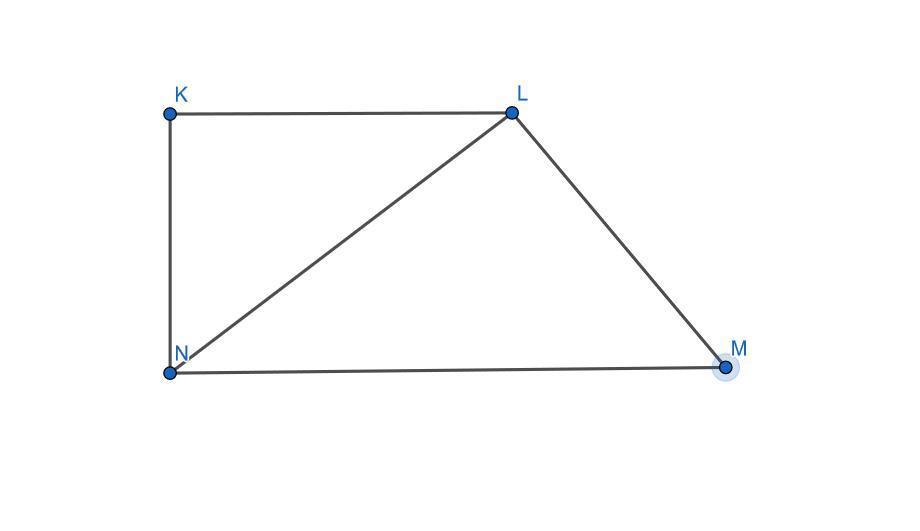
Given: KL ║ NM , LM = 45, m∠M = 50° KN ⊥ NM , NL ⊥ LM Find: KN and KL
Leona [12618]

Answer:

KL=45\tan 50^{\circ}\sin 50^{\circ}\approx 41.08\\ \\KN=45\sin 50^{\circ}\approx 34.47

Step-by-step explanation:

Given:

KL ║ NM,

LM = 45

m∠M = 50°

KN ⊥ NM  

NL ⊥ LM

To determine: KN and KL

1. Analyzing triangle NLM, we see it is a right triangle due to NL ⊥ LM. In this context,

LM = 45

m∠M = 50°

Consequently,

\tan \angle M=\dfrac{\text{opposite leg}}{\text{adjacent leg}}=\dfrac{NL}{LM}=\dfrac{NL}{45}\\ \\NL=45\tan 50^{\circ}

It is also true that

(angles LNM and M are complementary).m\angle LNM=90^{\circ}-50^{\circ}=40^{\circ}

2. Now considering triangle NKL, it also forms a right triangle as KN ⊥ NM. Within this triangle,

NL=45\tan 50^{\circ}

m\angle KLN=m\angle LNM=40^{\circ} (alternate interior angles)

m\angle KNL=90^{\circ}-40^{\circ}=50^{\circ} (angles KNL and KLN are complementary).

Thus,

\sin \angle KNL=\dfrac{\text{opposite leg}}{\text{hypotenuse}}=\dfrac{KL}{LN}=\dfrac{KL}{45\tan 50^{\circ}}\\ \\KL=45\tan 50^{\circ}\sin 50^{\circ}\approx 41.08

and

\cos \angle KNL=\dfrac{\text{adjacent leg}}{\text{hypotenuse}}=\dfrac{KN}{LN}=\dfrac{KN}{45\tan 50^{\circ}}\\ \\KN=45\tan 50^{\circ}\cos 50^{\circ}=45\sin 50^{\circ}\approx 34.47

3 0
2 months ago
Read 2 more answers
Venetta buys 2 pounds of pistachios and 3 pounds of almonds. The pistachios cost $4 more per pound than the almonds. She pays a
babunello [11817]

Answer:

A. Combining one pound of pistachios with one pound of almonds costs $20.

C. Decreasing the almond quantity by one pound leads to a total price of $40.

E. The price p (in dollars) per pound of pistachios is represented by the equation 2p + 3(p – 4) = 48.

Step-by-step explanation:

Let:

x = cost per pound of pistachios

y = cost per pound of almonds

We know that

x = y + 4 (Equation A)

2x + 3y = 48 (Equation B)

Substitute x from Equation A into Equation B:

2(y + 4) + 3y = 48

2y + 8 + 3y = 48

5y = 48 – 8

y = 8

Find x:

x = 8 + 4 = 12

Therefore, pistachios cost $12 per pound and almonds cost $8 per pound.

Verify the statements:

Case A) One pound of each equals $20.

True, since 12 + 8 = 20.

Case B) Pistachios cost twice as much as almonds.

False, because 2 × 8 = $16 ≠ $12.

Case C) Reducing almond pounds by 1 yields $40 total.

True, as 2(12) + 2(8) = 24 +16 = 40.

Case D) The almond cost modeled by 2(a – 4) + 3a = 48.

False; it should be 2(a + 4) + 3a = 48.

Case E) The pistachio cost modeled by 2p + 3(p – 4) = 48.

True, since p = a + 4 implies a = p – 4.

8 0
3 months ago
Heights of adult males are known to have a normal distribution. a researcher claims to have randomly selected adult males and me
Leona [12618]

Answer:

The total probability exceeds 100%, indicating a problem with the findings; moreover, the distribution shows excessive uniformity which disqualifies it as a normal distribution.

Detailed explanation:

The sum of probabilities should be exactly 100%. When you add the probabilities of this distribution:

22+24+21+26+28 = 46+21+26+28 = 67+26+28 = 93+28 = 121

This exceeds 100%, highlighting a significant error in the results.

A typical normal distribution possesses a bell curve. If we plot the probabilities for this distribution, we'd see bars at 22, 24, 21, 26, and 28.

The bars would fail to form a bell-shaped curve, confirming that this is not a normal distribution.

3 0
2 months ago
Read 2 more answers
Sales prices of baseball cards from the 1960's are known to possess a skewed-right distribution with a mean sale price of $5.25
Zina [12379]

Provided the details regarding the sale prices of baseball cards from the 1960s:

It's established that they display a skewed-right distribution

The average sale price is $5.25

The standard deviation measures $2.80.


If we draw a random sample of 100 cards from that era:

The distribution will be Normal

The mean will remain at $5.25

The standard error turns out to be $0.28

3 0
1 month ago
Read 2 more answers
Other questions:
  • Evaluate. 58−(14)2=58-142= ________
    13·1 answer
  • Find the coordinates of point B that lies along the directed line segment from A(-5, 2) to C(11, 0) and partitions the segment i
    9·2 answers
  • Andre wants to make an open-top box by cutting out corners of a 22 inch by 28 inch piece of poster board and then folding up the
    11·1 answer
  • Let x = 8.99999 . (a) Is x < 9 or is x = 9? x < 9 It is neither; x > 9 x = 9 x < 9 and x = 9 It cannot be determined
    6·1 answer
  • Hair Color/Height Less than 175 cm 175 to 180 cm Above 180 cm Total
    6·2 answers
  • Two asteroids are 1000 km apart and are heading straight for each other. One asteroid is travelling at 59 km per second and the
    5·1 answer
  • Marlena solved the equation 2x + 5 = –10 – x. Her steps are shown below.
    10·2 answers
  • Using the quadratic formula to solve 11x2 – 4x = 1, what are the values of x?
    13·2 answers
  • 5 pies were shared equally among 6 girls. What fraction of a pie did each girl receive? Explain.
    11·1 answer
  • Substitute the values for a, b, and c into b2 – 4ac to determine the discriminant. Which quadratic equations will have two real
    5·2 answers
Add answer
Login
Not registered? Fast signup
Signup
Login Signup
Ask question!