answer.
Ask question
Login Signup
Ask question
All categories
  • English
  • Mathematics
  • Social Studies
  • Business
  • History
  • Health
  • Geography
  • Biology
  • Physics
  • Chemistry
  • Computers and Technology
  • Arts
  • World Languages
  • Spanish
  • French
  • German
  • Advanced Placement (AP)
  • SAT
  • Medicine
  • Law
  • Engineering
DaniilM
1 month ago
14

Two blocks are attached to opposite ends of a massless rope that goes over a massless, frictionless, stationary pulley. One of t

he blocks, with a mass of 1.0 kg accelerates downward at 34g. What is the mass of the other box?

Physics
1 answer:
Softa [3K]1 month ago
3 0

Answer:

1/7 kg

Explanation:

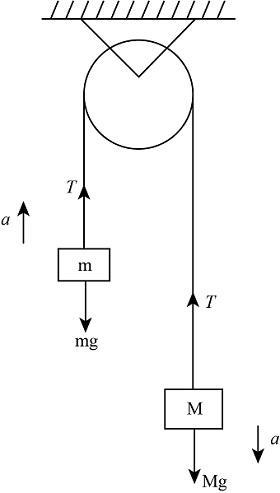
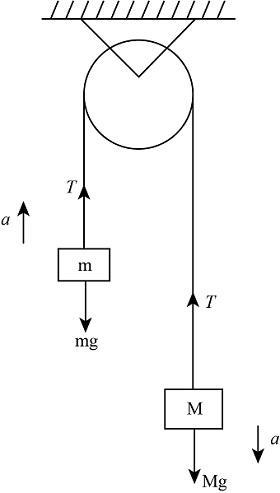
Refer to the attached diagram for enhanced clarity regarding the question.

One of the blocks weighs 1.0 kg and accelerates downward at 3/4g.

g denotes the acceleration due to gravity.

Let M represent the block with known mass, while 'm' signifies the mass of the other block and 'a' refers to the acceleration of body M.

Given M = 1.0 kg and a = 3/4g.

By applying Newton's second law; \sum fy = ma_y

For the body with mass m;

T - mg = ma... (1)

For the body with mass M;

Mg - T = Ma... (2)

Combining equations 1 and 2 gives;

+Mg -mg = ma + Ma

Ma-Mg = -mg-ma

M(a-g) = -m(a+g)

Substituting M = 1.0 kg and a = 3/4g into this equation leads to;

3/4 g-g = -m(3/4 g+g)

3/4 g-g = -m(7/4 g)

-g/4 = -m(7/4 g)

1/4 = 7m/4

Multiplying gives: 28m = 4

m = 1/7 kg

Hence, the mass of the other box is 1/7 kg

You might be interested in
The colored lines in the figure represent paths taken by different people walking around in a city. Assume that each city block
serg [3582]

Answer: 592.37m

Explanation:

Person D is represented by the blue line.

The total displacement is calculated by subtracting the initial position from the final position. Starting at (0,0), the path consists of moving down two blocks, then right six blocks, followed by moving up four blocks, and finally left one block.

Here, I consider the positive direction of the x-axis to the right and the positive direction of the y-axis as upward.

Thus, the new coordinates will be, with B representing a block:

P =(6*B - 1*B, -2*B + 4*B) = (5*B, 2*B)

Given that B = 110m

P = (550m, 220m)

The displacement corresponds to the length of the vector, since the change from the initial position (0,0) to P is simply P:

P = √(550^2 + 220^2) = 592.37m

4 0
1 month ago
Suppose Mitch Marner (mass=80kg) and Zdano Chara (mass=116kg) collide head-on at the blue line when Marner is skating 10m/s and
Maru [3345]

Answer:

1) Marner experiences a greater change in velocity

2) This happens because Chara has a greater mass compared to Marner, leading to a smaller change in velocity for Chara

Explanation:

Here are the details:

Mitch Marner's mass = 80 kg

Zdano Chara’s mass = 116 kg

Marner's speed prior to the collision = 10 m/s

According to the conservation of momentum, the sum of momentum before the collision equals the sum of momentum afterward:

m₁×u₁ + m₂×u₂ = m₁×v₁ + m₂×v₂

Where;

m₁ = Mitch Marner's mass = 80 kg

m₂ = Zdano Chara's mass = 116 kg

u₁ = Mitch Marner's initial velocity = 10 m/s

u₂ = Zdano Chara's initial velocity = 0 m/s

v₁ = Mitch Marner's final velocity

v₂ = Zdano Chara's final velocity

Assuming a direct collision, both players will have an identical instantaneous velocity just after impact, thus;

v₁ = v₂ = v

The equation can be expressed as;

m₁×u₁ + m₂×u₂ = (m₁ + m₂) × v₂

Substituting the numbers gives;

80 × 10 + 116 × 0 = (80 + 116) × v = 196 × v

Which simplifies to;

80 × 10 + 116 × 0 = 196 × v

800 = 196 × v

Thus, v = 800/196 = 100/49 = 4\frac{4}{19} \ m/s

This means the final instantaneous velocity for both Marner and Chara is 4\frac{4}{19} \ m/s

The change in velocity for Marner = 10 - 4\frac{4}{19} = 5\frac{15}{19} \ m/s

The change in velocity for Chara = 4\frac{4}{19} - 0 = 4\frac{4}{19} \ m/s

Therefore;

1) Marner's velocity changes more significantly

2) The reason being her mass relative to the total mass of both is smaller than Chara's mass relative to their total mass

This indicates that Marner's velocity alteration exceeds that of Chara due to Marner's lower mass.

5 0
1 month ago
Johnny was playing baseball with his friends and they noticed a bolt of lightning. They heard thunder seven seconds later. How f
ValentinkaMS [3465]
The storm is at least 7 miles away since light travels faster than sound, allowing us to estimate the distance of a lightning strike based on the time taken for the subsequent thunder.
4 0
25 days ago
A block weighing 400 kg rests on a horizontal surface and supports on top of it ,another block of weight 100 kg which is attache
Softa [3030]

Answer:

F_a=1470\ N

Explanation:

Friction Force

Friction forces arise when items come into contact with each other or a rough surface, especially when there is an attempt to move one against the other. Friction operates in the reverse direction of the intended motion: pushing to the right results in a friction force directed left.

In this scenario, we have two blocks: a 400 kg block on the ground and a 100 kg block positioned atop, secured to a vertical wall via a string. When we attempt to push the bottom block, it will not move freely because two friction forces come into play: one from the surface and the other from the contact between the two blocks, denoted as Fr1 and Fr2. The second block, constrained by the wall, cannot simply slide along with the first one.

The provided figure displays the free body diagrams.

The equilibrium condition for the first mass is given as

\displaystyle F_a-F_{r1}-F_{r2}=m.a=0

The mass m1 is subjected to an applied force Fa, such that slipping with mass m2 just begins, indicating no overall movement (a=0). We can solve for Fa using:

\displaystyle F_a=F_{r1}+F_{r2}.....[1]

The second mass experiences an attempt to move rightward due to the friction force Fr2 while the string maintains its position through tension T. The horizontal axis equation can be outlined as follows:

\displaystyle F_{r2}-T=0

The friction forces are calculated as

\displaystyle F_{r2}=\mu \ N_2=\mu\ m_2\ g

\displaystyle F_{r1}=\mu \ N_1=\mu(m_1+m_2)g

It is important to note that N1 signifies the reaction force from the surface acting on mass m1, which corresponds to the cumulative mass of m1+m2.

Substituting into [1]

\displaystyle F_{a}=\mu \ m_2\ g\ +\mu(m_1+m_2)g

Upon simplifying

\displaystyle F_{a}=\mu \ g(m_1+2\ m_2)

Finally, entering the numerical values will yield:

\displaystyle F_{a}=0.25(9.8)[400+2(100)]

\boxed{F_a=1470\ N}

8 0
1 month ago
A 5.00μF parallel-plate capacitor is connected to a 12.0 V battery. After the capacitor is fully charged, the battery is disconn
serg [3582]

(a) 12.0 V

The capacitor remains connected to the 12.0 V source until fully charged. Taking into account the capacitor's capacity, C=5.00 \mu F, the total charge held at the conclusion of this process is

Q=CV=(5.00 \mu F)(12.0 V)=60 \mu C

Upon disconnecting the battery, the charge on the capacitor stays the same. The capacitance, C, does not change either, as it solely relies on the capacitor's characteristics (area and distance between plates), which stay constant. Hence, according to the relationship

V=\frac{Q}{C}

and since neither Q nor C vary, the voltage V also remains at 12.0 V.

(b) (i) 24.0 V

In this scenario, the distance between the plates is doubled. Let's recall the formula for the capacitance of a parallel-plate capacitor:

C=\frac{\epsilon_0 \epsilon_r A}{d}

where:

\epsilon_0 is the permittivity of free space

\epsilon_r is the relative permittivity of the capacitor's material

A is the area of the plates

d is the distance separating the plates

As noted, the plate distance is now doubled: d'=2d. This indicates that the capacitance is halved: C'=\frac{C}{2}. The updated voltage across the plates is given by

V'=\frac{Q}{C'}

Since Q (the charge) remains constant (the capacitor is isolated, preventing charge flow), the new voltage turns out to be

V'=\frac{Q}{C'}=\frac{Q}{C/2}=2 \frac{Q}{C}=2V

This leads us to a new voltage of

V'=2 (12.0 V)=24.0 V

(c) (ii) 3.0 V

The area for each capacitor plate is determined as:

A=\pi r^2

where r indicates the radius of the plate. In this situation, the radius is doubled: r'=2r. Therefore, the new area becomes

A'=\pi (2r)^2 = 4 \pi r^2 = 4A

While the distance between the plates remained unchanged (d); consequently, the new capacitance can be expressed as

C'=\frac{\epsilon_0 \epsilon_r A'}{d}=4\frac{\epsilon_0 \epsilon_r A}{d}=4C

Thus, the capacitance has quadrupled, leading to a new voltage of

V'=\frac{Q}{C'}=\frac{Q}{4C}=\frac{1}{4} \frac{Q}{C}=\frac{V}{4}

which equates to

V'=\frac{12.0 V}{4}=3.0 V

3 0
1 month ago
Other questions:
  • Un tren parte de la ciudad A, a las 8 h. con una velocidad de 50 km/h, para llegar a la ciudad B a las 10 h. Allí permanece dura
    10·1 answer
  • When Jim and Rob ride bicycles, Jim can only accelerate at three-quarters the acceleration of Rob. Both startfrom rest at the bo
    15·1 answer
  • If you are anchored in a fixed spot, and a set of six waves pass underneath you during a 60 second time interval, what is the wa
    11·1 answer
  • A small object slides along the frictionless loop-the-loop with a diameter of 3 m. what minimum speed must it have at the top of
    11·1 answer
  • A constant torque of 260 Nm acts on a flywheel. If the flywheel makes 25 complete revolutions in 2 minutes, what is the power ex
    5·2 answers
  • Two of the types of ultraviolet light, uva and uvb, are both components of sunlight. their wavelengths range from 320 to 400 nm
    12·2 answers
  • Which of the following statements are true of an object in orbit around Earth? (Select all that apply.) The gravity force on the
    8·1 answer
  • Calculate the average charge on arginine when ph=9.20. (hint : find the average charge for each ionizable group and sum these to
    12·1 answer
  • As Aubrey watches this merry-go-round for a total of 2 minutes, she notices the black horse pass by 15 times. What is the period
    12·2 answers
  • Megan rode the bus to school, which is located 8 kilometers from her home. If Megan's frame of reference is her house, and it to
    7·1 answer
Add answer
Login
Not registered? Fast signup
Signup
Login Signup
Ask question!