answer.
Ask question
Login Signup
Ask question
All categories
  • English
  • Mathematics
  • Social Studies
  • Business
  • History
  • Health
  • Geography
  • Biology
  • Physics
  • Chemistry
  • Computers and Technology
  • Arts
  • World Languages
  • Spanish
  • French
  • German
  • Advanced Placement (AP)
  • SAT
  • Medicine
  • Law
  • Engineering
Vinil7
1 month ago
15

John worked 43 hours last week. His hourly rate is $9.00. He has the following deductions taken from his pay: Social Security ta

x at the rate of 6.2 percent, Medicare tax at the rate of 1.45 percent, health insurance premiums of $15.00, and 401(k) contributions of 5 percent of gross pay. John also has federal income tax withheld at the rate of 10 percent. Federal taxes do not apply to the 401(k) contribution. John’s net pay for last week was
Mathematics
2 answers:
lawyer [12.5K]1 month ago
6 0

Assuming John does not receive premium compensation for hours exceeding 40, his earnings would be...

... 43 hours × $9.00 = $387

... - 6.2% × $387 = $23.99

... - 1.45% × $387 = $5.61

... - $15.00

... - 5% × $387 = $19.35

... - 10% × ($387 -19.35) = $36.77

... = $286.28.... net pay after all deductions

Svet_ta [12.7K]1 month ago
3 0

Answer:

$286.28

Explanation:

For working 43 hours at $9 per hour, John's gross pay amounts to

43(9) = $387.

Social Security tax is 6.2% of gross; 6.2% equals 6.2/100 = 0.062; this leads to a deduction of

387(0.062) = 23.994 ≈ $23.99

Medicare tax is 1.45% of gross; 1.45% equals 1.45/100 = 0.0145; thus, the deduction is

387(0.0145) = 5.6115 ≈ $5.61

Health insurance has a flat deduction of $15.

For 401(k) contributions, which are 5% of gross; 5% equals 5/100 = 0.05; the deduction calculates as

387(0.05) = $19.35

Federal tax is applied after the 401(k) contribution, meaning it will be 10% of

387-19.35 = $367.65

10% equals 10/100 = 0.1; this implies a deduction of

367.65(0.1) = 36.765 ≈ $36.77

Ultimately, John's net pay is:

387-23.99-5.61-15-19.35-36.77 = $286.28

You might be interested in
Return to the credit card scenario of Exercise 12 (Section 2.2), and let C be the event that the selected student has an America
zzz [12365]

Answer:

A. P = 0.73

B. P(A∩B∩C') = 0.22

C. P(B/A) = 0.5

P(A/B) = 0.75

D. P(A∩B/C) = 0.4

E. P(A∪B/C) = 0.85

Step-by-step explanation:

Denote A as the event of a student having a Visa card, B as the event of holding a MasterCard, and C as the event of owning an American Express card. Additionally, let A' indicate the event of not having a Visa card, B' signify not having a MasterCard, and C denote the event of not possessing an American Express card.

Thus, with the given probabilities, we can determine the following probabilities:

P(A∩B∩C') = P(A∩B) - P(A∩B∩C) = 0.3 - 0.08 = 0.22

Here, P(A∩B∩C') refers to the chance that a student has both a Visa and MasterCard but does not own an American Express, P(A∩B) indicates the probability that a student possesses both a Visa and a MasterCard, and P(A∩B∩C) represents the likelihood that a student has a Visa, MasterCard, and American Express. Similarly, we can find:

P(A∩C∩B') = P(A∩C) - P(A∩B∩C) = 0.15 - 0.08 = 0.07

P(B∩C∩A') = P(B∩C) - P(A∩B∩C) = 0.1 - 0.08 = 0.02

P(A∩B'∩C') = P(A) - P(A∩B∩C') - P(A∩C∩B') - P(A∩B∩C)

                   = 0.6 - 0.22 - 0.07 - 0.08 = 0.23

P(B∩A'∩C') = P(B) - P(A∩B∩C') - P(B∩C∩A') - P(A∩B∩C)

                   = 0.4 - 0.22 - 0.02 - 0.08 = 0.08

P(C∩A'∩A') = P(C) - P(A∩C∩B') - P(B∩C∩A') - P(A∩B∩C)

                   = 0.2 - 0.07 - 0.02 - 0.08 = 0.03

A. The likelihood that the selected student holds at least one of the three card types is calculated as follows:

P = P(A∩B∩C) + P(A∩B∩C') + P(A∩C∩B') + P(B∩C∩A') + P(A∩B'∩C') +              

     P(B∩A'∩C') + P(C∩A'∩A')

P = 0.08 + 0.22 + 0.07 + 0.02 + 0.23 + 0.08 + 0.03 = 0.73

B. The probability that the chosen student possesses both a Visa and a MasterCard without an American Express card can be represented as P(A∩B∩C') equaling 0.22

C. P(B/A) represents the chance that a student holds a MasterCard provided they have a Visa. This is calculated as:

P(B/A) = P(A∩B)/P(A)

By substituting in the values, we find:

P(B/A) = 0.3/0.6 = 0.5

In a similar manner, P(A/B) represents the probability a student has a Visa given they possess a MasterCard, calculated as:

P(A/B) = P(A∩B)/P(B) = 0.3/0.4 = 0.75

D. For a student with an American Express card, the likelihood they also hold both a Visa and a MasterCard is expressed as P(A∩B/C), calculated as:

P(A∩B/C) = P(A∩B∩C)/P(C) = 0.08/0.2 = 0.4

E. If the student has an American Express card, the probability they possess at least one of the other two card types is denoted as P(A∪B/C), computed as:

P(A∪B/C) = P(A∪B∩C)/P(C)

Where P(A∪B∩C) = P(A∩B∩C)+P(B∩C∩A')+P(A∩C∩B')

Consequently, P(A∪B∩C) equals 0.08 + 0.07 + 0.02 = 0.17

Ultimately, P(A∪B/C) equals:

P(A∪B/C) = 0.17/0.2 =0.85

4 0
19 days ago
Suppose that the weights of airline passenger bags are normally distributed with a mean of 47.88 pounds and a standard deviation
Zina [12379]

Answer:

There is a probability of 24.51% that the weight of a bag exceeds the maximum permitted weight of 50 pounds.

Step-by-step explanation:

Problems dealing with normally distributed samples can be addressed using the z-score formula.

For a set with the mean \mu and a standard deviation \sigma, the z-score for a measure X is calculated by

Z = \frac{X - \mu}{\sigma}

Once the Z-score is determined, we consult the z-score table to find the related p-value for this score. The p-value signifies the likelihood that the measured value is less than X. Since all probabilities total 1, calculating 1 minus the p-value gives us the probability that the measure exceeds X.

For this case

Imagine the weights of passenger bags are normally distributed with a mean of 47.88 pounds and a standard deviation of 3.09 pounds, thus \mu = 47.88, \sigma = 3.09

What probability exists that a bag’s weight will surpass the maximum allowable of 50 pounds?

That translates to P(X > 50)

Thus

Z = \frac{X - \mu}{\sigma}

Z = \frac{50 - 47.88}{3.09}

Z = 0.69

Z = 0.69 has a p-value of 0.7549.

<pthis indicates="" that="" src="https://tex.z-dn.net/?f=P%28X%20%5Cleq%2050%29%20%3D%200.7549" id="TexFormula10" title="P(X \leq 50) = 0.7549" alt="P(X \leq 50) = 0.7549" align="absmiddle" class="latex-formula">.

Additionally, we have that

P(X \leq 50) + P(X > 50) = 1

P(X > 50) = 1 - 0.7549 = 0.2451

There is a probability of 24.51% that the weight of a bag will exceed the maximum allowable weight of 50 pounds.

</pthis>
6 0
1 month ago
The value of a car t years after it is purchased is given by the decreasing function V, where V(t) is measured in dollars. The r
PIT_PIT [12445]

Answer:

dV(t)/dt = kV(t)

Step-by-step explanation:

The annual change in the car's value, represented by dV(t)/dt, has a proportional relationship with V(t), the car's current value.

dV(t)/dt ∝ V(t)

dV(t)/dt = kV(t)

7 0
1 month ago
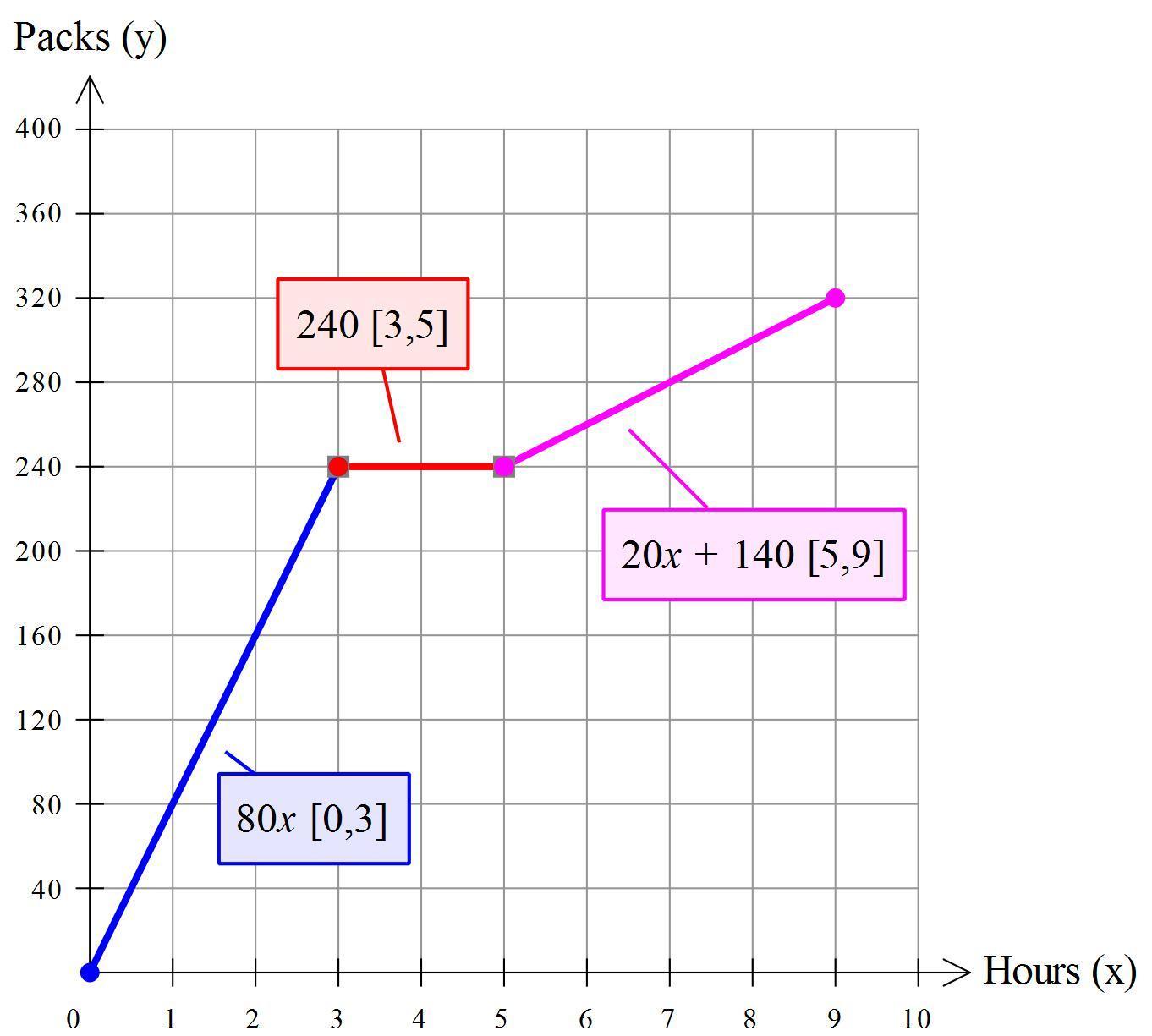
Claire is a manager at a toy packaging company. The company packs 80 boxes of toys every hour for the first 3 hours of the day.
Svet_ta [12734]

Response:

Refer to the figure attached.

Step-by-step explanation:

Each portion is treated as a function.

Let x represent the hours worked in a day

The company packs 80 boxes of toys each hour during the first three hours. Thus, y₁ = 80x, for x ∈ [0,3]

After three hours, the total boxes packed = 80 * 3 = 240

They pause packaging for two hours for a training session. Therefore, y₂ = 240, for x ∈ [3,5]

Next, for the subsequent four hours, they pack 20 boxes of toys hourly

y₃ = 20x + c, for x ∈ [5,9]

To determine c, equate y₂ and y₃ at x = 5

∴ 240 = 20 * 5 + c

∴ c = 240 - 20 * 5 = 240 - 100 = 140

∴ y₃ = 20x + 140, for x ∈ [5,9]

Consequently,

y₁ = 80x, for x ∈ [0,3]

y₂ = 240, for x ∈ [3,5]

y₃ = 20x + 140, for x ∈ [5,9]

The graph plotting the piecewise function that depicts the described situation is shown in the attached illustration.

8 0
1 month ago
Read 2 more answers
Program X has an annual cost of $35,000, and, in return, is expected to save the Company C $40,000 during the first year. Assumi
babunello [11817]
The cost of Program X is $35,000, and it generates yearly savings of $40,000. To find the payback period:
Cost divided by savings times 12 months
35000 / 40000 × 12
= 10.5 months
Thus, the company will recover its investment in 10.5 months.
7 0
1 month ago
Other questions:
  • 25.691 rounded to the greatest place
    13·3 answers
  • Hank estimated width of the door to his classroom in feet. what is a reasonable estimate?
    15·1 answer
  • At time t = 0 a car moves into the passing lane to pass a slow-moving truck. The average velocity of the car from t =1tot =1+his
    6·1 answer
  • Town Hall is located 4.3 miles directly east of the middle school. The fire station is located 1.7 miles directly north of Town
    12·1 answer
  • There were 340,000 cattle placed on feed. Write an equivalent ratio that could be used to find how many of these cattle were bet
    12·2 answers
  • A biologist created the following graph to show the relationship between the temperature of water (x), in degrees Celsius, and t
    15·2 answers
  • The final velocity, V, of an object under constant acceleration can be found using the formula uppercase V squared = v squared +
    14·2 answers
  • 1.4 puzzle time Why was the geometry book so sad? It had
    11·2 answers
  • Find the component form of the vector that translates p(-3,6) to p’ (-4,8)
    12·1 answer
  • Jason inherited a piece of land from his great-uncle. Owners in the area claim that there is a 45% chance that the land has oil.
    6·1 answer
Add answer
Login
Not registered? Fast signup
Signup
Login Signup
Ask question!