answer.
Ask question
Login Signup
Ask question
All categories
  • English
  • Mathematics
  • Social Studies
  • Business
  • History
  • Health
  • Geography
  • Biology
  • Physics
  • Chemistry
  • Computers and Technology
  • Arts
  • World Languages
  • Spanish
  • French
  • German
  • Advanced Placement (AP)
  • SAT
  • Medicine
  • Law
  • Engineering
Masja
6 days ago
10

A marble rolls with a velocity of 10 mm/s [E] on a game board that is being pulled [60o N of E] at 40.0 mm/s. What is the veloci

ty of the marble relative to the floor?

Physics
1 answer:
ValentinkaMS [1.1K]6 days ago
7 0

Answer:

R = 45.82[mm/s], with an angle of 48.95°

Explanation:

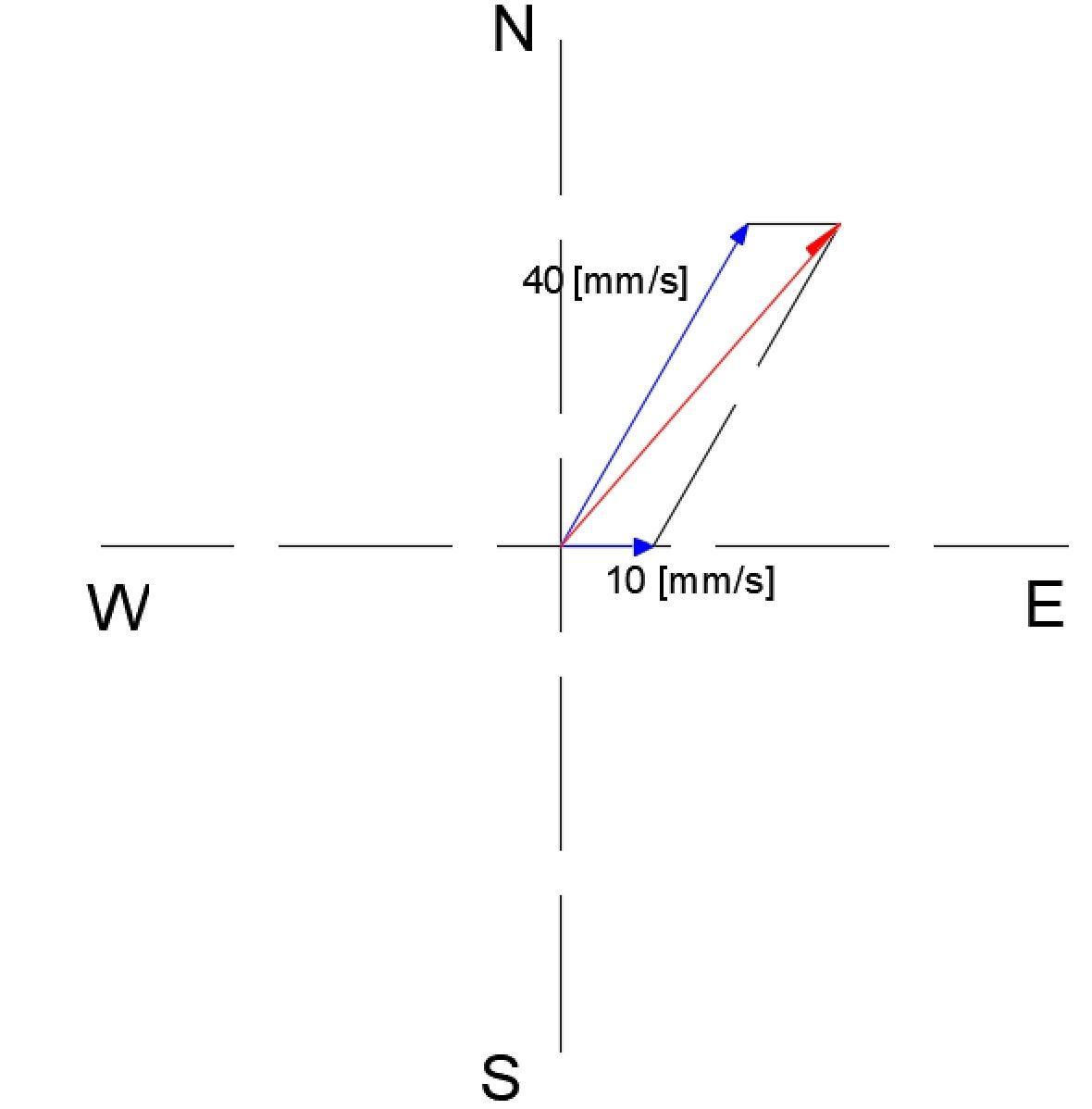
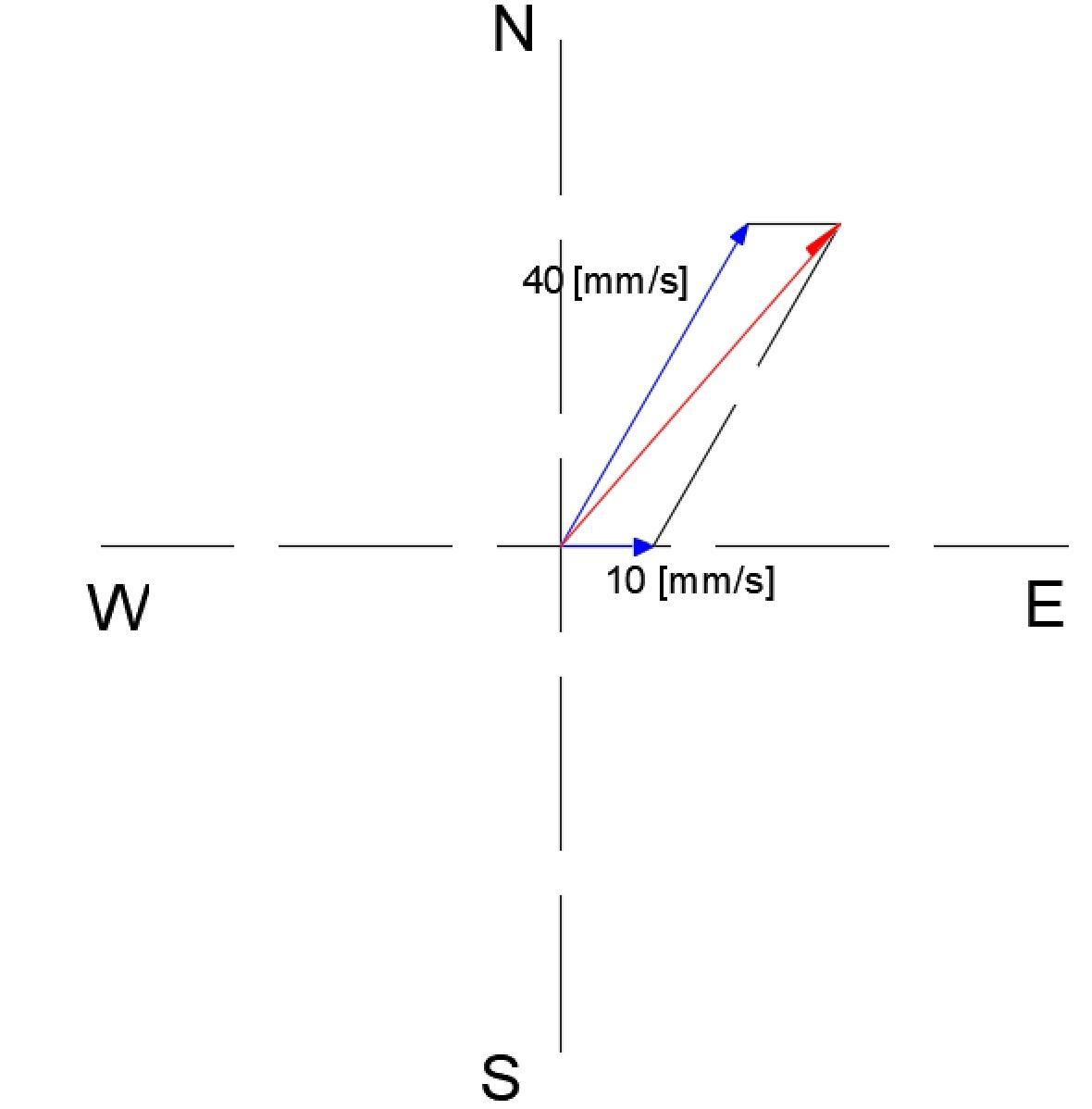
To solve this, the two vectors will be illustrated in a diagram, allowing someone viewing from outside the game board to see that the collective motion comes from both the marble's trajectory and the board's movement.

The image attached displays this vector addition. By utilizing the parallelogram law, we can derive the resultant vector, shown in red.

Next, we will break down the velocity vector of 40 [mm/s] into its x and y components.

x = 40*cos(60) = 20 [mm/s]

y = 40*sin(60) = 34.64 [mm/s]

<pConsequently, the resultant vector is:

Rx = 20 + 10 = 30 [mm/s]

Ry = 34.64 [mm/s]

<pApplying the Pythagorean theorem, we can ascertain the vector’s magnitude

R = \sqrt{(30)^{2} +(34.64)^{2} }\\ R = \sqrt{2099.92}\\R=45.82[mm/s]

Next, we can calculate the angle relative to the horizontal using the previously obtained components.

tan α = 34.46 / 30

α = 48.95°

You might be interested in
A rocket has a mass 250 x (10^3) slugs on earth. Specify(a) its mass in SI units, and(b)its weight in SI units.If the rocket is
Yuliya22 [1153]

Explanation:

We are given that,

Mass of the rocket, m=250\times 10^3\ slugs

(a) The standard unit of mass is kilogram (kg). The conversion between slugs and kilograms is as follows:

1 slug = 14.59 kg

Thus, 250\times 10^3\ slugs=250\times 10^3\times 14.59

Mass of the rocket, m = 3647500 kg

(b) The weight of the rocket can be expressed as:

W = m g

W=3647500\times 9.8=35745500\ N

or

W=3.5\times 10^7\ N

(c) If the rocket were on the moon, the gravitational acceleration on the moon is given as a=5.3\ ft/s^2=1.61\ m/s^2

Mass refers to the quantity of matter present in an object. Therefore, the mass of the rocket remains constant at 3647500 kg

The weight of the rocket on the moon would be, W=mg

W=3647500\times 1.61

W = 5872475 N

or

W=5.8\times 10^6\ N

Thus, this is the final answer required.

8 0
3 days ago
For a group class project, students are building model roller coasters. Each roller coaster needs to begin at the top of the fir
Keith_Richards [1034]

Case A:

A.75 kg 65 N/m 1.2 m

m = weight of the car = 0.75 kg

k = spring's stiffness = 65 N/m

h = elevation of the hill = 1.2 m

x = spring's compression = 0.25 m

Applying the principle of energy conservation from the Top of the hill to the Bottom of the hill

Energy at the Top of the hill equals Energy at the Bottom of the hill

spring energy + gravitational potential energy = kinetic energy

(0.5) k x² + mgh = (0.5) m v²

(0.5) (65) (0.25)² + (0.75 x 9.8 x 1.2) = (0.5) (0.75) v²

v = 5.4 m/s


Case B:

B.60 kg 35 N/m.9 m

m = weight of the car = 0.60 kg

k = spring's stiffness = 35 N/m

h = height of the hill = 0.9 m

x = spring's compression = 0.25 m

Using energy conservation from the Top of the hill to the Bottom of the hill

Top hill energy = Bottom hill energy

spring energy + gravitational potential energy = kinetic energy

(0.5) k x² + mgh = (0.5) m v²

(0.5) (35) (0.25)² + (0.60 x 9.8 x 0.9) = (0.5) (0.60) v²

v = 4.6 m/s


Case C:

C.55 kg 40 N/m 1.1 m

m = weight of the car = 0.55 kg

k = spring's stiffness = 40 N/m

h = height of the hill = 1.1 m

x = spring's compression = 0.25 m

Using conservation of energy from the Top of the hill to the Bottom of the hill

Energy at the Top of the hill = Energy at the Bottom of the hill

spring energy + gravitational potential energy = kinetic energy

(0.5) k x² + mgh = (0.5) m v²

(0.5) (40) (0.25)² + (0.55 x 9.8 x 1.1) = (0.5) (0.55) v²

v = 5.1 m/s


Case D:

D.84 kg 32 N/m.95 m

m = weight of the car = 0.84 kg

k = spring's stiffness = 32 N/m

h = height of the hill = 0.95 m

x = spring's compression = 0.25 m

Using energy conservation from the Top of the hill to the Bottom of the hill

Total energy at Top of hill = Total energy at Bottom of hill

spring energy + gravitational potential energy = kinetic energy

(0.5) k x² + mgh = (0.5) m v²

(0.5) (32) (0.25)² + (0.84 x 9.8 x 0.95) = (0.5) (0.84) v²

v = 4.6 m/s


thus, the closest result is from case C at 5.1 m/s


7 0
5 days ago
Read 2 more answers
The water level in a tank is 20 m above the ground. a hose is connected to the bottom of the tank, and the nozzle at the end of
serg [1198]

Respuesta:

P_(bomba) = 98,000 Pa

Explicación:

Se nos proporciona;

h2 = 30m

h1 = 20m

Densidad; ρ = 1000 kg/m³

Primero, entendemos que la suma de las presiones en el tanque y la bomba es igual a la del boquilla,

Así, se puede expresar como;

P_(tanque)+ P_(bomba) = P_(boquilla)

Ahora, la presión se daría como;

P = ρgh

Y así,

ρgh_1 + P_(bomba) = ρgh_2

<ppor lo="" tanto="">

P_(bomba) = ρg(h_2 - h_1)

<pal sustituir="" los="" valores="" pertinentes="" obtenemos="">

P_(bomba) = 1000•9.8(30 - 20)

P_(bomba) = 98,000 Pa

</pal></ppor>
5 0
2 days ago
A student performs an experiment that involves the motion of a pendulum. The student attaches one end of a string to an object o
ValentinkaMS [1149]

Answer:

-utilize precisely the same apparatus

-maintain identical measures (release height)

Explanation:

7 0
14 days ago
Daria was swimming in a friend’s pool yesterday, when she saw that a fly had landed in the water about 5 feet away from her. She
Ostrovityanka [942]

Answer:

Daria likely has Entomophobia.

5 0
2 days ago
Other questions:
  • Upon impact, bicycle helmets compress, thus lowering the potentially dangerous acceleration experienced by the head. A new kind
    14·1 answer
  • The nucleus of an atom has all of the following characteristics except that it
    5·1 answer
  • An electron is released from rest at a distance d = 100 m from an infinite conducting plane. The electron will begin to move tow
    11·1 answer
  • If 300. mL of water are poured into the measuring cup, the volume reading is 10.1 oz . This indicates that 300. mL and 10.1 oz a
    15·2 answers
  • Two friends, Burt and Ernie, are standing at opposite ends of a uniform log that is floating in a lake. The log is 3.2m long and
    7·1 answer
  • The summer camps had a field trip from the campus to the fragrance Hill they traveled at an average speed of 65 km an hour and t
    6·1 answer
  • Steel blocks A and B, which have equal masses, are at TA = 300 oC and T8 = 400 oC. Block C, with mc - 2mA, is at TC = 350 oC. Bl
    13·1 answer
  • You apply the brakes of your car abruptly and your book starts sliding off the front seat. Three observers sitting in the car ex
    13·1 answer
  • Suppose you analyze standardized test results for a country and discover almost identical distributions of physics scores for fe
    6·1 answer
  • Albert uses as his unit of length (for walking to visit his neighbors or plowing his fields) the albert (a), the distance albert
    14·1 answer
Add answer
Login
Not registered? Fast signup
Signup
Login Signup
Ask question!