answer.
Ask question
Login Signup
Ask question
All categories
  • English
  • Mathematics
  • Social Studies
  • Business
  • History
  • Health
  • Geography
  • Biology
  • Physics
  • Chemistry
  • Computers and Technology
  • Arts
  • World Languages
  • Spanish
  • French
  • German
  • Advanced Placement (AP)
  • SAT
  • Medicine
  • Law
  • Engineering
natka813
1 month ago
10

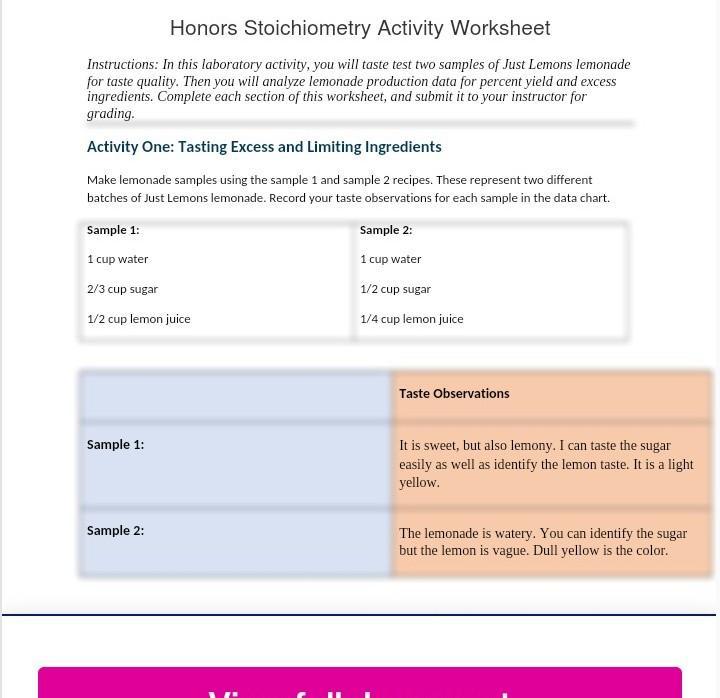
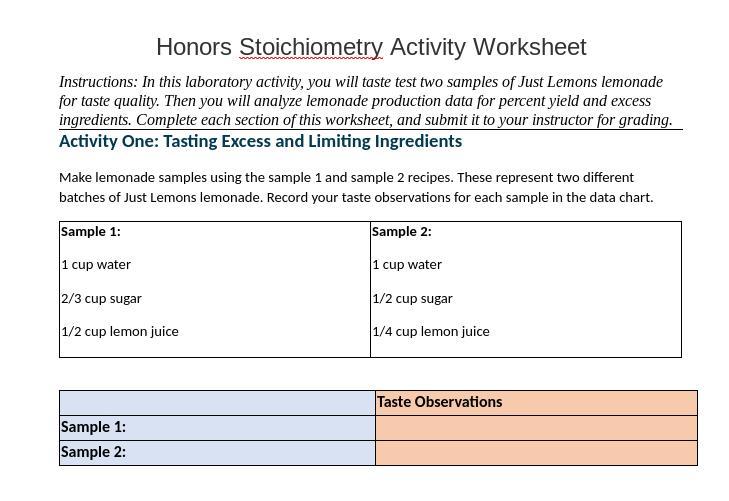
100 POINTS PLEASE HELP!! Honors Stoichiometry Activity Worksheet Instructions: In this laboratory activity, you will taste test

two samples of Just Lemons lemonade for taste quality. Then you will analyze lemonade production data for percent yield and excess ingredients. Complete each section of this worksheet, and submit it to your instructor for grading. Activity One: Tasting Excess and Limiting Ingredients Make lemonade samples using the sample 1 and sample 2 recipes. These represent two different batches of Just Lemons lemonade. Record your taste observations for each sample in the data chart. Sample 1: 1 cup water 2/3 cup sugar 1/2 cup lemon juice Sample 2: 1 cup water 1/2 cup sugar 1/4 cup lemon juice Taste Observations Sample 1: Sample 2: Activity Two: Just Lemons, Inc. Production Here's a one-batch sample of Just Lemons lemonade production. Determine the percent yield and amount of leftover ingredients for lemonade production and place your answers in the data chart. Hint: Complete stoichiometry calculations for each ingredient to determine the theoretical yield. Complete a limiting reactant-to-excess reactant calculation for both excess ingredients. Water Sugar Lemon Juice Lemonade Percent Yield Leftover Ingredients 946.36 g 196.86 g 193.37 g 719.84 g Just Lemons Lemonade Recipe Equation: 2 water + sugar + lemon juice = 4 lemonade Mole conversion factors: 1 mole of water = 1 cup = 236.59 g 1 mole of sugar = 1 cup = 198 g 1 mole of lemon juice = 1 cup = 229.96 g 1 mole of lemonade = 1 cup = 225.285 g Show your calculations below. Analysis Questions 1. Based on taste observations only, which ingredients were in excess in the lemonade samples in Activity One? 2. Based on the data in Activity Two, which excess ingredients are affecting the taste of the lemonade in the sample batch? 3. What can Just Lemons, Inc. do during production to reduce the amount of excess ingredients and improve the taste of their lemonade? 4. Try to reduce the amount of leftover ingredients by changing the amount of one, two, or all three starting ingredients. Show your stoichiometric calculations below. 5. During factory inspection, Just Lemons, Inc. discovered that a water valve to the lemonade mixing station was not functioning. Once they repair it, more water will enter the mixing station. From what you know about the limiting and excess ingredients for current lemonade production, what advice would you give engineers about the upcoming increase in water?

Chemistry
2 answers:
castortr0y [3K]1 month ago
6 0

Answer:

2 water + sugar + lemon juice → 4 lemonade

Calculating the moles of water in 946.36 g of water=\frac{946.36 g}{236.59 g/mol}=4 mol=

236.59g/mol

946.36g

=4mol

Calculating the moles of sugar in 196.86 g of sugar=\frac{196.86 g}{225 g/mol}=0.8749 mol=

225g/mol

196.86g

=0.8749mol

Calculating the moles of lemon juice in 193.37 g of lemon juice=\frac{193.37 g}{257.83 g/mol}=0.7499 mol=

257.83g/mol

193.37g

=0.7499mol

Calculating the moles of lemonade in 2050.25 g of lemonade=\frac{2050.25 g}{719.42 g/mol}=2.8498 mol=

719.42g/mol

2050.25g

=2.8498mol

It is apparent that the amount of lemon juice limits the reaction.

Consequently, we will base the reaction's completion on the quantity of lemon juice.

1 mole of lemon juice reacts with 2 moles of water, therefore, 0.7499 mol of lemon juice will react with:

\frac{2}{1}\times 0.7499 mol = 1.4998 mol

1

2

×0.7499mol=1.4998mol of water

Mass of water utilized = 1.4998 mol × 236.59 g/mol=354.8376 g

Unused water = 946.36 g - 354.8376 g =591.5223 g

1 mole of lemon juice reacts with 1 mole of sugar, thus 0.7499 mol of lemon juice will react with:

\frac{1}{1}\times 0.7499 mol = 0.7499 mol

1

1

×0.7499mol=0.7499mol of sugar

Mass of sugar consumed = 0.7499 mol × 225 g/mol = 168.7275 g

Excess sugar = 196.86 g - 168.7275 g

1 mole of lemon juice results in 4 moles of lemonade.

Hence, 0.7499 mol of lemon juice will produce:

\frac{4}{1}\times 0.7499 mol=2.996 mol

1

4

×0.7499mol=2.996mol of lemonade

The mass of lemonade yielded = 2.996 mol × 719.42 g/mol = 2157.9722 g

Theoretical production of lemonade = 2157.9722 g

Actual yield of lemonade = 2050.25 g

Calculating the percentage yield of lemonade:

\frac{\text{Actual yield}}{\text{theoretical yield}}\times 100

theoretical yield

Actual yield

× 100

\frac{2050.25 g}{2157.9722 g}\times 100=95.00\%

2157.9722g

2050.25g

× 100=95.00%
VMariaS [2.9K]1 month ago
5 0

Answer:

You essentially review your own writing. You create two distinct lemonade recipes and then calculate the different percentages.

You might be interested in
HIPVs can cause what two more severe illnesses?
VMariaS [2998]
One of the conditions is Cancer.
4 0
1 month ago
Eva buys a package of food, and the nutrition label says that
lorasvet [2795]

The answer is a total of 74,844 calories.

8 0
1 month ago
How many molecules of PF5 are found in 39.5 grams of PF5?
Anarel [2989]

Response:

1.9 \times 10^{23} molecules of PF_5 can be found in 39.5 grams of PF_5.

Clarification:

Atomic weights: P= 31, F= 19,

The molar mass equals 1 atomic weight of P + 5 atomic weights of

 F= 31+5 × 19\times = 31+95

=126 g/mole

The number of moles in 39.5 gm of

equals \frac{Mass}{Molar mass}

 = \frac{39.5}{126}moles

 =0.3134 moles

1 mole of any substance encompasses

0.3131 moles comprises 0.3134

= 1.9 \times 10^{23} molecules

Thus, 1.9 \times 10^{23} molecules of PF_5 can be found in 39.5 grams of PF_5.

7 0
4 days ago
Draw the structures of two different compounds that have the composition CH3NO2. All three H atoms must remain bonded to the C a
Tems11 [2777]

Answer:

The configurations are illustrated below.

Explanation:

Hydrogen possesses a single electron in its outer shell, carbon has 4, nitrogen has 5, and oxygen holds 6. To achieve an octet (or duet for hydrogen), they require 1, 4, 3, and 2 electrons respectively.

Therefore, each hydrogen atom will share one electron with carbon, while the remaining electron will be shared with nitrogen, maintaining 4 electrons available for sharing. Carbon can form two bonds with both oxygen atoms, expanding its octet; however, this renders it unstable, leading to the formation of resonance structures (redistribution of electrons), and charge formation. One of the oxygen atoms will share only one electron with nitrogen.

The two structures are depicted below.

3 0
21 day ago
Given the connection between Aw and K (Aw=2k) could you use the ideal gas law and derive the Boltzmann constant. Water freezes a
lions [2927]

Answer:

Explanation:

The relationship between the new temperature scale and the absolute temperature scale is defined as follows

Aw = 2 K

for K = 273.15 (the freezing point of water on the absolute scale)

Aw = 2 x 273.15 = 546.3 K

Each division of the new scale is equivalent to half that of each division on the absolute scale

each division of the new scale is minimal.

The value of R = 8.314 J per mole per K

Here, per K corresponds to 2Aw

Hence, the value of R in the new scale = 8.314/2 J per mole per Aw

= 4.157 J per mole per Aw

k = R / N

= 4.157 / 6.02 x 10²³

= .69 x 10⁻²³

= 6.9 x 10⁻²⁴ J per molecule per Aw .

7 0
1 month ago
Read 2 more answers
Other questions:
  • A liquid has a volume of 34.6 ml and a mass of 46.0 g. what is the density of the liquid?
    10·1 answer
  • What is the mass of 0.75 moles of (NH4)3PO4?
    6·2 answers
  • How many liters of gas will be in the closed reaction flask when 36.0L of ethane (C2H6) is allowed to react with 105.0L of oxyge
    6·1 answer
  • How many seconds are required to produce 4.00 g of aluminum metal from the electrolysis of molten alcl3 with an electrical curre
    14·1 answer
  • The statement "Although sulfuric acid is a strong electrolyte, an aqueous solution of H2SO4 contains more HSO4− ions than SO42−
    5·1 answer
  • Aluminum has a specific heat of 0.902 j/gC. How much heat is lost when a piece of aluminum with a mass of 23.984 g cools from a
    6·1 answer
  • A flask contains 0.25 mole of SO2(g), 0.50 mole of CH4(g), and 0.50 mole of O2(g). The total pressure of the gases in the flask
    6·1 answer
  • a mixture of emanations from radioactive atoms is passed through electrically charged plates imagination number one is attracted
    6·1 answer
  • Methanol (ch3oh) can react with oxygen gas to produce formaldehyde (h2co) and water. How many mole of formaldehyde can be produc
    14·2 answers
  • tekanan uap jenuh air murni pada suhu 20°C adalah 18 mmHg.apabila pada temperatur yang sama sebanyak 120 gram zat x dilarutkan d
    12·1 answer
Add answer
Login
Not registered? Fast signup
Signup
Login Signup
Ask question!