answer.
Ask question
Login Signup
Ask question
All categories
  • English
  • Mathematics
  • Social Studies
  • Business
  • History
  • Health
  • Geography
  • Biology
  • Physics
  • Chemistry
  • Computers and Technology
  • Arts
  • World Languages
  • Spanish
  • French
  • German
  • Advanced Placement (AP)
  • SAT
  • Medicine
  • Law
  • Engineering
Neporo4naja
3 days ago
16

The two sides of the DNA double helix are connected by pairs of bases (adenine, thymine, cytosine, and guanine). Because of the

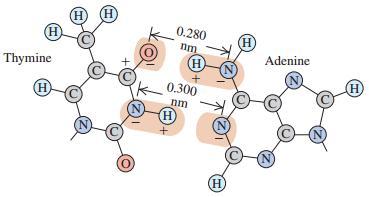
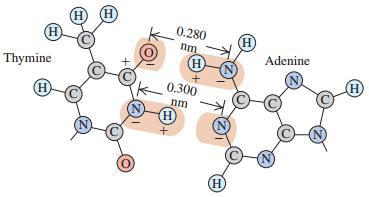
geometric shape of these molecules, adenine bonds with thymine and cytosine bonds with guanine. The figure (Figure 1) shows the thymine-adenine bond. Each charge shown is ±e, and the H−N distance is 0.110 nm.
A) Calculate the net force that thymine exerts on adenine. To keep the calculations fairly simple, yet reasonable, consider only the forces due to the O−H−N and the N−H−N combinations, assuming that these two combinations are parallel to each other. Remember, however, that in the O−H−N set, the O− exerts a force on both the H+ and the N−, and likewise along the N−H−N set.

B) Is the net force attractive or repulsive?

C) Calculate the force on the electron in the hydrogen atom, which is 5.29×10⁻² nm from the proton.

D) Compare the strength of the bonding force of the electron in hydrogen with the bonding force of the adenine-thymine molecules.

Physics
1 answer:
kicyunya [1K]3 days ago
5 0

Answer:

Explanation:

An image of the bond resulting from the search is attached.

Consider the force directed towards thymine as negative.

For the O-H-N combination:

The resulting force from this combination is:

F=-F_{OH}+F_{ON}\\\\=\frac{Ke^2}{r^2}+\frac{Ke^2}{r'^2}\\\\=Ke^2(\frac{-1}{r^2}+\frac{1}{r'^2})\\\\=(9.0\times 10^9Nm^2/kg^2)(1.6\times 10^{-19}C)^2[\frac{1}{[(0.280-0.110)\times 10^{-9}m]^2}+\frac{1}{0.280\times 10^{-9}m)^2}]\\\\=-5.03354\times 10^{-9}N

In the case of the N-H-N combination:

The total force acting from this combination is:

F'=F_{NN}-F_{HN}\\\\=\frac{Ke^2}{r^2}-\frac{Ke^2}{r'^2}\\\\=Ke^2(\frac{-1}{r^2}+\frac{1}{r'^2})\\\\=(9.0\times 10^9Nm^2/kg^2)(1.6\times 10^{-19}C)^2[\frac{1}{[0.300\times 10^{-9}m]^2}-\frac{1}{((0300-0..110)\times 10^{-9})m)^2}]\\\\=-3.822\times 10^{-9}N

The force that thymine applies on adenine is:

F_{net}=F+F'\\\\=-5.03354\times 10^{-9}N-3.822\times 10^{-9}N\\\\=-8.8558\times 10^{-9}N

When rounded to three significant figures, the net force is 8.86\times 10^{-9}N

b)

The negative value indicates that the force is attractive, as it is aimed towards thymi.

c)

The force acting on the electron due to the proton is:

F=\frac{Ke^2}{r^2}\\\\=\frac{(9.0\times 10^9Nm^2/C^2)(1.6\times 10^{-9}C)^2}{(5.29\times 10^{-11}m)^2}\\\\=8.233\times 10^{-8}N

Since the electron and proton carry opposite charges, the force on the electron points towards the proton.

d)

The ratio of the above forces is:

\frac{F}{F_{net}}=\frac{8.233\times 10^{-8}N}{8.233\times 10^{-8}N}\\\\=9.3

Therefore, the bonding strength of the electron in the hydrogen atom is 9.3 times greater than the bonding force between adenine and thymine molecules.

You might be interested in
To avoid an accident, a driver steps on the brakes to stop a 1000-kg car traveling at 65km/h. if the braking distance is 35 m, h
Maru [1056]
Initially, we need to calculate the acceleration required for the car to halt from its initial speed based on the distance traveled. This can be done using the formula,
                                             2ad = Vf² - Vi²
where a represents acceleration, d is distance, and Vf and Vi are the final and initial speeds respectively. Plugging in the known quantities,
           2(a)(35 m) = (0 m/s)² - ((65 km/h) x (1000 m/ 1 km) x (1 hr / 3600 s))²
The resulting acceleration is −4.66 m/s².
To calculate the force required to stop the car, we multiply the mass by the acceleration. This calculation yields -4,660 N, and we take the absolute value, which is 4,660 N. 
6 0
7 days ago
A ball is dropped from the top of a cliff. By the time it reaches the ground, all the energy in its gravitational potential ener
ValentinkaMS [1149]

The ball was released from a height of 20 meters

Explanation:

The scenario is as follows:

1. A ball drops from the edge of a cliff.

2. Upon reaching the ground, the energy held in its gravitational potential energy transforms entirely into kinetic energy.

   This implies K.E = P.E.

3. The ball impacts the ground at a speed of 20 m/s.

4. The gravitational field strength noted is 10 N/kg.

<pOur goal is to ascertain the height from which the ball was dropped.

<pSince the ball was dropped from a cliff, its initial velocity is 0.<p→ K.E = \frac{1}{2}m(v^{2}-v_{0}^{2})

where v is the final velocity, v_{0} is the initial velocity, and m is the mass.

<p→ v = 20 m/s and v_{0} = 0 m/s.<p→ K.E = \frac{1}{2}m(20^{2}-0^{2})

→ K.E = \frac{1}{2}m(400)

→ K.E = 200 m joules when the ball strikes the ground.

<p→ P.E = mg h

where g is the gravitational field strength, m is mass, and h signifies height.

<p→ g = 10 N/kg.<p→ P.E = m(10)(h)

→ P.E = 10m h joules.

<p→ P.E = K.E.

→ 10m h = 200 m.

Dividing through by 10m yields:

→ h = 20 meters.

The ball was released from a height of 20 meters.

Learn more

To understand more about gravitational potential energy, visit

8 0
4 days ago
On a caterpillars map all distances are marked in kilometers . The caterpillars map shows the distance between two milkweed plan
ValentinkaMS [1149]

Answer:

The equivalent distance in kilometers is 4012 ×10^{-6} km.

Explanation:

It's known that 1 millimeter converts to 10^{-3} meters. Then, 1 meter converts to 10^{-3} kilometers. Therefore, the conversion for 1 millimeter to kilometers can be stated as

1 mm = 10^{-3} m

1 m = 10^{-3} km

Thus, 1 mm = 10^{-3}×10^{-3} km = 10^{-6} km.

Given the distance of 4012 mm, the corresponding distance in kilometers will be

4012 mm = 4012 ×10^{-6} km.

The distance therefore is 4012 ×10^{-6} km.

5 0
13 days ago
A force is applied to a block sliding along a surface (Figure 2). The magnitude of the force is 15 N, and the horizontal compone
Softa [913]

If my calculations are accurate, the angle is 67.5 degrees.

4 0
15 days ago
Read 2 more answers
A solid conducting sphere carrying charge q has radius a. It is inside a concentric hollow conducting sphere with inner radius b
Softa [913]

Response:

Clarification:

Refer to the diagram indicating the charges on the specified sphere (see attachment).

The electric field at the stated positions is

E(r) = 0 for r≤a.  Equation 1

E(r) = kq/r² for a<r<b.   Equation 2

E(r) = 0 for b<r<c.      Equation 3

E(r) = kq/r² for r>c.    Equation 4.

We understand that electric potential correlates with the electric field through

V = Ed

A. To compute the potential at the outer surface of the hollow sphere (r=c), we determine that the electric field there is

E = kQ / r²

Then,

V = Ed,

At d = r = c

Thus,

Vc = (kQ / c²) × c

Vc = kQ / c

As a result, the total charge Q consists of +q, -q, and +q

Hence, Q = q - q + q = q

V = kq / c

B. To calculate the potential at the inner surface of the hollow sphere (r=b), we have

V = kQ/r

V = kQ / b,   noting that r = b

So, Q = q

V = kq / b

C. At r = a

Following from equation 1:

E(r) = 0 for r≤a.  Equation 1

The electric field at the surface of the solid sphere is 0, E = 0N/C

Thus,

V = Ed = 0 V

Consequently, the electric potential at the solid sphere's surface is 0.

D. At r = 0

The electric potential can be determined by

V = kq / r

As r approaches 0,

V = kq / 0

V approaches infinity.

8 0
10 days ago
Other questions:
  • If a radio wave has a period of 1 μs what is the wave's period in seconds
    14·1 answer
  • Bonnie and clyde are sliding a 300 kg bank safe across the floor to their getaway car. the safe slides with a constant speed if
    14·1 answer
  • Below are birds-eye views of six identical toy cars moving to the right at 2 m/s. Various forces act on the cars with magnitudes
    5·1 answer
  • A transverse wave on a string has an amplitude A. A tiny spot on the string is colored red. As one cycle of the wave passes by,
    13·1 answer
  • Argelia has a stack of schoolbooks sitting in the backseat of her car. When Argelia makes a sharp right turn, the books slide to
    11·2 answers
  • A pitching machine is programmed to pitch baseballs horizontally at a speed of 87 mph . The machine is mounted on a truck and ai
    8·1 answer
  • A 2.50-kg textbook is forced against a horizontal spring of negligible mass and force constant 250 N/m, compressing the spring a
    10·1 answer
  • An electron is trapped in a square well of unknown width, L. It starts in unknown energy level, n. When it falls to level n-1 it
    15·1 answer
  • You ride a roller coaster with a loop-the-loop. Compare the normal force that the seat exerts on you to the force that Earth exe
    14·1 answer
  • f a car is speeding down a road at 40 miles/hour (mph), how long is the stopping distance D40 compared to the stopping distance
    6·1 answer
Add answer
Login
Not registered? Fast signup
Signup
Login Signup
Ask question!