answer.
Ask question
Login Signup
Ask question
All categories
  • English
  • Mathematics
  • Social Studies
  • Business
  • History
  • Health
  • Geography
  • Biology
  • Physics
  • Chemistry
  • Computers and Technology
  • Arts
  • World Languages
  • Spanish
  • French
  • German
  • Advanced Placement (AP)
  • SAT
  • Medicine
  • Law
  • Engineering
Klio2033
1 month ago
14

Carbon dioxide (CO2) gas in a piston-cylinder assembly undergoes three processes in series that begin and end at the same state

(a cycle).
Process 1-2: Expansion from State 1 where p1 = 10 bar, V1 = 1 m3 , to State 2 where V2 = 4 m3 . During the process, pressure and volume are related by pV1.5 = constant.
Process 2-3: Constant volume heating to State 3 where p3 = 10 bar.
Process 3-1: Constant pressure compression to State

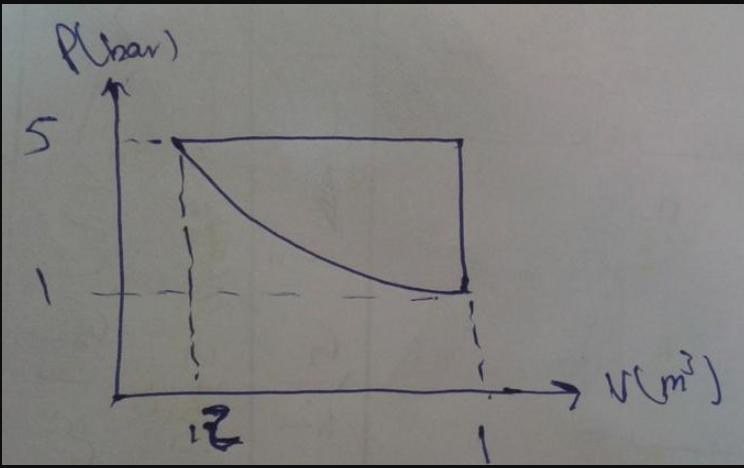
Sketch the processes on p-V coordinates and evaluate the work for each process, in kJ. What is net work for the cycle, in kJ?

Physics
1 answer:
inna [3.1K]1 month ago
5 0

Answer:

a) W =400 kJ

b) W = 0 kJ

c) W =-160.944 KJ

Explanation:

Given

Process 1 ---> 2

Pressure at point (1) P1 = 10 bar = P2

Volume at point (1) V1 = 1 m^3

Volume at point (2) V2 =4 m^3

For Process 2 ---> 3, where V = constant

Pressure at point (3) P3 = 10 bar

Volume at point (3) V3 = 4 m^3

Process 3 ---> 1 defined as PV = constant.

Required

Sketch the processes on the PV coordinates To calculate the work in kJ

Work is calculated by W=

a=V2

b=V1

x=Pdx=dV

For Process 1 ---> 2 where P3 = P4 = 5 bar  

\int\limits^a_b {x} \, dxW=

a=V3

b=V2

x=4dx=dV

substituting the values here into the integral gives

W=400 kJFor Process 2 ---> 3

As V = constant in this case, the volume remains unchanged, resulting in W = 0 kJ  

For Process 3 ---> 1  By applying point (1) --> 5 x.2 = C ---> C = 1 P = 5V^-1  

 W=

a=V1\int\limits^a_b {x} \, dx

b=V3

x=1V^-1dx=dVsubstituting values into this integral results in

W=| ln V | limits a and b

  = -160.944 KJ
You might be interested in
Three balls of equal mass are fired simultaneously with equal speeds from the same height h above the ground. Ball 1 is fired st
Ostrovityanka [3204]

Answer:

d) v1 = v2 = v3

Explanation:

This can be determined through the principle of energy conservation. We assess the total mechanical energy E=K+U (the sum of kinetic energy and gravitational potential energy) at both the initial and final positions, ensuring they remain constant.

<pInitially, for the three spheres, we have:

E_i=K_i+U_i=\frac{mv_i^2}{2}+mgh_i=\frac{mv^2}{2}+mgh

Finally, for the three spheres, we see:

E_f=K_f+U_f=\frac{mv_f^2}{2}+mgh_f=\frac{mv_f^2}{2}

<pGiven that E_i=E_f, and since E_i remains identical for all spheres, it follows that E_f is identical for all spheres, indicating that v_f, the final velocity, is equal for each ball.
4 0
2 months ago
A very small round ball is located near a large solid sphere of uniform density. The force that the large sphere exerts on the b
Softa [3030]

Respuesta:

Opción e

Explicación:

La Ley de Gravitación Universal indica que toda masa puntual atrae a otra masa puntual en el universo con una fuerza que se dirige en línea recta entre los centros de masa de ambos, siendo esta fuerza proporcional a las masas de los objetos y inversamente proporcional a su separación. Esta fuerza atractiva siempre es dirigida del uno hacia el otro. La ley es aplicable a objetos de cualquier masa, sin importar su tamaño. Dos objetos grandes pueden ser considerados masas puntuales si la distancia entre ellos es considerablemente mayor que sus dimensiones o si presentan simetría esférica. En tales casos, la masa de cada objeto puede ser modelada como una masa puntual en su centro de masa.

La misma fuerza actúa sobre ambas bolas.

5 0
2 months ago
During the construction of an office building, a hammer is accidentally dropped from a height of 784 ft. the distance (in feet)
Softa [3030]
T= 24.5 feet per second. That’s the speed it attains just before hitting the ground.
7 0
1 month ago
Read 2 more answers
The iron ball shown is being swung in a vertical circle at the end of a 0.7-m string. how slowly can the ball go through its top
Keith_Richards [3271]
<span>A centripetal force maintains an object's circular motion. When the ball is at the highest point, we can assume that the ball's speed v is such that the weight of the ball matches the required centripetal force to keep it moving in a circle. Hence, the string will not become slack. centripetal force = weight of the ball m v^2 / r = m g v^2 / r = g v^2 = g r v = sqrt { g r } v = sqrt { (9.80~m/s^2) (0.7 m) } v = 2.62 m/s Thus, the minimum speed for the ball at the top position is 2.62 m/s.</span>
6 0
2 months ago
How do electromagnetism and gravitation differ from the strong and weak nuclear forces?
ValentinkaMS [3465]
Electromagnetism, which deals with interactions between charged particles, has a considerable range and can create forces that repel like charges while attracting opposites. In contrast, the weak nuclear force is very short-ranged and isn't classified as a force.
5 0
29 days ago
Other questions:
  • Three equal negative point charges are placed at three of the corners of a square of side d. What is the magnitude of the net el
    9·2 answers
  • Which, if any, of the following statements concerning the work done by a conservative force is NOT true? All of these statements
    8·1 answer
  • In the sport of parasailing, a person is attached to a rope being pulled by a boat while hanging from a parachute-like sail. A r
    10·1 answer
  • Rosa studies the position-time graph of two race cars. A graph titled Position versus Time shows time in hours on the x axis, nu
    6·2 answers
  • A proton (mass = 1.67 10–27 kg, charge = 1.60 10–19 C) moves from point A to point B under the influence of an electrostatic for
    6·1 answer
  • Marcus can drive his boat 24 miles down the river in 2 hours but takes 3 hours to return upstream. Find the rate of the boat in
    13·2 answers
  • Object A and object B are initially uncharged and are separated by a distance of 1 meter. Suppose 10,000 electrons are removed f
    11·1 answer
  • a 62.0 kg curler runs into a stationary 78.1 kg curler and they hold on to each other. Together they move away at 1.29 m/s, west
    9·1 answer
  • The concrete post (Ec = 3.6 × 10⁶ psi and αc = 5.5 × 10⁻⁶/°F) is reinforced with six steel bars, each of 78-in. diameter (Es = 2
    6·1 answer
  • Two electrodes, separated by a distance d, in a vacuum are maintained at a constant potential difference. An electron, accelerat
    13·1 answer
Add answer
Login
Not registered? Fast signup
Signup
Login Signup
Ask question!
