answer.
Ask question
Login Signup
Ask question
All categories
  • English
  • Mathematics
  • Social Studies
  • Business
  • History
  • Health
  • Geography
  • Biology
  • Physics
  • Chemistry
  • Computers and Technology
  • Arts
  • World Languages
  • Spanish
  • French
  • German
  • Advanced Placement (AP)
  • SAT
  • Medicine
  • Law
  • Engineering
lozanna
3 months ago
6

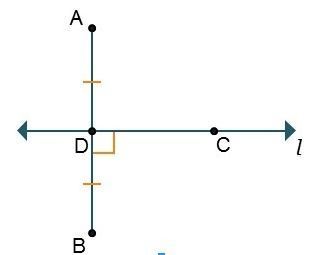
iven: C is a point on the perpendicular bisector, l, of AB. Prove: AC = BC Use the drop-down menus to complete the proof. By the

unique line postulate, you can draw only one segment, . Using the definition of , reflect BC over l. By the definition of reflection, C is the image of itself and is the image of B. Since reflections preserve , AC = BC.

Mathematics
2 answers:
Leona [12.6K]3 months ago
8 0

Answer:

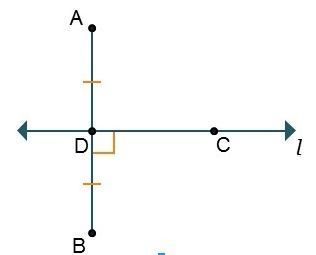
For a clearer understanding, refer to the attached figure:

Step-by-step breakdown:

1. According to the unique line postulate, only one line segment can be created: BC

This is because a single line can only connect two distinct points.

2. Utilizing the definition of reflection, reflect BC across l.

To identify the line segment reflected over l, we will apply the reflection definition.

3. Based on the reflection definition, C remains as its own image and A represents the image of B.

The reflection definition states that a figure is transformed into a mirror image around a line. Thus, CD serves as the perpendicular bisector of AB, which makes A and B equidistant from D, producing their mirror images.

4. Because reflections maintain length, we find that AC = BC

In a reflection, the figure transforms to create a mirror image, ensuring the lengths remain unchanged.

Leona [12.6K]3 months ago
4 0

Response:

1.BC

2.mirroring

3. A

4. distance

You might be interested in
“The perimeter P of a triangle is equal to the sum of the lengths of sides a,b, and c”
AnnZ [12381]

Answer:

1. Calculate the sum of "a", "b" and "c".

2. The perimeter equation is: P=a+b+c

Step-by-step explanation:

In this case, P denotes the triangle's perimeter while a, b, and c are the triangle's sides.

The definition states that the sum results from an addition operation. Thus, the statement "The perimeter P of a triangle equals the total of sides a, b, and c" means that the perimeter is determined by aggregating the lengths of the triangle's sides.

Consequently, you can express this in the following equation:

P=a+b+c

5 0
3 months ago
In triangle JKL, sin(b°) = three fifths and cos(b°) = four fifths. If triangle JKL is dilated by a scale factor of 2, what is ta
Inessa [12570]

Answer:

Tan(b°) = 3/4, which is equivalent to three fourths (C).

Step-by-step explanation:

Triangle JKL is a right triangle with angle K being the right angle and angle L equal to b°.

We will employ SOHCAHTOA principles from trigonometry to calculate the sides' values.

For triangle ∆JKL:

Sin(b°) = opposite/hypotenuse

Sin(b°) = 3/5

Cos(b°) = adjacent/hypotenuse

Cos(b°) = 4/5

Tan(b°) = 3/4.

From the earlier information, we have the values for each side of triangle ∆JKL.

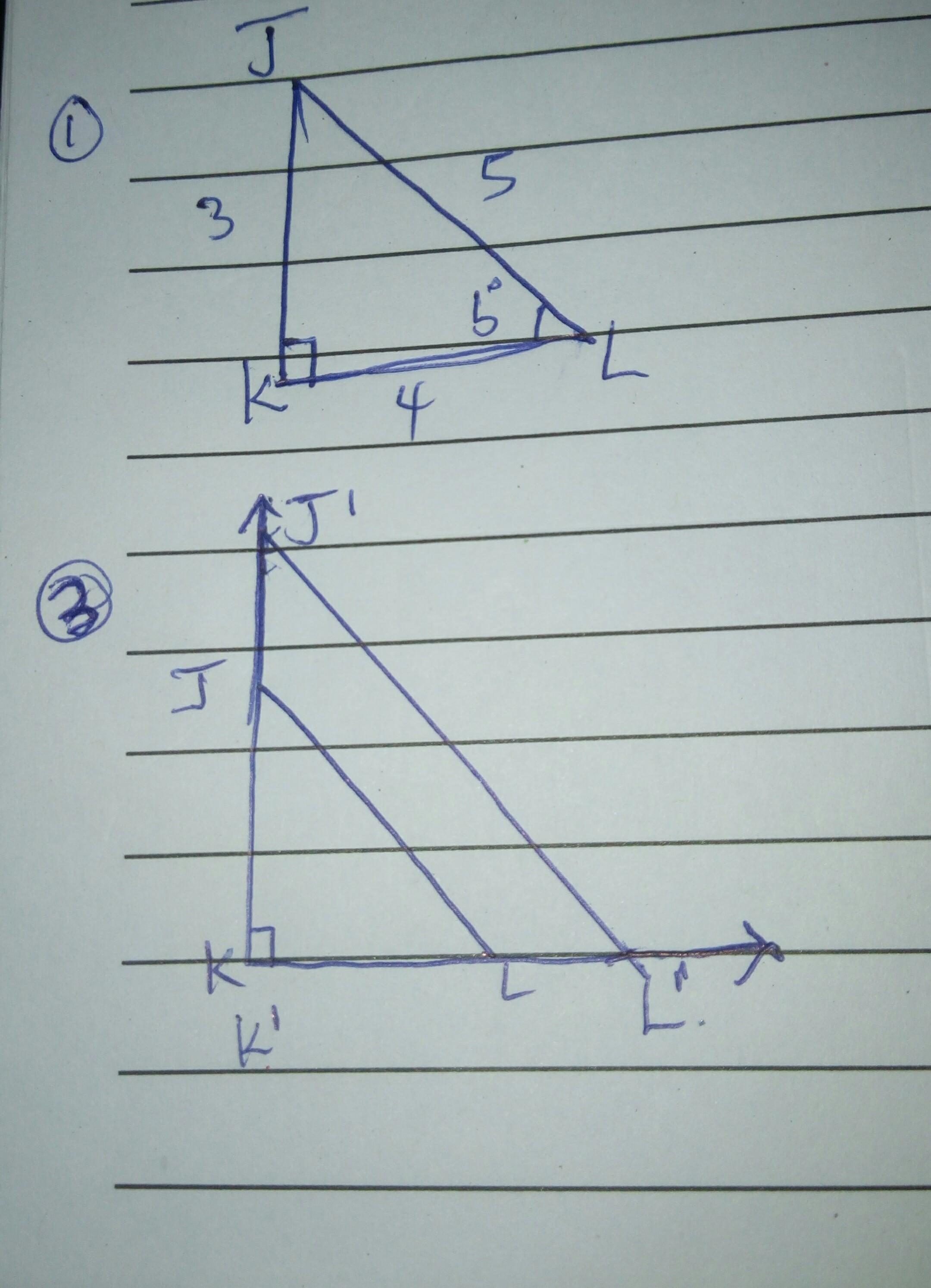
Please refer to the attached diagram for the triangle (1).

Triangle ∆JKL is scaled with a factor of 2.

This implies multiplying each side of ∆JKL by 2, resulting in:

Opposite side = 2(3) = 6

Adjacent side = 2(4) = 8

Hypotenuse = 2(5) = 10.

To find tan(b°) for the new triangle, we use the tangent ratio:

Tan(b°) = opposite/adjacent.

Tan(b°) = 6/8.

Tan(b°) = 3/4.

Find the diagram for the new triangle included (2).

Diagram 3 provides a depiction of both triangles.

As shown, the angle remains unchanged when a triangle is scaled by a factor.

Thus, we conclude that tan(b°) = three fourths (C).

6 0
3 months ago
It takes 40 min for a bus to travel the 36 miles from Framingham to Worcester. A car traveling from Worcester to Framingham move
Inessa [12570]
The bus's speed is calculated as: velocity (bus) = 36 miles / 40 min, which simplifies to velocity (bus) = 0.9 miles / min. Given that the car's speed is 1.5 times that of the bus, we find: velocity (car) = 1.5 * 0.9 miles / min, leading to velocity (car) = 1.35 miles / min. At the point where they meet, the total distance covered equals 36 miles. Hence: 1.35 t + 0.9 t = 36, and thus 2.25 t = 36 resulting in t = 16 min. They will converge after 16 minutes.
6 0
2 months ago
Lily begins solving the equation 4(x – 1) – x = 3(x + 5) – 11. Her work is shown below. 4(x – 1) – x = 3(x + 5) – 11 4x – 4 – x
Zina [12379]

Finding a solution to an equation entails determining the value of x that renders the equation valid.

We must reverse the operations applied to x to isolate it.

4(x-1)-x = 3(x + 5)-11\\Distributing \; 4 \; and \; 3 \; in \; right \; and \; left \; side \; of \; the \; equation\\\\ 4x-4-x=3x+15-11\\Combine \; like \; terms\\\\3x-4=3x+4\\Subtract \; 3x \; on \; both \; sides\\\\3x-3x-4=3x-3x+4\\ Combine \; like \; terms\\\\-4=4

Final Note:

The resulting equation is false, indicating that there is NO solution. Graphically, both equations will be represented as parallel lines that do not intersect.

4 0
3 months ago
Read 2 more answers
Other questions:
  • Emma is an artist and has created seven paintings. She plans to paint three additional paintings each week. What statements are
    5·2 answers
  • Solve the following quadratic equations by extracting square roots.Answer the questions that follow.
    15·2 answers
  • Which of the following functions is graphed below?
    10·1 answer
  • The length of a pencil is measured with two rulers. Report the length of the pencil from each ruler with the proper number of di
    5·1 answer
  • 1+4=5 2+5=12 3+6=21 8+11=?
    6·1 answer
  • Add (1.3t3 + 0.4t2 – 24t) + (8 – 18t + 0.6t2) For each term in the second polynomial, enter the letter showing where that term s
    10·1 answer
  • 4. An airplane is traveling at a speed of 724 km/hr at a direction of 30 degrees. The wind is blowing from the west at 32 km/hr.
    7·1 answer
  • Diego is 59.5 inches tall. His brother is 40.125 inches tall. How much taller than his his brother is Diego?
    6·1 answer
  • What is the approximate area of the shaded region under the standard normal curve below? Use the portion of the standard normal
    10·1 answer
  • Which point is a solution to the inequality shown in this graph? (0,1) (3,-1)
    11·2 answers
Add answer
Login
Not registered? Fast signup
Signup
Login Signup
Ask question!