answer.
Ask question
Login Signup
Ask question
All categories
  • English
  • Mathematics
  • Social Studies
  • Business
  • History
  • Health
  • Geography
  • Biology
  • Physics
  • Chemistry
  • Computers and Technology
  • Arts
  • World Languages
  • Spanish
  • French
  • German
  • Advanced Placement (AP)
  • SAT
  • Medicine
  • Law
  • Engineering
jeka57
19 days ago
8

A 30.0-kg child sits on one end of a long uniform beam having a mass of 20.0 kg, and a 40.0-kg child sits on the other end. The

beam balances when a fulcrum is placed below the beam a distance 1.10 m from the 30.0-kg child. How long is the beam?

Physics
1 answer:
Softa [2K]19 days ago
4 0

Let "L" denote the beam's length.

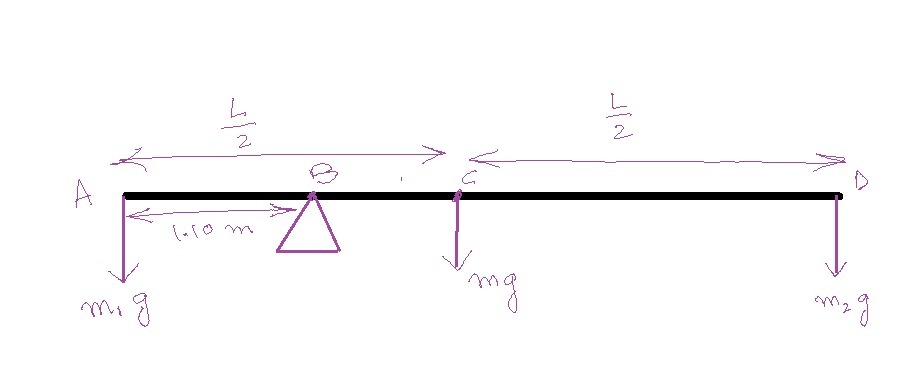
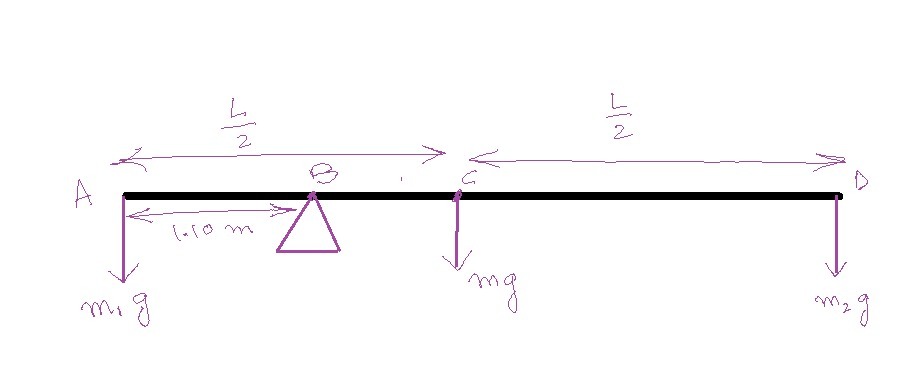
According to the diagram:

AD = length of the beam = L

AC = CD = AD/2 = L/2

BC = AC - AB = (L/2) - 1.10

BD = AD - AB = L - 1.10

m = mass of the beam = 20 kg

m₁ = mass of the child at one end = 30 kg

m₂ = mass of the child at the opposite end = 40 kg

By applying the principle of torque equilibrium around point B:

(m₁ g) (AB) = (mg) (BC) + (m₂ g) (BD)

30 (1.10) = (20) ((L/2) - 1.10) + (40) (L - 1.10)

L = 1.98 m

You might be interested in
When you apply the torque equation ∑τ = 0 to an object in equilibrium, the axis about which torques are calculated:
Softa [2035]

Answer:

option D.

Explanation:

The correct choice is option D.

For an object in equilibrium, the torque measured at any point will be zero.

An object is deemed to be in equilibrium when the net moment acting on it equals zero.

If the object experiences a net moment not equal to zero, it will rotate and will not remain stable.

3 0
1 month ago
you are sitting on a beach and a wave strikes the shore every 10 seconds. a surfer tells you that these waves travel at a speed
ValentinkaMS [2425]

Answer:

50 meters

Explanation:

5 0
10 days ago
Problem: An ice hockey player hits a puck of mass 0.15 kilograms with a force of 100 newtons in the horizontal direction. What i
ValentinkaMS [2425]
The acceleration of an object will always align with the direction of the resultant force acting upon it. Thus, we can find horizontal acceleration by examining the horizontal force applied, applying Newton's second law in its mathematical form: Force = mass * acceleration. Therefore, acceleration = force / mass. By inputting the numbers, we have a = 100 / 0.15, which results in a = 666.7 m/s². Consequently, the acceleration experienced by the hockey puck is 670 m/s².
7 0
5 days ago
Read 2 more answers
Suppose your friend claims to have discovered a mysterious force in nature that acts on all particles in some region of space. H
ValentinkaMS [2425]

Answer:

             U = 1 / r²

Explanation:

In this problem, the task does not require calculating potential energy via the force equation since these two variables are interconnected.


         F = - dU / dr

This derivative represents a gradient, meaning it indicates direction, leading us to write

          dU = - F. dr

The formula for force becomes

         F = B / r³

Now, let’s apply this in the integral:

          ∫ dU = - ∫ B / r³  dr

Here, the force aligns with the displacement, simplifying the scalar product to the product of magnitudes.

Now, we can solve the integrals:

            U - Uo = -B (- / 2r² + 1 / 2r₀²)

To finalize the calculations, a reference point for energy must be designated; commonly, potential energy is set to zero (Uo = 0) at infinity (r = ∞).

             U = B / 2r²

Substituting B = 2, we arrive at:

             U = 1 / r²

5 0
15 days ago
Assume you are driving 20 mph on a straight road. Also, assume that at a speed of 20 miles per hour, it takes 100 feet to stop.
Maru [2360]

Answer:900 feet

Explanation:

Given

Velocity \left ( V_1\right )=20 mph\approx 29.334 ft/s

It takes 100 feet to come to a stop.

Utilizing the equation of motion

v^2-u^2=2as

Where

v,u=Final and initial velocities

a=acceleration

s=distance traveled

0-\left ( 29.334\right )^2=2\left (-a\right )\left ( 100\right )

a=\frac{29.334^2}{2\times 100}=4.302 ft/s^2

When the speed is 60 mph \approx 88.002 ft/s

v^2-u^2=2as

0-\left ( 88.002\right )^2=2\left ( -4.302\right )\left ( s\right )

s=900.08 feet

8 0
1 month ago
Read 2 more answers
Other questions:
  • Evaluate the final kinetic energy of the supply spacecraft for the actual tractor beam force, F(x)=αx3+βF(x)=αx3+β.
    12·1 answer
  • Which, if any, of the following statements concerning the work done by a conservative force is NOT true? All of these statements
    8·1 answer
  • An electron is released from rest at a distance d = 100 m from an infinite conducting plane. The electron will begin to move tow
    11·1 answer
  • A ferris wheel of radius 100 feet is rotating at a constant angular speed Ï rad/sec counterclockwise. using a stopwatch, the rid
    7·1 answer
  • A 25kg child sits on one end of a 2m see saw. How far from the pivot point should a rock of 50kg be placed on the other side of
    14·1 answer
  • If a 50.0-kg mass weighs 554 n on the planet saturn, calculate saturn’s radius
    14·1 answer
  • Robin Hood wishes to split an arrow already in the bull's-eye of a target 40 m away.
    12·1 answer
  • The total energy of a 0.050 kg object travelling at 0.70 c is:
    8·2 answers
  • A ball rolls up a slope. At the end of three seconds its velocity is 20 cm/s; at the end of eight seconds its velocity is 0. Wha
    12·1 answer
  • An uncharged spherical conducting shell surrounds a charge –q at the center of the shell. Then charge +3q is placed on the outsi
    7·1 answer
Add answer
Login
Not registered? Fast signup
Signup
Login Signup
Ask question!