Responses
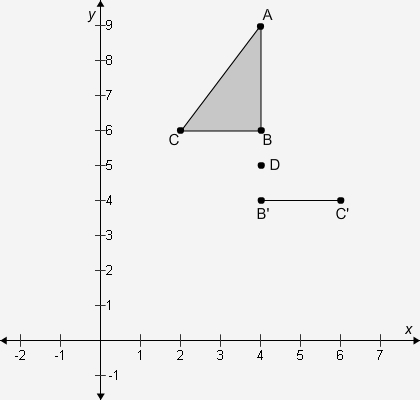
1) The coordinates of A' are (4,1).
2) The coordinates of A″ are (11,2).
Solution
1) Triangle ∆ABC rotates by an angle of 180° counterclockwise around point D, forming triangle ∆A′B′C′.
The coordinates for A are (4,9)=(xa,ya) hence xa=4, ya=9.
The coordinates of A regarding the pivot D(4,5)=(xd,yd) result in xd=4, yd=5. Thus, the transformed coordinates become (xa-xd, ya-yd)=(4-4,9-5)=(0,4) leading to (x,y) where x=0, y=4.
The transformed coordinates A'=(x',y') concerning point D are calculated as follows:
x'= x cos A - y sin A
x' = 0 cos 180° - 4 sin 180°
x'= 0 (-1) - 4 (0)
x'=0-0
x'=0
y' = y cos A + x sin A
y' = 4 cos 180° + 0 sin 180°
y' = 4 (-1) + 0 (0)
y' = -4+0
y'= -4
Thus, (x',y')=(0,-4).
Concerning the origin coordinates, A'=(xa', ya') yields:
xa'=x'+xd→xa'=0+4→xa'=4.
ya'=y'+yd→ya'=-4+5→ya'=1.
Therefore, A' coordinates are (xa',ya')=(4,1).
2) Triangle ∆A′B′C′ rotates 90° counterclockwise around point E(7, 5) to form triangle ∆A″B″C″.
Coordinates of A' are (4,1)=(xa',ya') hence xa'=4, ya'=1.
With respect to E(7,5)=(xe,ye) meaning xe=7, ye=5, the coordinates modify to (xa'-xe, ya'-ye)=(4-7,1-5)=(-3,-4) as (x,y) leads to x=-3, y=-4.
Coordinates for A''=(x'',y'') regarding point E are calculated as:
x''= x cos B - y sin B
x'' = -3 cos 90° - (-4) sin 90°
x''= -3(0) + 4 (1)
x''= -0+4
x''=4
y'' = y cos B + x sin B
y'' = -4 cos 90° + (-3) sin 90°
y'' = -4 (0) - 3 (1)
y'' = -0-3
y''= -3
Thus, (x'',y'')=(4,-3).
Final coordinates for A''=(xa'', ya'') concerning the origin yield:
xa''=x''+xe→xa''=4+7→xa''=11.
ya''=y''+ye→ya''=-3+5→ya''=2.
Consequently, A'' coordinates are (xa'',ya'')=(11,2).