answer.
Ask question
Login Signup
Ask question
All categories
  • English
  • Mathematics
  • Social Studies
  • Business
  • History
  • Health
  • Geography
  • Biology
  • Physics
  • Chemistry
  • Computers and Technology
  • Arts
  • World Languages
  • Spanish
  • French
  • German
  • Advanced Placement (AP)
  • SAT
  • Medicine
  • Law
  • Engineering
stiv31
2 months ago
11

Which statement describes characteristics of a 0.01 M KOH(aq) solution? 1. The solution is acidic with a pH less than 7. 2. The

solution is acidic with a pH greater than 7. 3. The solution is basic with a pH less than 7. 4. The solution is basic with a pH greater than 7.
Chemistry
1 answer:
Tems11 [2.7K]2 months ago
6 0
To begin, it's important to recognize that KOH is a base and not an acid, which means the solution is basic.

You can determine the pH using these two equations:

1) pOH = - log [OH-]

2) pH + pOH = 14 => pH = 14 - pOH


1) pOH = - log (0.01) = 2

2) pH = 14 - 2 = 12

Therefore, the response is option 4, indicating that the solution is basic with a pH exceeding 7 (since, by definition, a basic solution has a pH above 7).
You might be interested in
Every single-celled organism is able to survive because it carries out *
castortr0y [3046]

Every unicellular organism prospers by executing metabolic activities.

Metabolic activities encompass the set of chemical reactions essential for sustaining life.

Explanation:

Different metabolic pathways maintain an organism's viability. Various metabolic activities occur in all living organisms.

These include processes like cellular respiration, reproduction, excretion, and digestion. Each living cell engages in these activities to survive.

Organisms acquire the energy necessary for these activities through food consumption.

Read more on -

6 0
2 months ago
A container is filled with 4.0 g and 5.0 g 02. The mixture is ignited produced water how much water is produced
VMariaS [2998]
The chemical equation can be expressed as:

2H2 + O2 = 2H2O

Given the amounts of the reactants, we need to identify the limiting reactant before calculating the amount of product generated.

4.0 g H2 ( 1 mol / 2.02 g ) = 1.98 mol H2
5.0 g O2 ( 1 mol / 32 g ) = 0.1563 mol O2

The limiting reactant is O2, as it will be fully consumed in the reaction.

0.1563 mol O2 ( 2 mol H2O / 1 mol O2 ) ( 18.02 g / mol ) = 5.6 g H2O will be produced
6 0
2 months ago
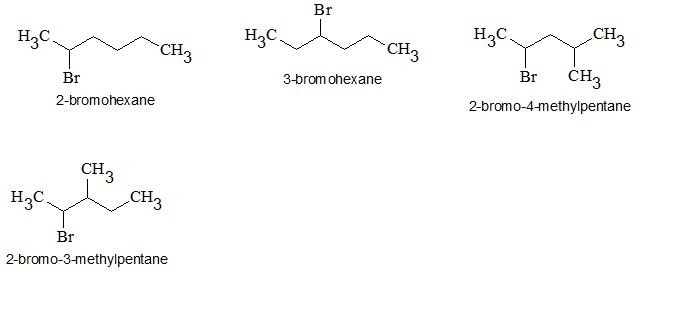
How many 2º alkyl bromides, neglecting stereoisomers, exist with the formula c6h13br?
Anarel [2989]

A secondary alkyl halide would be characterized by having a carbon atom connected to two other carbon atoms, with bromine attached to that carbon.


Therefore, bromo-hexane qualifies as a 2-degree or secondary alkyl halide


5 0
1 month ago
A sample of 0.300 mg pure chromium was added to excess hydrochloric acid to form a 10.0 mL aqueous solution of a chromium (III)
eduard [2782]
extinction coefficient (ε) = 347 L·mol⁻¹·cm⁻¹. The chemical equation representing the reaction of chromium (Cr) with hydrochloric acid (HCl) is: 2 Cr + 6 HCl → 2 CrCl₃ + 3 H₂. To find the number of moles, we apply the formula: number of moles = mass / molar weight. For chromium, we calculate: number of moles of Cr = 0.3 × 10⁻³ (g) / 52 (g/mole), leading to number of moles of Cr = 5.77 × 10⁻⁶ moles. Examining the reaction, we observe that 2 moles of Cr yield 2 moles of CrCl₃, hence 5.77 × 10⁻⁶ moles of Cr will also produce 5.77 × 10⁻⁶ moles of CrCl₃. The molar concentration is determined by: molar concentration = number of moles / volume (L), thus molar concentration of CrCl₃ = 5.77 × 10⁻⁶ / 10 × 10⁻³, which equals 5.77 × 10⁻⁴ moles/L. To convert percent transmittance (%T) to absorbance (A), we use the equation A = 2 - log(%T). Therefore, A = 2 - log(62.5), leading to A = 0.2. The relationship defining absorbance (A) includes the extinction coefficient (ε), path length (l), and concentration (c): A = εlc, hence ε = A / lc, giving ε = 0.2 / (1 × 5.77 × 10⁻⁴), which results in ε = 0.0347 × 10⁴. Thus, the extinction coefficient is ε = 347 L·mol⁻¹·cm⁻¹.

7 0
1 month ago
Other questions:
  • At what temperature would the volume of a gas be 0.550 L if it had a volume of 0.432 L at –20.0 o C?
    8·2 answers
  • What mass of carbon dioxide (co2) can be produced from 86.17 grams of c6h14 and excess oxygen?
    15·1 answer
  • Which of the reagents listed below would efficiently accomplish the transformation of 2-methyl-3-cyclopentenol into 2-methyl-3-c
    6·1 answer
  • A sample of a compound contains 60.0 g C and 5.05 g H. Its molar mass is 78.12 g/mol. What is the compound’s molecular formula?
    11·2 answers
  • For each case below, identify the most likely value for x: a. BHx b. CHx c. NHx d. CH2Clx
    7·1 answer
  • How many grams of Fe are produced from 65.9 g of FeO given the following reaction: 3FeO + 2Al -> 3Fe +Al2O3
    6·2 answers
  • The diagram below represents a portion of a cell membrane. The arrow indicates that the cell membrane is carrying out the proces
    10·1 answer
  • compare and contrast melting 10 kg of ice freezing 1 kg of water. be sure to address temperature,heat flow, and thermal energy
    15·1 answer
  • <img src="https://tex.z-dn.net/?f=PCl_5%20%5Crightleftarrows%20PCl_3%20%2B%20Cl_2" id="TexFormula1" title="PCl_5 \rightleftarrow
    13·1 answer
  • Jack researched J.J. Thomson’s experiments. Read Jack’s summary below and find the error.
    14·1 answer
Add answer
Login
Not registered? Fast signup
Signup
Login Signup
Ask question!