answer.
Ask question
Login Signup
Ask question
All categories
  • English
  • Mathematics
  • Social Studies
  • Business
  • History
  • Health
  • Geography
  • Biology
  • Physics
  • Chemistry
  • Computers and Technology
  • Arts
  • World Languages
  • Spanish
  • French
  • German
  • Advanced Placement (AP)
  • SAT
  • Medicine
  • Law
  • Engineering
Dvinal
15 days ago
7

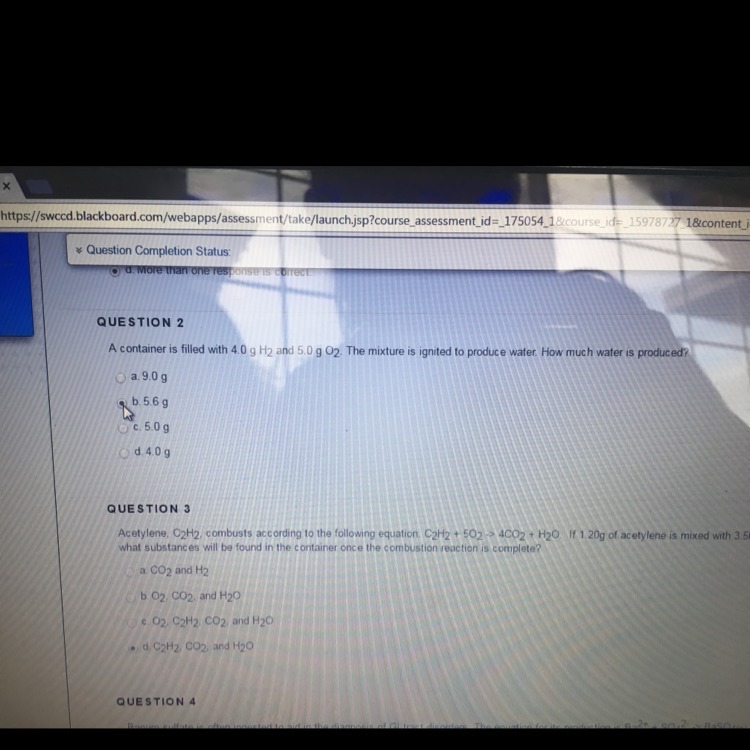
A container is filled with 4.0 g and 5.0 g 02. The mixture is ignited produced water how much water is produced

Chemistry
1 answer:
VMariaS [2.6K]15 days ago
6 0
The chemical equation can be expressed as:

2H2 + O2 = 2H2O

Given the amounts of the reactants, we need to identify the limiting reactant before calculating the amount of product generated.

4.0 g H2 ( 1 mol / 2.02 g ) = 1.98 mol H2
5.0 g O2 ( 1 mol / 32 g ) = 0.1563 mol O2

The limiting reactant is O2, as it will be fully consumed in the reaction.

0.1563 mol O2 ( 2 mol H2O / 1 mol O2 ) ( 18.02 g / mol ) = 5.6 g H2O will be produced
You might be interested in
The volume of the ideal gas in the container is 9 m3. What would the volume be if four more blocks were placed on top of the lid
castortr0y [2743]
Response:
             4.5 m³

Resolution:
              The statement indicates the presence of two blocks on a lid of a container with a volume of 9 m³. The lid's weight is equal to that of the two blocks. Thus, there were initially four blocks (or 4 atm pressure) acting on a volume of 9 m³.

After adding four additional blocks on the lid, the pressure rises from 4 atm to 8 atm (2 atm from the lid, 2 atm from the original blocks, and 4 atm from the new blocks).

Hence, The data established is,

                  P₁  =  4 atm

                  V₁  =  9 m³

                  P₂  =  8 atm

                  V₂  =?

Using Boyle's Law,

                               P₁ V₁  =  P₂ V₂

Resolving for V₂,
                               V₂  =  P₁ V₁ / P₂

Substituting values yields:
                               V₂  =  (4 atm × 9 m³) ÷ 8 atm

                               V₂  =  4.5 m³
0 0
19 days ago
One hour of bicycle riding can require 500-900 kcal of energy, depending on the speed, the terrain, and the weight of the racer.
alisha [2704]
145 hours. Explanation: Riding a bicycle for one hour expends 505 kcal of energy. Given that one gram of body fat equals 7.70 kcal, and 1 pound of body fat is equivalent to 454 grams: 1 lb = 454 g; thus, 21 lb = 21 × 454/1 = 9534 g. Moreover, converting 9534 g of body fat gives us 9534 × 7.70 kcal/1 = 73411.8 kcal. If riding for one hour burns 505 kcal, then to lose 73411.8 kcal, it would require 73411.8 kcal x 1 hour/505 kcal = 145 hours.
3 0
10 days ago
Salt solutions can be __________ to give solid salts. What word completes this sentence?
alisha [2704]

Answer:

evaporated

Explanation:

Once the solution evaporates, only salt will remain, as the sole other component in the solution is water.

7 0
10 days ago
To save time you can approximate the initial volume of water to ±1 mL and the initial mass of the solid to ±1 g. For example, if
castortr0y [2743]

Answer:

The correct options include choice 2, 3, and 6.

Explanation:

Density is identified as the mass of a substance per unit volume occupied by that substance.

Density=\frac{Mass}{Volume}

The density remains constant for a given substance, regardless of variations in mass and volume hence it is considered an intensive property.

2. 20.2 g of silver in 21.6 mL of water and 12.0 g of silver also in 21.6 mL of water.

3. 15.2 g of copper in 21.6 mL of water and 50.0 g of copper in 23.4 mL of water.

6. 11.2 g of gold in 21.6 mL of water and 14.9 g of gold in 23.4 mL of water.

The same metals in both instances will yield consistent densities due to the fixed density of the metal.

7 0
1 month ago
A 25.0 g sample of an alloy was heated to 100.0 oC and dropped into a beaker containing 90 grams of water at 25.32 oC. The tempe
KiRa [2711]

Response:

The specific heat of the alloy C_{a} = 0.37 \frac{KJ}{Kg K}

Clarification:

Weight of the alloy m_{a} = 25 gm

Initial temperature T_{a} = 100°c = 373 K

Weight of the water m_{w} = 90 gm

Initial temperature of water T_{w} = 25.32 °c = 298.32 K

Final temperature T_{f} = 27.18 °c = 300.18 K

Using the energy balance equation,

Heat released by the alloy = Heat absorbed by the water

m_{a} C_{a} [[T_{a} - T_{f}] = m_{w} C_w (T_{f} -T_{w} )

25 × C_{a} × ( 373 - 300.18 ) = 90 × 4.2 (300.18 - 298.32)

C_{a} = 0.37 \frac{KJ}{Kg K}

This gives us the specific heat of the alloy.

4 0
1 month ago
Other questions:
  • If the density of carbon tetrachloride is 1.59 g/ml, what is the volume in l, of 4.21 kg of carbon tetrachloride
    7·1 answer
  • The metallic radius of a lithium atom is 152 pm. What is the volume of a lithium atom in cubic meters?
    12·1 answer
  • What mass of water freezes if 5.43 kJ oh heat are released in the process
    14·1 answer
  • Assuming complete dissociation of the solute, how many grams of KNO3 must be added to 275 mL of water to produce a solution that
    12·1 answer
  • Two different atoms have six protons each and the same mass. However, one has a negative charge while the other has a positive c
    15·2 answers
  • Jane made this picture to represent a chemical reaction: Two circles, one white and the other gray are shown on the left. A smal
    10·2 answers
  • The highest energy occupied molecular orbital in the f-f bond of the f2 molecule is _____
    10·1 answer
  • Why is it important to ensure that treated water remains safe to drink when it is stored after treatment? what is one way to mak
    5·1 answer
  • Some oxygen gas takes up a volume of 2.00 liters at 0.99 atm and 273 K. Its volume doubles and its temperature decreases to 137
    13·2 answers
  • A sample of solid naphthalene is introduced into an evacuated flask. Use the data below to calculate the equilibrium vapor press
    12·1 answer
Add answer
Login
Not registered? Fast signup
Signup
Login Signup
Ask question!