answer.
Ask question
Login Signup
Ask question
All categories
  • English
  • Mathematics
  • Social Studies
  • Business
  • History
  • Health
  • Geography
  • Biology
  • Physics
  • Chemistry
  • Computers and Technology
  • Arts
  • World Languages
  • Spanish
  • French
  • German
  • Advanced Placement (AP)
  • SAT
  • Medicine
  • Law
  • Engineering
jeka94
18 days ago
8

A subway car leaves station A; it gains speed at the rate of 4 ft/s^2 for of until it has reached and then at the rate 6 then th

e speed of 48 ft/s The car maintains the same speed until it approaches station B; driver applies the brakes, giving the car a constant deceleration and bringing it to a stop in 6 s. The total running time from A to B is 40 s Draw the a-t, v t, and s-t curves, and determine the distance between stations A and B.

Engineering
1 answer:
Daniel [215]18 days ago
8 0

Answer:

Refer to the attached document

1512 ft

Explanation:

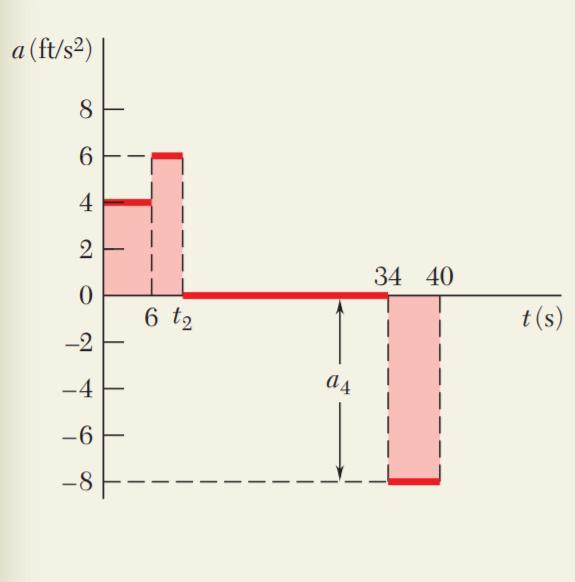
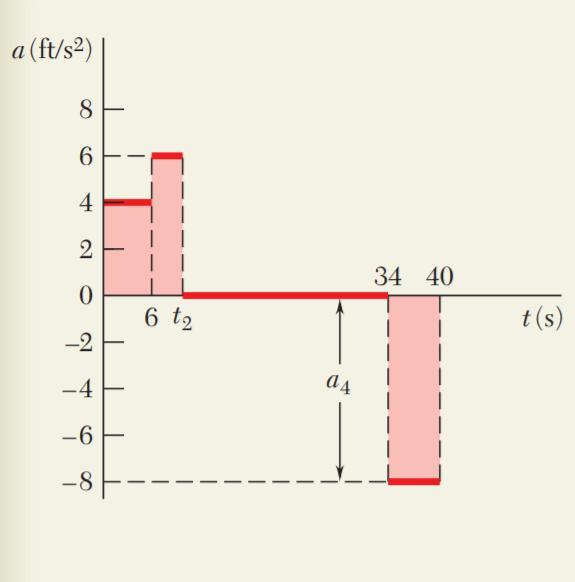
Because the acceleration is constant or zero, the acceleration-time graph consists of horizontal segments. The values for t2 and a4 are derived as follows:

Acceleration - Time

0 < t < 6: Velocity change = area beneath the a–t graph

V_6 - 0 =  (6 s)(4 ft/s²) = 24 ft/s

6 < t < t2: The velocity rises from 24 to 48 ft/s,

Velocity change = area beneath the a–t graph

48 - 24 = (t2 - 6) * 6

t2 = 10 s

t2 < t < 34: The velocity remains constant, meaning acceleration is zero.

34 < t < 40: Velocity change = area beneath the a–t graph

0 - 42 = 6*a4

a4 = - 8 ft / s²

A negative acceleration shows the area lies below the t-axis, indicating a decrease in speed.

Velocity - Time

Since acceleration remains constant or zero, the v−t graph is made up of linear segments connecting the calculated points.

Position change = area beneath the v−t graph

0 < t < 6:  x6 - 0 = 0.5*6*24 = 72 ft

6 < t < 10:    x10 - x6 = 0.5*4*(24 + 48) = 144 ft

10 < t < 34: x34 - x10 = 48*24 = 1152 ft

34 < t < 40: x40 - x34 = 0.5*6*48 = 144 ft

Summing these position changes yields the distance from A to B:

d = x40 - 0 = 1512 ft
You might be interested in
A well-insulated rigid tank contains 1.5 kg of a saturated liquid–vapor mixture of water at 200 kPa. Initially, three-quarters o
Daniel [215]

Answer:

The change in entropy of the steam is 2.673 kJ/K

Explanation:

The mass of the liquid-vapor mixture is 1.5 kg

The mass in the liquid phase is calculated as 3/4 × 1.5 kg = 1.125 kg

The mass in the vapor phase is calculated as 1.5 - 1.125 = 0.375 kg

According to the steam tables

At a pressure of 200 kPa (200/100 = 2 bar), the specific entropy of steam is found to be 7.127 kJ/kgK

The entropy of steam can be calculated as specific entropy multiplied by mass = 7.127 × 0.375 = 2.673 kJ/K

6 0
1 day ago
Read 2 more answers
You are working in a lab where RC circuits are used to delay the initiation of a process. One particular experiment involves an
pantera1 [220]

Answer:

t'_{1\2} = 6.6 sec

Explanation:

The half-life for the specified RC circuit can be expressed as

t_{1\2} =\tau ln2

where [/tex]\tau = RC[/tex]

t_{1\2} = RCln2

Given t_{1\2} = 3 sec

The circuit has a resistance of 40 ohms, and by adding a new resistor of 48 ohms, the total resistance becomes 40 + 48 = 88 ohms.

Thus, the new half-life is

t'_{1\2} =R'Cln2

Now, divide equation 2 by 1

\frac{t'_{1\2}}{t_{1\2}} = \frac{R'Cln2}{RCln2} = \frac{R'}{R}

t'_{1\2} = t'_{1\2}\frac{R'}{R}

After substituting all values, we can calculate the revised half-life

t'_{1\2} = 3 * \frac{88}{40} = 6.6 sec

t'_{1\2} = 6.6 sec

7 0
25 days ago
The rate of flow of water in a pump installation is 60.6 kg/s. The intake static gage is 1.22 m below the pump centreline and re
mote1985 [204]

Answer:

The power of the pump is 23.09 kW.

Explanation:

Parameters

gravitational constant, g = 9.81 m/s^2

mass flow rate, \dot{m} = 60.6 kg/s

flow density, \rho = 1000 kg/m^3

efficiency of the pump, \eta = 0.74

output gauge pressure, p_o = 344.75 kPa

input gauge pressure, p_i = 68.95 kPa

cross-sectional area of output pipe, A_o = 0.069 m^2

cross-sectional area of input pipe, A_i = 0.093 m^2

height of discharge, z_o = 1.22 m - 0.61 m = 0.61 m (evaluated at pump’s maximum height of 1.22 m)

input height, z_i = 0 m

hydraulic power of the pump,P =? kW

Initially, the volumetric flow (Q) needs to be determined

Q = \frac{\dot{m}}{\rho}

Q = \frac{60.6 kg/s}{1000 kg/m^3}

Q = 0.0606 m^3/s

Next, compute the velocity (v) for both input and output

v_o = \frac{Q}{A_o}

v_o = \frac{0.0606 m^3/s}{0.069 m^2}

v_o = 0.88 m/s

v_i = \frac{Q}{A_i}

v_i = \frac{0.0606 m^3/s}{0.093 m^2}

v_i = 0.65 m/s

Subsequently, the total head (H) can be calculated

H = (z_o - z_i) + \frac{v_o^2 - v_i^2}{2 \, g} + \frac{p_o - p_i}{\rho \, g}

H = (0.61 m - 0 m) + \frac{{0.88 m/s}^2 - {0.65 m/s}^2}{2 \, 9.81 m/s^2} + \frac{(344.75 Pa-68.95 Pa)\times 10^3}{1000 kg/m^3 \, 9.81 m/s^2}

H = 28.74m

Finally, the computation of pump power is done as follows

P = \frac{Q \, \rho \, g \, H}{\eta}

P = \frac{0.0606 m^3/s \, 1000 kg/m^3 \, 9.81 m/s^2 \, 28.74m}{0.74}

P = 23.09 kW

6 0
25 days ago
estimate the area for a landfill for 12000 p producing waste for 10 y. assume that the national average is
alex41 [274]

Answer:

1.015 ha.

Explanation:

To calculate the landfill area required for 12,000 people producing waste over 10 years, follow these steps:[STEP ONE: Calculate the average solid waste generated per person per year (kg p^-1 ^y(kg/py)).

According to the problem, the average solid waste produced is 2.78 kg per person daily (kg/pd), hence converting to kg/py involves:

2.78 × 365 days = 1014.7 kg/py.

STEP TWO: Determine yearly volume of refuse per person.

Thus, volume = 1014.7 kg/py ÷ 500 kg/m^3 = 2.03 m^3 per person per year.

STEP THREE: Calculate total solid waste volume over 10 years for 12,000 individuals.

Total waste volume over 10 years = 10 × 12,000 × 2.03 = 243,600 m^3.

STEP FOUR: Find the required area for the landfill.

Note: The total height for the landfill should be 20 + 4 = 24m.

Thus, the area for the landfill = 243,600 m^3 / 24m = 10,150 m^2.

If 10,000 m^2 equals 1 ha, then 10,150 m^2 ÷ 10,000 m^2 = 1.015 ha.

(f). Ensure to expand the landfill area for enhancements.

4 0
21 hour ago
How does Accenture generate value for clients through Agile and DevOps?
Daniel [215]
By securing stakeholder needs throughout the project planning stage via thorough process documentation that is revised after each work cycle.
7 0
1 month ago
Read 2 more answers
Other questions:
  • Gold and silver rings can receive an arc and turn molten. True or False
    12·2 answers
  • A Carnot heat engine receives heat from a reservoir at 900oC at a rate of 800 kJ/min and rejects the waste heat to the ambient a
    13·1 answer
  • A sign erected on uneven ground is guyed by cables EF and EG. If the force exerted by cable EF at E is 46 lb, determine the mome
    13·1 answer
  • Degreasers can be broken down into two main categories
    9·2 answers
  • An overhead 25m-long, uninsulated industrial steam pipe of 100-mm diameter, is routed through a building whose walls and air are
    5·1 answer
  • All MOS devices are subject to damage from:________
    7·1 answer
  • At a certain elevation, the pilot of a balloon has a mass of 120 lb and a weight of 119 lbf. What is the local acceleration of g
    6·1 answer
  • Radioactive wastes are temporarily stored in a spherical container, the center of which is buried a distance of 10 m below the e
    13·1 answer
  • Consider a rectangular fin that is used to cool a motorcycle engine. The fin is 0.15m long and at a temperature of 250C, while t
    5·1 answer
  • PDAs with two stacks are strictly more powerful than PDAs with one stack. Prove that 2-stack PDAs are not a valid model for CFLs
    12·1 answer
Add answer
Login
Not registered? Fast signup
Signup
Login Signup
Ask question!