answer.
Ask question
Login Signup
Ask question
All categories
  • English
  • Mathematics
  • Social Studies
  • Business
  • History
  • Health
  • Geography
  • Biology
  • Physics
  • Chemistry
  • Computers and Technology
  • Arts
  • World Languages
  • Spanish
  • French
  • German
  • Advanced Placement (AP)
  • SAT
  • Medicine
  • Law
  • Engineering
wariber
2 months ago
9

A thin-film gold conductor for an integrated circuit in a satellite application is deposited from a vapor, and the deposited gol

d thin film has a high resistivity. It is proposed that the high resistivity is due to a high non-equilibrium vacancy concentration, created when the vapor atoms rapidly condense into the thin film. To reduce the vacancy concentration, it is proposed to anneal (heat) the gold to a temperature that will result in only 1 vacancy for every 108 gold atoms, and then to cool the film slowly to room temperature. The enthalpy of formation for 1 vacancy in gold is equal to 0.94 eV. Specify the temperature

Engineering
1 answer:
mote1985 [299]2 months ago
5 0

Answer:

Explanation:

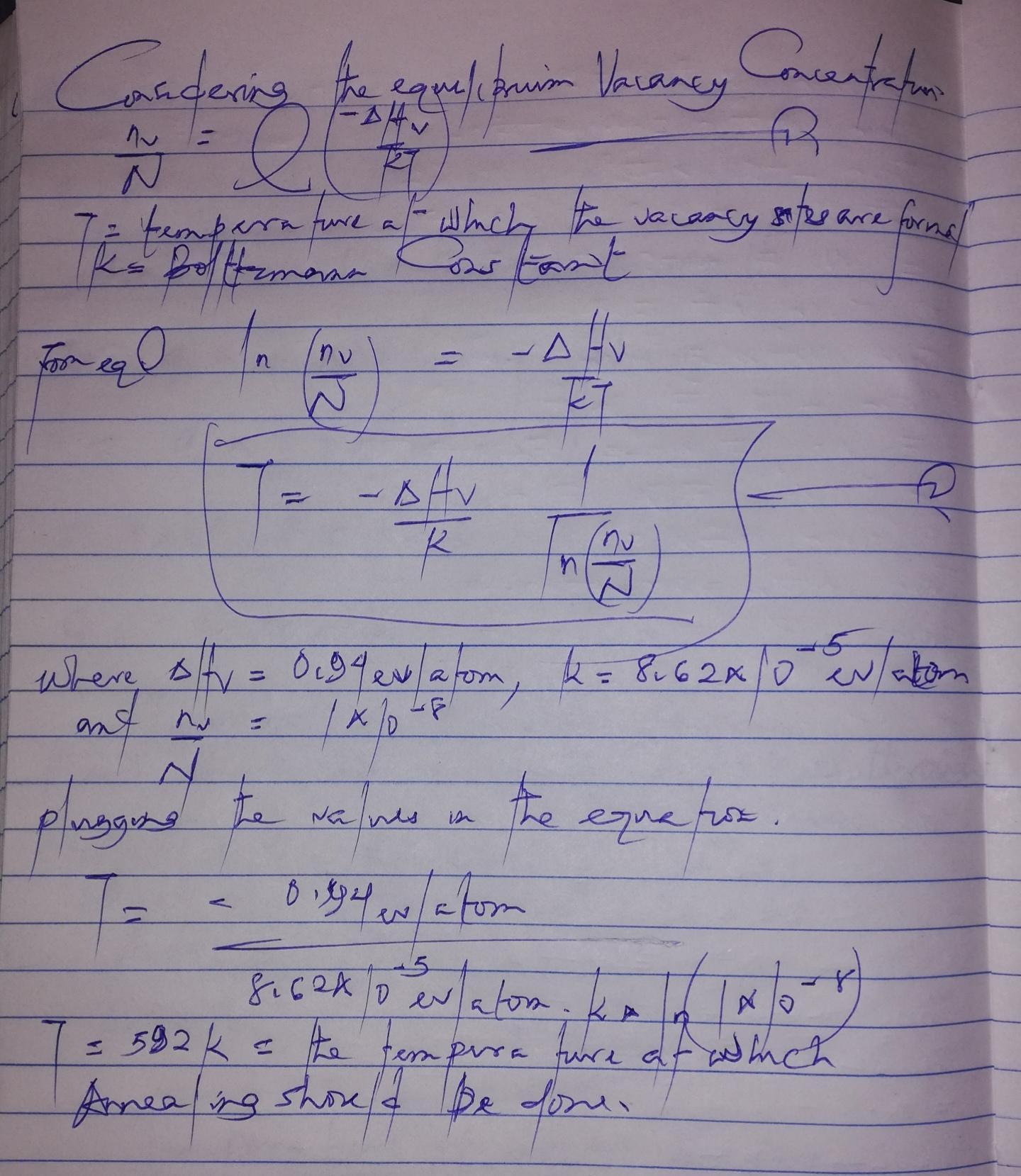
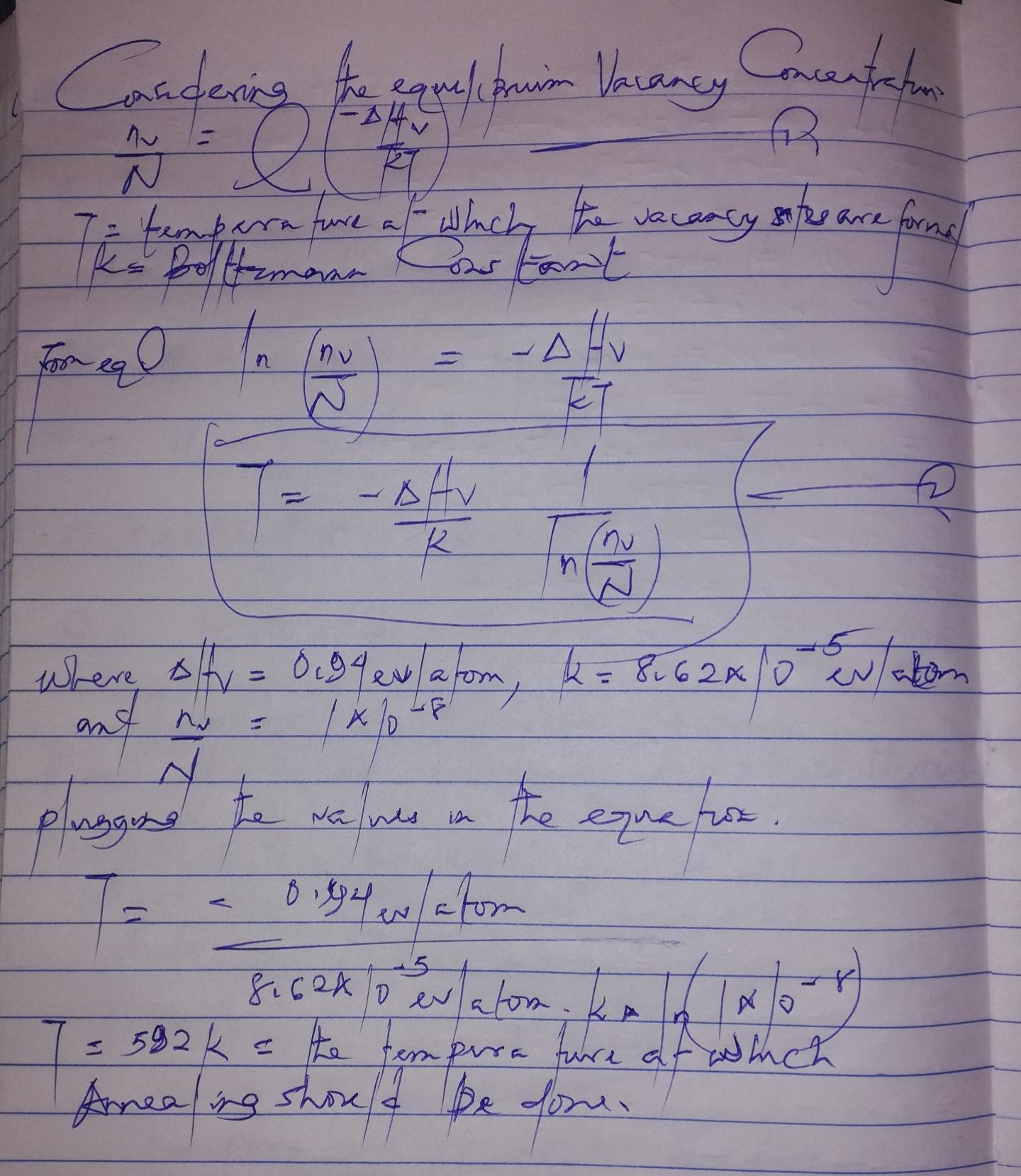
The equilibrium vacancy concentration can be described by:

nv/N = exp(-ΔHv/KT),

where T is the temperature at which vacancies form,

K = Boltzmann's constant,

and ΔHv = enthalpy of vacancy formation.

Rearranging this equation to express temperature allows you to calculate it using the provided values. A detailed breakdown of the process is included in the attached file.

You might be interested in
A subway car leaves station A; it gains speed at the rate of 4 ft/s^2 for of until it has reached and then at the rate 6 then th
Daniel [329]

Answer:

Refer to the attached document

1512 ft

Explanation:

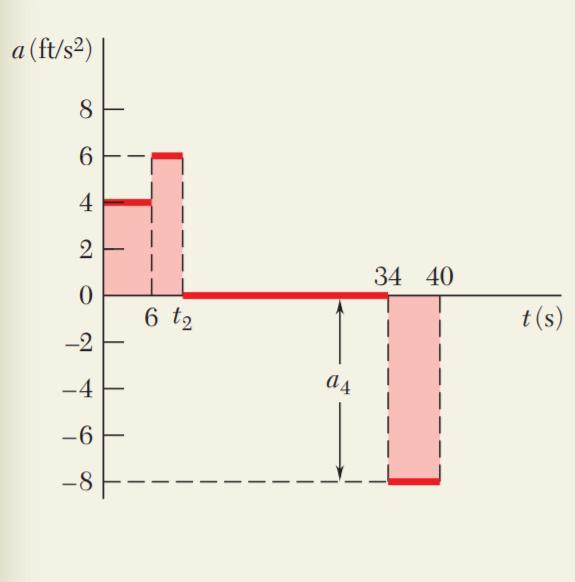
Because the acceleration is constant or zero, the acceleration-time graph consists of horizontal segments. The values for t2 and a4 are derived as follows:

Acceleration - Time

0 < t < 6: Velocity change = area beneath the a–t graph

V_6 - 0 =  (6 s)(4 ft/s²) = 24 ft/s

6 < t < t2: The velocity rises from 24 to 48 ft/s,

Velocity change = area beneath the a–t graph

48 - 24 = (t2 - 6) * 6

t2 = 10 s

t2 < t < 34: The velocity remains constant, meaning acceleration is zero.

34 < t < 40: Velocity change = area beneath the a–t graph

0 - 42 = 6*a4

a4 = - 8 ft / s²

A negative acceleration shows the area lies below the t-axis, indicating a decrease in speed.

Velocity - Time

Since acceleration remains constant or zero, the v−t graph is made up of linear segments connecting the calculated points.

Position change = area beneath the v−t graph

0 < t < 6:  x6 - 0 = 0.5*6*24 = 72 ft

6 < t < 10:    x10 - x6 = 0.5*4*(24 + 48) = 144 ft

10 < t < 34: x34 - x10 = 48*24 = 1152 ft

34 < t < 40: x40 - x34 = 0.5*6*48 = 144 ft

Summing these position changes yields the distance from A to B:

d = x40 - 0 = 1512 ft

8 0
2 months ago
How does Accenture generate value for clients through Agile and DevOps?
Daniel [329]
By securing stakeholder needs throughout the project planning stage via thorough process documentation that is revised after each work cycle.
7 0
3 months ago
Read 2 more answers
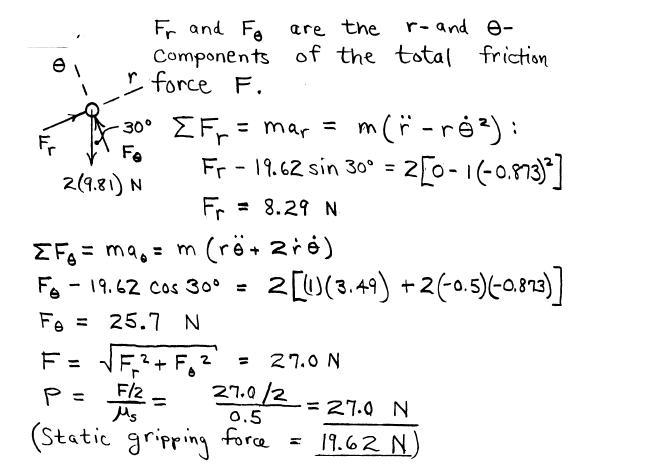
3/63 A 2‐kg sphere S is being moved in a vertical plane by a robotic arm. When the angle θ is 30°, the angular velocity of the a
Kisachek [356]

Answer:

Ps=19.62N

Explanation:

A thorough explanation of the answer can be found in the attached files.

5 0
2 months ago
A thermometer requires 1 minute to indicate 98% of the response to a unit step input. Assuming the thermometer to be a first ord
mote1985 [299]

Answer:

Time constant = 15.34 seconds

The thermometer indicates an error margin of 0.838°

Explanation:

Given

t = 1 minute = 60 seconds

c(t) = 98% = 0.98

According to the details provided, the thermometer functions as a first-order system.

The transfer function of such a system is expressed as;

C(s)/R(s) = 1/(sT + 1).

To determine the time constant, the step response must be evaluated.

This is defined as

r(t) = u(t) --- Applying Laplace Transformation

R(s) = 1/s

Replacing 1/s back into C(s)/R(s) = 1/(sT + 1).

What we have

C(s)/1/s = 1/(sT + 1)

C(s) = 1/(sT + 1) * 1/s

C(s) = 1/s - 1/(s + 1/T) --- Taking Inverse Laplace Transformation

L^-1(C(s)) = L^-1(1/s - 1/(s + 1/T))

Given that e^-t <–> 1/(s + 1) --- {L}

1 <–> 1/s {L}

Thus, the unit response c(t) = 1 - e^-(t/T)

Substituting 0.98 for c(t) and 60 for t

0.98 = 1 - e^-(60/T)

0.98 - 1 = - e^-(60/T)

-0.02 = - e^-(60/T)

e^-(60/T) = 0.02

ln(e^-(60/T)) = ln(0.02)

-60/T = -3.912

T = -60/-3.912

T = 15.34 seconds

It follows that the time constant = 15.34 seconds

The error signal is characterized by

E(s) = R(s) - C(s)

Where the temperature shifts at 10°/min; which equals 10°/60 s = 1/6

Thus,

E(s) = R(s) - 1/6 C(s)

Calculating C(s)

C(s) = 1/s - 1/(s + 1/T)

C(s) = 1/s - 1/(s + 1/15.34)

Note that R(s) = 1/s

Thus, E(s) turns into

E(s) = 1/s - 1/6(1/s - 1/(s + 1/15.34))

E(s) = 1/s - 1/6(1/s - 1/(s + 0.0652)

E(s) = 1/s - 1/6s + 1/(6(s+0.0652))

E(s) = 5/6s + 1/(6(s+0.0652))

E(s) = 0.833/s + 1/(6(s+0.0652)) ---- Taking Inverse Laplace Transformation

e(t) = 1/6e^-0.652t + 0.833

In a first-order system, a steady state condition is reached when the time is four times the time constant.

Thus,

Time = 4 * 15.34

Time = 61.36 seconds

Consequently, e(t) becomes

e(t) = 1/6e^-0.652t + 0.833

e(t) = 1/(6e^-0.652(61.36)) + 0.833

e(t) = 0.83821342824942664566211

e(t) = 0.838 --- Rounded off

Thus, the thermometer reveals an error of 0.838°
4 0
2 months ago
Read 2 more answers
6.15. In an attempt to conserve water and to be awarded LEED (Leadership in Energy and Environmental Design) certification, a 20
Viktor [391]

Explanation:

At a temperature of 33^{\circ} C and relative humidity of 86%, the humidity ratio stands at 0.0223 with a specific volume of 14.289.

At a temperature of 33^{\circ} C and relative humidity of 40%, the humidity ratio is 0.0066 while the specific volume is 13.535.

To determine the mass of air, the following formula can be used:

\begin{aligned}m _{1} &=\frac{ v }{ v }(1- w ) \\&=\frac{1 \times 10^{5}}{13.535}(1-0.0066) \\&=7339.49 lb / min \\v _{ a } &=\frac{ m _{1} v }{(1- w )} \\v _{ a } &=\frac{7339.49 \times 14.289}{(1-0.0223)} \\v _{ a } &=107266.0 ft ^{3} / min\end{aligned}

Now, we will calculate the volume

\begin{aligned}m _{ w } &=\frac{ v _{ a }}{ v _{ a }} w _{ a }-\frac{ v _{ i }}{ v _{ i }} w _{ i } \\&=\frac{107266.0}{14.289} \times 0.0223-\frac{100000}{13.535} \times 0.0066 \\&=118.64 lb / min\end{aligned}

The duration required to fill the cistern can be determined with the equation:

Time \(=\frac{\text { cistern volume }}{\text { removal water perminute volume }}\)

By substituting the values into the preceding formula, we find:

\(\frac{\left(15 \times 10^{3} L\right) \times\left(0.0353147 ft ^{3} / L \right)}{(118.641 b / min ) \times\left(\frac{1}{62.41 lb / ft ^{3}}\right)}\)\\\(=279.09\) minutes\\\(=4.65\) hours.

Thus, the hours necessary to fill the cistern amount to 4.65 hours.

3 0
2 months ago
Other questions:
  • Which of the following ranges depicts the 2% tolerance range to the full 9 digits provided?
    6·1 answer
  • Identify the four engineering economy symbols and their values from the following problem statement. Use a question mark with th
    10·1 answer
  • Multiply each element in origList with the corresponding value in offsetAmount. Print each product followed by a space.Ex: If or
    13·1 answer
  • A tank contains initially 2500 liters of 50% solution. Water enters the tank at the rate of 25 iters per minute and the solution
    13·1 answer
  • Can a 1½ " conduit, with a total area of 2.04 square inches, be filled with wires that total 0.93 square inches if the maximum f
    8·1 answer
  • Consider a rectangular fin that is used to cool a motorcycle engine. The fin is 0.15m long and at a temperature of 250C, while t
    5·1 answer
  • PDAs with two stacks are strictly more powerful than PDAs with one stack. Prove that 2-stack PDAs are not a valid model for CFLs
    12·1 answer
  • The extruder head in a fused- deposition modeling setup has a diameter of 1.25 mm (0.05 in) and produces layers that are 0.25mm
    8·1 answer
  • A single-phase load is located 2800 ft from its source. The load draws a current of 86 A and operated on 480 V. The maximum volt
    9·1 answer
  • A tank contains 500 kg of a liquid whose specific gravity is 2. Determine the volume of the liquid in the tank.
    12·1 answer
Add answer
Login
Not registered? Fast signup
Signup
Login Signup
Ask question!