answer.
Ask question
Login Signup
Ask question
All categories
  • English
  • Mathematics
  • Social Studies
  • Business
  • History
  • Health
  • Geography
  • Biology
  • Physics
  • Chemistry
  • Computers and Technology
  • Arts
  • World Languages
  • Spanish
  • French
  • German
  • Advanced Placement (AP)
  • SAT
  • Medicine
  • Law
  • Engineering
Vilka
17 days ago
6

cubical tank 1 meter on each edge is filled with water at 20 degrees C. A cubical pure copper block 0.46 meters on each edge wit

h an initial temperature of 100 degrees C is quickly submerged in the water, causing an amount of water equal to the volume of the smaller cube to spill from the tank. An insulated cover is placed on the tank. The tank is adiabatic. Estimate the equilibrium temperature of the system (block + water). Be sure to state all applicable assumptions.
Engineering
1 answer:
grin007 [219]17 days ago
3 0

Answer:

final temperature = 26.5°

Explanation:

The water's initial volume is calculated as 1 x 1 x 1 = 1 m^{3}

The starting temperature of the water is 20° C

Water density = 1000 kg/m^{3}

Volume of the copper block is determined as 0.46 x 0.46 x 0.46 = 0.097 m^{3}

The copper block's initial temperature is 100° C

Copper density = 8960 kg/m^{3}

The water's final volume after accounting for the copper block is 1 - 0.097 = 0.903 m^{3}

Assumptions:

  • the tank is adiabatic, meaning there’s no heat exchange through its walls
  • the tank is completely filled, lacking space for any air to cool the water
  • the total thermal energy in the tank is comprised of both the water’s heat energy and that of the copper block.

The mass of the remaining water in the tank can be calculated using density x volume = 1000 x 0.903 = 903 kg

The specific heat capacity for water, c = 4186 J/K-kg

Total heat content of the water Hw = mcT = 903 x 4186 x 20 = 75.59 Mega-joules

The copper's mass is calculated as density x volume = 8960 x 0.097 = 869.12 kg

Copper's specific heat capacity is 385 J/K-kg

The heat content of copper Hc = mcT = 869.12 x 385 x 100 = 33.46 Mega-joules

The overall heat in the system totals up to 75.59 + 33.46 = 109.05 Mega-joules

This heat will be evenly dispersed across the system

The heat energy of the water in the system is expressed as mcT

where T signifies the final temperature

= 903 x 4186 x T = 3779958T

For copper, the heat will be

mcT = 869.12 x 385 = 334611.2T

The combined heat from both will equal the total heat of the system, meaning

3779958T + 334611.2T = 109.05 x 10^{6}

4114569.2T = 109.05 x 10^{6}

Thus, the final temperature T = (109.05 x 10^{6})/4114569.2 = 26.5°

You might be interested in
Multiply each element in origList with the corresponding value in offsetAmount. Print each product followed by a space.Ex: If or
Kisachek [217]

Answer:

Here is the JAVA program:

import java.util.Scanner; // to take input from user

public class VectorElementOperations {

public static void main(String[] args) {

final int NUM_VALS = 4; // size is fixed to 4 assigned to NUM_VALS

int[] origList = new int[NUM_VALS];

int[] offsetAmount = new int[NUM_VALS];

int i;

//two arrays origList[] and offsetAmount[] get assigned their values

origList[0] = 20;

origList[1] = 30;

origList[2] = 40;

origList[3] = 50;

offsetAmount[0] = 4;

offsetAmount[1] = 6;

offsetAmount[2] = 2;

offsetAmount[3] = 8;

String product=""; // variable for storing the product results

for(i = 0; i <= origList.length - 1; i++){

/* iterates from 0 to the end of origList */

/* multiplies each origList entry with the corresponding offsetAmount entry, stores results in product */

product+= Integer.toString(origList[i] *= offsetAmount[i]) + " "; }

System.out.println(product); }}

Output:

80 180 80 400

Explanation:

If you wish to print the product of origList alongside offsetAmount values vertically, this can be done in this manner:

import java.util.Scanner;

public class VectorElementOperations {

public static void main(String[] args) {

final int NUM_VALS = 4;

int[] origList = new int[NUM_VALS];

int[] offsetAmount = new int[NUM_VALS];

int i;

origList[0] = 20;

origList[1] = 30;

origList[2] = 40;

origList[3] = 50;

offsetAmount[0] = 4;

offsetAmount[1] = 6;

offsetAmount[2] = 2;

offsetAmount[3] = 8;

for(i = 0; i <= origList.length - 1; i++){

origList[i] *= offsetAmount[i];

System.out.println(origList[i]);}

}}

Output:

80

180

80

400

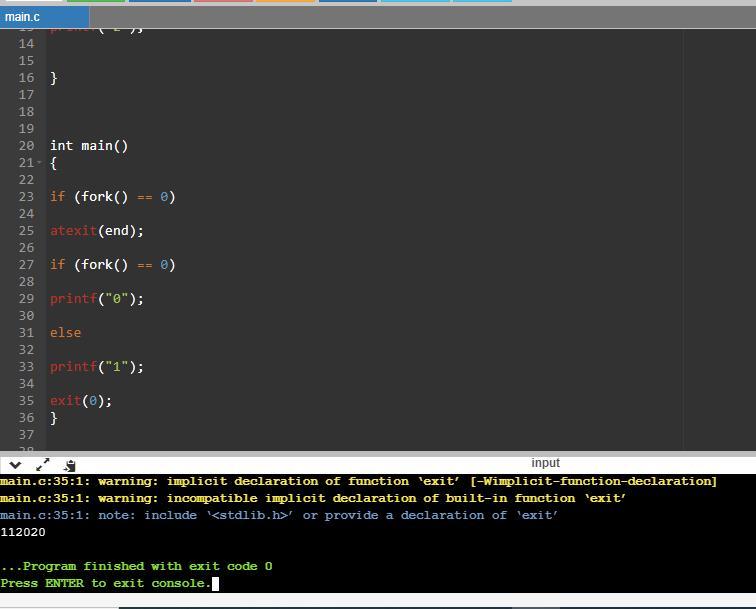
The program is shown with the output as a screenshot along with the example's input.

8 0
24 days ago
Can a 1½ " conduit, with a total area of 2.04 square inches, be filled with wires that total 0.93 square inches if the maximum f
Kisachek [217]
It is not feasible to install the wires within the conduit. Explanation: The given dimensions show that the total area is 2.04 square inches while the wires occupy 0.93 square inches. The maximum allowable fill for the conduit is 40%. To determine if placement is possible, compute the conduit’s area at 40% which equates to 0.816 square inches, less than the required area of the wires.
4 0
9 days ago
A cylinder in space is of uniform temperature and dissipates 100 Watts. The cylinder diameter is 3" and its height is 12". Assum
Kisachek [217]

Answer:

Temperature T = 394.38 K

Explanation:

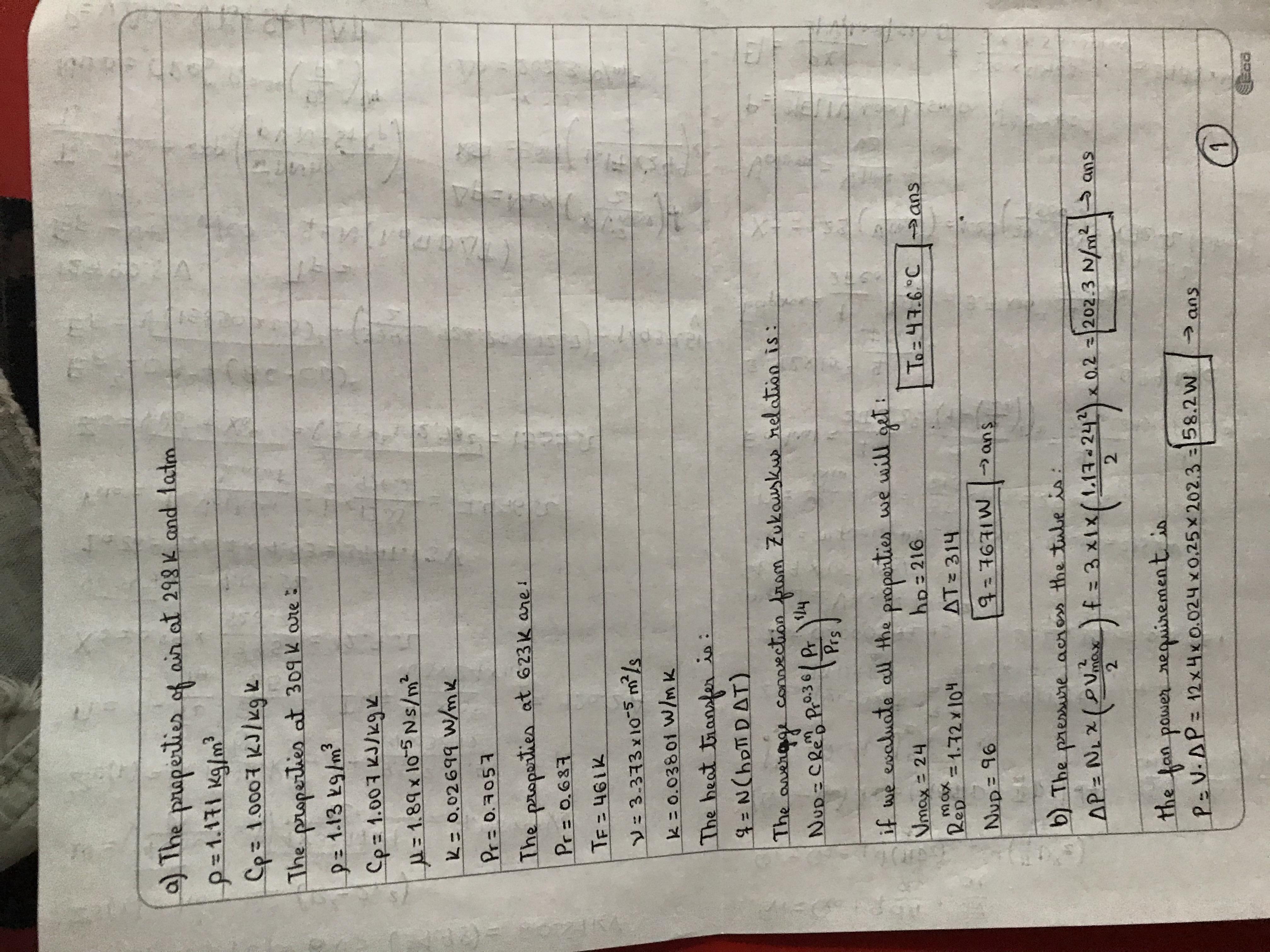
The full solution and detailed explanation regarding the above question and its specified conditions can be found below in the accompanying document. I trust my explanation will assist you in grasping this particular topic.

7 0
1 day ago
The rigid beam is supported by a pin at C and an A992 steel guy wire AB of length 6 ft. If the wire has a diameter of 0.2 in., d
Mrrafil [253]

Answer:

Change in length = 0.0913 in

Explanation:

Given data:

Length = 6 ft

Diameter = 0.2 in

Load w = 200 lb/ft

Solution:

We start by applying the equilibrium moment about point C, expressed as

∑M(c) = 0.............1

This can be used to find the force in AB.

10× 200 × ( 5) - (T cos(30)) × 10 = 0

Solving gives us

Tension in wire T(AB) = 1154.7 lb

We also know the modulus of elasticity for A992 is

E = 29000 ksi

And the area will be

Area = \frac{\pi }{4}\times 0.2^2

The change in length is expressed as

Change in length = \frac{PL}{AE}.........2

Substituting values results in

Change in length = \frac{1154.7 \times 6 \times 12}{\frac{\pi }{4}\times 0.2^2 \times 29000 \times 1000}

Change in length = 0.0913 in

8 0
26 days ago
Which of the following types of protective equipment protects workers who are passing by from stray sparks or metal while anothe
choli [191]

Answer:

Flame-resistant clothing and aprons

Explanation:

Workers involved with welding are generally mandated to wear flame-resistant clothing and aprons to shield them from various hazards, including heat, flames, burns, and potential radiation. In the context of welding, this gear protects individuals from flying sparks that can ignite and cause fires. Hence, such clothing helps to prevent accidents in these situations.

7 0
1 month ago
Other questions:
  • Given two input integers for an arrowhead and arrow body, print a right-facing arrow. Ex: If the input is 0 1, the output is
    8·1 answer
  • A certain full-wave rectifier has a peak output voltage of 30 V. A 50 mF capacitor-input filter is connected to the rectifier. C
    6·1 answer
  • A test machine that kicks soccer balls has a 5-lb simulated foot attached to the end of a 6-ft long pendulum arm of negligible m
    12·1 answer
  • 5 kg of steam contained within a piston-cylinder assembly undergoes an expansion from state 1, where the specific internal energ
    7·1 answer
  • At a certain elevation, the pilot of a balloon has a mass of 120 lb and a weight of 119 lbf. What is the local acceleration of g
    6·1 answer
  • Consider a very long, slender rod. One end of the rod is attached to a base surface maintained at Tb, while the surface of the r
    8·1 answer
  • NEEDS TO BE IN PYTHON:ISBN-13 is a new standard for indentifying books. It uses 13 digits d1d2d3d4d5d6d7d8d910d11d12d13 . The la
    15·1 answer
  • 1. A four-lane freeway (two lanes in each direction) is located on rolling terrain and has 12-ft lanes, no lateral obstructions
    7·1 answer
  • The electrical panel schedules are located on EWR Plan number ___.
    13·1 answer
  • A center-point bending test was performed on a 2 in. x d in. wood lumber according to ASTM D198 procedure with a span of 4 ft an
    12·1 answer
Add answer
Login
Not registered? Fast signup
Signup
Login Signup
Ask question!