answer.
Ask question
Login Signup
Ask question
All categories
  • English
  • Mathematics
  • Social Studies
  • Business
  • History
  • Health
  • Geography
  • Biology
  • Physics
  • Chemistry
  • Computers and Technology
  • Arts
  • World Languages
  • Spanish
  • French
  • German
  • Advanced Placement (AP)
  • SAT
  • Medicine
  • Law
  • Engineering
scoundrel
16 days ago
11

A dinner plate falls vertically to the floor and breaks up into three pieces, which slide horizontally along the floor. immediat

ely after the impact, a 200-g piece moves along the +x-axis with a speed of 2.00 m/s, a 235-g piece moves along the +y-axis with a speed of 1.50 m/s. the third piece has a mass of 100 g. what is the speed of the third piece?

Physics
2 answers:
Ostrovityanka [2.2K]16 days ago
4 0

The velocity of the third piece weighing 100{\text{ g}} equals \boxed{5.33{\text{ }}{{\text{m}}\mathord{\left/{\vphantom{{\text{m}}{\text{s}}}}\right.\kern-\nulldelimiterspace}{\text{s}}}}.

Explanation:

After the plate has fallen straight down and fragmented into three sections, they move horizontally in different directions.

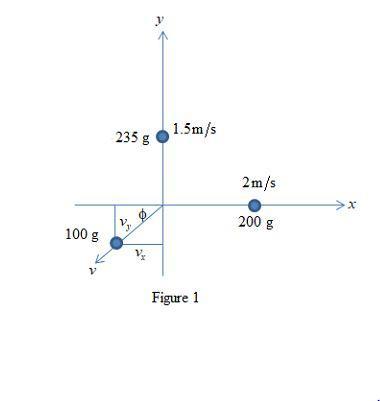
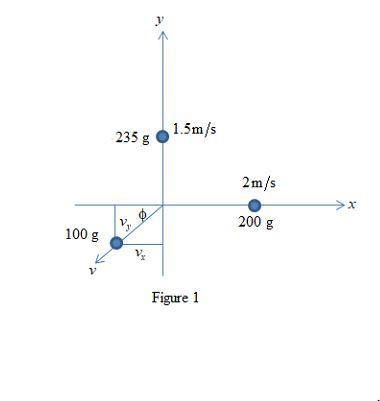
The initial piece with a mass of 200{\text{ g}} is moving on the x-axis at a speed of 2{\text{ }}{{\text{m}}\mathord{\left/{\vphantom{{\text{m}}{\text{s}}}}\right.\kern-\nulldelimiterspace}{\text{s}}}, while the second piece with a mass of 235{\text{ g}} moves vertically on the y-axis at a speed of 1.5{\text{ }}{{\text{m}}\mathord{\left/{\vphantom{{\text{m}}{\text{s}}}}\right.\kern-\nulldelimiterspace}{\text{s}}}.

We need to determine the speed of the third part weighing 100{\text{ g}}.

Assuming the x-y plane represents the horizontal surface, there was no prior momentum before impact.

Designate the third piece’s velocity components as {v_x} and {v_y}, and the resultant velocity v creates an angle of \phi from the negative x-axis as depicted in Figure 1.

Using the principle of conservation of momentum gives the following equation:

\begin{aligned}100{v_x}+2\left({200}\right)&=0\\100{v_x}&=-400\\{v_x}&=-4{\text{ }}{{\text{m}}\mathord{\left/{\vphantom{{\text{m}}{\text{s}}}}\right.\kern-\nulldelimiterspace}{\text{s}}}\\\end{aligned}

A second equation based on conservation of momentum can be expressed as:

\begin{aligned}100{v_y}+1.5\left({235}\right)&=0\\100{v_y}&=-352.5\\{v_y}&=-3.525{\text{ }}{{\text{m}}\mathord{\left/{\vphantom{{\text{m}}{\text{s}}}}\right.\kern-\nulldelimiterspace}{\text{s}}}\\\end{aligned}

The velocity v that the third piece travels is determined as follows:

\begin{aligned}v&=\sqrt{v_x^2+v_y^2}\\&=\sqrt{{{\left({-4}\right)}^2}+{{\left({-3.525}\right)}^2}}\\&=5.33{\text{ }}{{\text{m}}\mathord{\left/{\vphantom{{\text{m}}{\text{s}}}}\right.\kern-\nulldelimiterspace}{\text{s}}}\\\end{aligned}

Thus, the speed of the third piece is 5.33{\text{ }}{{\text{m}}\mathord{\left/{\vphantom{{\text{m}}{\text{s}}}}\right.\kern-\nulldelimiterspace}{\text{s}}}.

Hence, the velocity of the third piece that has a mass of 100{\text{ g}} amounts to \boxed{5.33{\text{ }}{{\text{m}}\mathord{\left/{\vphantom{{\text{m}}{\text{s}}}}\right.\kern-\nulldelimiterspace}{\text{s}}}}.

Learn More:

1. Speed and momentum

2. Linear momentum

3. Velocity and Momentum

Answer Details:

Grade: High School

Subject: Physics

Chapter: Momentum

Keywords:

Plate, momentum, falls, collision, slide, impact, 200 g, 2 m/s, 235 g, 1.50 m/s, 100 g, direction, motion, horizontal, force, x-axis, y-axis, vertically, floor, breaks, three, pieces.
serg [2.5K]16 days ago
4 0
<span>We will apply the momentum-impulse theorem here. The total momentum along the x-direction is defined as p_(f) = p_(1) + p_(2) + p_(3) = 0.
Therefore, p_(1x) = m1v1 = 0.2 * 2 = 0.4. Additionally, p_(2x) = m2v2 = 0 and p_(3x) = m3v3 = 0.1 *v3, where v3 represents the unknown speed and m3 signifies the mass of the third object, which has an unspecified velocity.
In the same way, for the particle of 235g, the y-component of the total momentum is described with p_(fy) = p_(1y) + p_(2y) + p_(3y) = 0.
Thus, p_(1y) = 0, p_(2y) = m2v2 = 0.235 * 1.5 = 0.3525 and p_(3y) = m3v3 = 0.1 * v3, where m3 is the mass of the third piece.
Consequently, p_(fx) = p_(1x) + p_(2x) + p_(3x) = 0.4 + 0.1v3; yielding v3 = 0.4/-0.1 = - 4.
Similarly, p_(fy) = 0.3525 + 0.1v3; thus v3 = - 0.3525/0.1 = -3.525.
Therefore, the x-component of the speed of the third piece is v_3x = -4 and the y-component is v_3y = 3.525.
The overall speed is calculated as follows: resultant = âš (-4)^2 + (-3.525)^2 = 5.335</span>
You might be interested in
Point charge A with a charge of +4.00 μC is located at the origin. Point charge B with a charge of +7.00 μC is located on the x
ValentinkaMS [2425]

Response:

210.3 degrees

Justification:

The total force acting on charge A is 59.5 N

Apply the x and y components of the net force to determine the direction

atan (y/x)
8 0
1 day ago
Read 2 more answers
A transverse wave on a string has an amplitude A. A tiny spot on the string is colored red. As one cycle of the wave passes by,
Sav [2230]
Since it's classified as a transverse wave, the particle on the string moves horizontally as the wave progresses, without actual forward or backward travel. Consequently, the red dot shifts 'A' to the left, returns 'A' to the center, moves 'A' to the right, and goes back 'A' to the center once again. Thus, the red dot collectively travels a distance totaling 4A.
6 0
8 days ago
The iron ball shown is being swung in a vertical circle at the end of a 0.7-m string. how slowly can the ball go through its top
Keith_Richards [2263]
<span>A centripetal force maintains an object's circular motion. When the ball is at the highest point, we can assume that the ball's speed v is such that the weight of the ball matches the required centripetal force to keep it moving in a circle. Hence, the string will not become slack. centripetal force = weight of the ball m v^2 / r = m g v^2 / r = g v^2 = g r v = sqrt { g r } v = sqrt { (9.80~m/s^2) (0.7 m) } v = 2.62 m/s Thus, the minimum speed for the ball at the top position is 2.62 m/s.</span>
6 0
26 days ago
A projectile is fired from ground level with a speed of 150 m/s at an angle 30.° above the horizontal on an airless planet where
Yuliya22 [2438]

Answer:

130 m/s (to two significant figures)

Explanation:

In projectile motion, the launching velocity and launch angle help to determine both the horizontal and vertical velocity components.

u represents the initial projectile velocity = 150 m/s

uₓ = u cos θ = 150 cos 30° = 129.9 m/s

uᵧ = u sin θ = 150 sin 30° = 75.0 m/s

A projectile's motion can be viewed as made up of independent vertical and horizontal elements.

The vertical motion is affected by gravitational acceleration (which pulls down on the projectile), altering the vertical velocity component due to this acting force.

Conversely, there is no acting force in the horizontal direction, which means the horizontal component maintains a steady velocity throughout the projectile's flight.

Thus, at t = 4 s, the horizontal component of the projectile's speed remains equal to the initial horizontal velocity component.

At t = 4 s, the horizontal component of velocity is uₓ = u cos θ = 150 cos 30° = 129.9 m/s ≈ 130 m/s

6 0
6 days ago
Read 2 more answers
A jogger accelerates from rest to 3.0 m/s in 2.0 s. A car accelerates from 38.0 to 41.0 m/s also in 2.0 s. (a) Find the accelera
Sav [2230]

Answer:

a) The jogger's acceleration is 1.5 m/s²

b) The car's acceleration is also 1.5 m/s²

c) Yes, the car covers a distance 76 m greater than the jogger.

Explanation:

a) Acceleration is the change in velocity over a given time interval:

a = (final velocity - initial velocity) / time

For the jogger:

a = (3.0 m/s - 0 m/s) / 2.0 s = 1.5 m/s²

b) For the car:

a = (41.0 m/s - 38.0 m/s) / 2.0 s = 1.5 m/s²

c) To find how far the car has traveled after 2 seconds, use the formula for position under acceleration along a straight path:

x = x₀ + v₀ t + ½ a t²

where

x = position at time t

x₀ = initial position

v₀ = initial velocity

t = elapsed time

a = acceleration

Assuming x₀ = 0 (origin at car's starting point):

x = 38.0 m/s × 2 s + ½ × 1.5 m/s² × (2.0 s)²

x = 79 m

Similarly, position of the jogger after 2 seconds is:

x = 0 m/s × 2 s + ½ × 1.5 m/s² × (2.0 s)² = 3 m

The difference traveled by the car compared to the jogger is 79 m - 3 m = 76 m

4 0
1 month ago
Other questions:
  • A child runs at speed vc while an adult runs at speed va. if the adult gives the child a head start of distance d, how long will
    8·1 answer
  • A compact car has a maximum acceleration of 4.0 m/s2 when it carries only the driver and has a total mass of 1200 kg . you may w
    7·2 answers
  • How many electrons must be removed from a neutral, isolated conducting sphere to give it a positive charge of 8.0 x 10 8 C? [Q=n
    14·1 answer
  • The summer camps had a field trip from the campus to the fragrance Hill they traveled at an average speed of 65 km an hour and t
    6·1 answer
  • Two loudspeakers 42.0 m apart and facing each other emit identical 115 Hz sinusoidal sound waves in a room where the sound speed
    5·1 answer
  • A gas is compressed in a cylinder from a volume of 20.0 l to 2.0 l by a constant pressure of 10.0 atm. calculate the amount of w
    6·1 answer
  • what is a possible unit for the product VI, where V is the potential difference across a resistor and I is the current through t
    14·1 answer
  • A standard baseball has a circumference of approximately 23 cm . if a baseball had the same mass per unit volume as a neutron or
    5·2 answers
  • The human heart is a powerful and extremely reliable pump. Each day it takes in and discharges about 7500 L of blood. Assume tha
    6·1 answer
  • A distance of 2.00 mm separates two objects of equal mass. If the gravitational force between them is 0.0104 N, find the mass of
    10·2 answers
Add answer
Login
Not registered? Fast signup
Signup
Login Signup
Ask question!
