Answer:
The BMX rider lands 5.4 meters horizontally away from the ramp's end.
Explanation:
The BMX position vector is represented as:
r = (x0 + v0 × t × cos α, y0 + v0 × t × sin α + ½ × g × t²)
Where:
r = position at time t
x0 = initial horizontal position
v0 = initial speed
α = angle of jump
y0 = initial vertical height
g = gravitational acceleration (-9.8 m/s², upward positive)
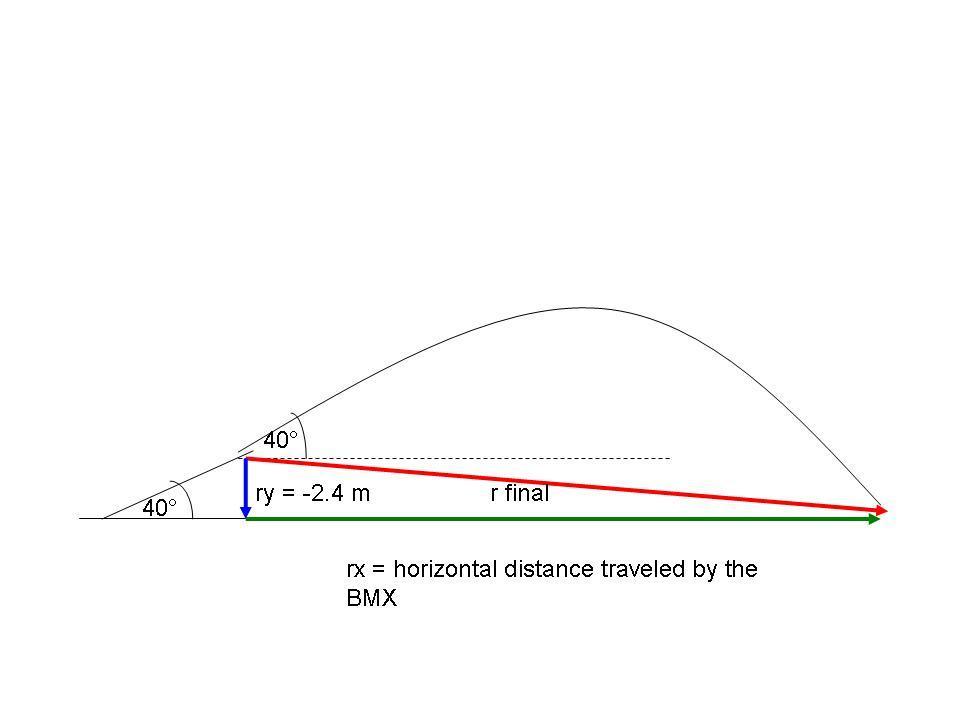
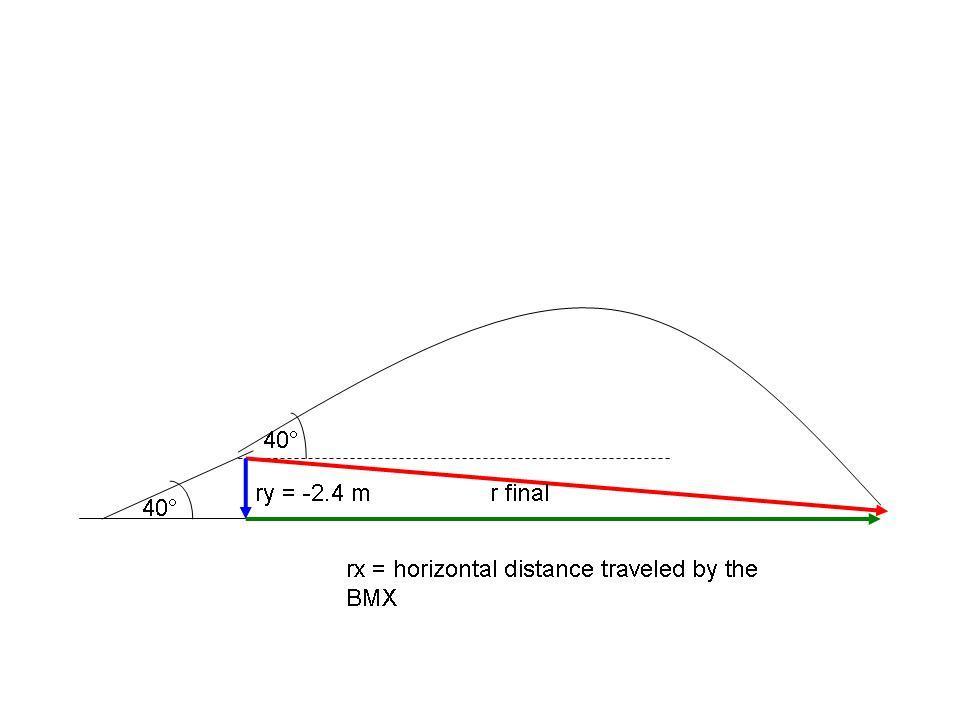
Refer to the diagram for clarity. At the landing time, the vertical coordinate of the position vector is -2.4 m, measured from the ramp's edge as the origin. Using the vertical component equation for y, one can solve for t, then substitute t to find the horizontal distance.
The vertical position equation:
-2.4 m = 0 + 5.9 m/s × t × sin 40° - ½ × 9.8 m/s² × t²
Rearranged:
0 = -4.9 t² + 5.9 t × sin 40° + 2.4
Solving this quadratic yields:
t = 1.2 seconds
Then, calculate horizontal distance:
x = 0 + 5.9 m/s × 1.2 s × cos 40° = 5.4 m
This means the BMX lands 5.4 meters from the ramp's edge.
Have a great day!