answer.
Ask question
Login Signup
Ask question
All categories
  • English
  • Mathematics
  • Social Studies
  • Business
  • History
  • Health
  • Geography
  • Biology
  • Physics
  • Chemistry
  • Computers and Technology
  • Arts
  • World Languages
  • Spanish
  • French
  • German
  • Advanced Placement (AP)
  • SAT
  • Medicine
  • Law
  • Engineering
son4ous
11 days ago
11

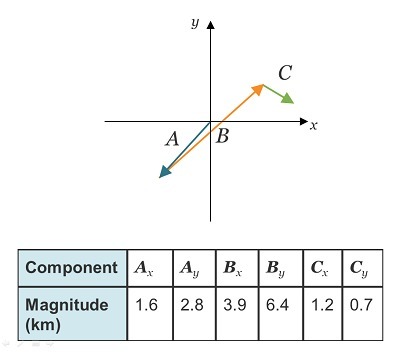
The image shows the displacement of a motorboat. The data table shows the magnitudes of the components of each displacement vect

or.
What is the value of Rx?

km

What is the value of Ry?

km

Physics
2 answers:
serg [2.5K]11 days ago
8 0

R_x = A_x + B_x + C_x

A_x is negative since the vector resides in the third quadrant.

B_x is positive as it is directed in the first quadrant.

C_x is positive because it points towards the fourth quadrant.

Thus,

R_x = -1.6 + 3.9 + 1.2

R_x = 3.5 km

R_y = A_y + B_y + C_y

A_y is negative as it exists in the third quadrant.

B_y is positive because it's in the first quadrant.

C_y is negative since it is in the fourth quadrant.

R_y = -2.8 + 6.4 - 0.7

R_y = 2.9 km

serg [2.5K]11 days ago
4 0
Rx= 3.5 km

Ry= 2.9 km
You might be interested in
a fixed mass of a n ideal gas is heated from 50 to 80C at a constant pressure at 1 atm and again at a constant pressure of 3 atm
inna [2205]

Answer:

The required energy remains identical in both scenarios since the specific heat capacity (Cp) does not change with varying pressure.

Explanation:

Given;

initial temperature, t₁ = 50 °C

final temperature, t₂ = 80 °C

Temperature change, ΔT = 80 °C - 50 °C = 30 °C

Pressure for scenario one = 1 atm

Pressure for scenario two = 3 atm

The energy needed in both scenarios is expressed as;

Q = M*C_p*\delta T

Where;

Cp denotes specific heat capacity, which only varies with temperature and remains unaffected by pressure.

Hence, the energy required remains the same for both scenarios since specific heat capacity (Cp) is pressure-independent.

8 0
1 month ago
A brick is dropped (zero initial speed) from the roof of a building. The brick strikes the ground in 1.90 s. You may ignore air
Sav [2226]

Answer:

Height (h) = 17 m

Velocity (v) = 18.6 m/s

Explanation: This problem can be solved using kinematic motion equations.

Given Data

Initial velocity (u) = 0

Acceleration (a) = g

Time (t) = 1.9 seconds

First, we calculate the height.

s=ut+0.5at^2\\h=ut+0.5at^2\\h=0*1.9+0.5*9.81*1.9^2\\h=17.707 m

Then, we find the final velocity

v=u+at\\v=0+9.81*1.9\\v=18.639

The acceleration graph is a linear representation described by y=9.8, as it remains constant:

The velocity graph can be represented by y=9.8x (where y signifies velocity and x indicates time):

The displacement graph can be described as y=4.9x^2 (with x as time and y as displacement):

These graphs apply exclusively from x=0 to x=1.9, so disregard other sections of the graphs.

5 0
1 month ago
The intensity level of a "Super-Silent" power lawn mower at a distance of 1.0 m is 100 dB. You wake up one morning to find that
Maru [2355]

Answer:

The correct option is 80 dB.

Explanation:

The transformation of sound intensity level into sound intensity utilizes the formula

[D] = 10 log (I/I₀)

Where I₀ = 10⁻¹² W/m²

[D] results in 100 dB

100 = 10 log (I/I₀)

Log (I/I₀) converts to 10

(I/I₀) = 10¹⁰

I is determined as I₀ × 10¹⁰ = 10⁻¹² × 10¹⁰ = 10⁻² W/m²

Sound intensity inversely relates to the square of the distance from the source.

I ∝ (1/d²)

I can be expressed as k/d²

When d = 1 m, the intensity is 10⁻² W/m²

Thus, 0.01 = k/1

Providing that k = 0.01 W

For d = 20 m, we can calculate I

I = 0.01/20² = 2.5 × 10⁻⁵ W/m²

With four neighbors mowing their lawns concurrently,

I = 4 × 2.5 × 10⁻⁵ = 10⁻⁴ W/m⁻²

The sound intensity level in decibels is represented as

[D] = 10 log (I/I₀)

[D] = 10 log (10⁻⁴/10⁻¹²)

[D] = 10 log (10⁸)

[D] = 10 × 8 = 80dB

4 0
18 days ago
Ability of the muscles to function effectively and efficiently without undue fatigue
Keith_Richards [2256]

Response:

Physical well-being

Clarification:

7 0
1 month ago
A student placed a pencil in a cup of water. The pencil appears broken because light- always travels in a straight line makes th
kicyunya [2264]
<span>None of the provided options presents an accurate statement. The third choice is nearly correct,
yet it can be considered misleading.

The pencil seems broken due to light bending away from a straight path
when it transitions from air to water.</span>
5 0
5 days ago
Read 2 more answers
Other questions:
  • f a stadium pays $11,000 for labor and $7,000 for parking, what would the stadium's parking revenue have to be if the stadium is
    5·2 answers
  • If the position of an object is zero at one instant, what is true about the velocity of that object?
    7·1 answer
  • A very long uniform line of charge has charge per unit length λ1 = 4.80 μC/m and lies along the x-axis. A second long uniform li
    14·1 answer
  • A trooper is moving due south along the freeway at a speed of 23 m/s. at time t = 0, a red car passes the trooper. the red car m
    12·2 answers
  • Russ makes the diagram below to organize his notes about how Newton’s first law describes objects at equilibrium.
    13·2 answers
  • In pulling two identical carry-on bags through the airport, Mr. Myers and his 13 year old grandson, Vincent, do the same amount
    15·1 answer
  • A rope connects boat A to boat B. Boat A starts from rest and accelerates to a speed of 9.5 m/s in a time t = 47 s. The mass of
    10·1 answer
  • A Top Fuel Dragster initially at rest undergoes an average acceleration of 39 m/s2 for 3.97 seconds. How far will it go in this
    15·1 answer
  • Which process is a form of mechanical weathering?
    15·2 answers
  • A 1.0-kg block and a 2.0-kg block are pressed together on a horizontal frictionless surface with a compressed very light spring
    13·2 answers
Add answer
Login
Not registered? Fast signup
Signup
Login Signup
Ask question!