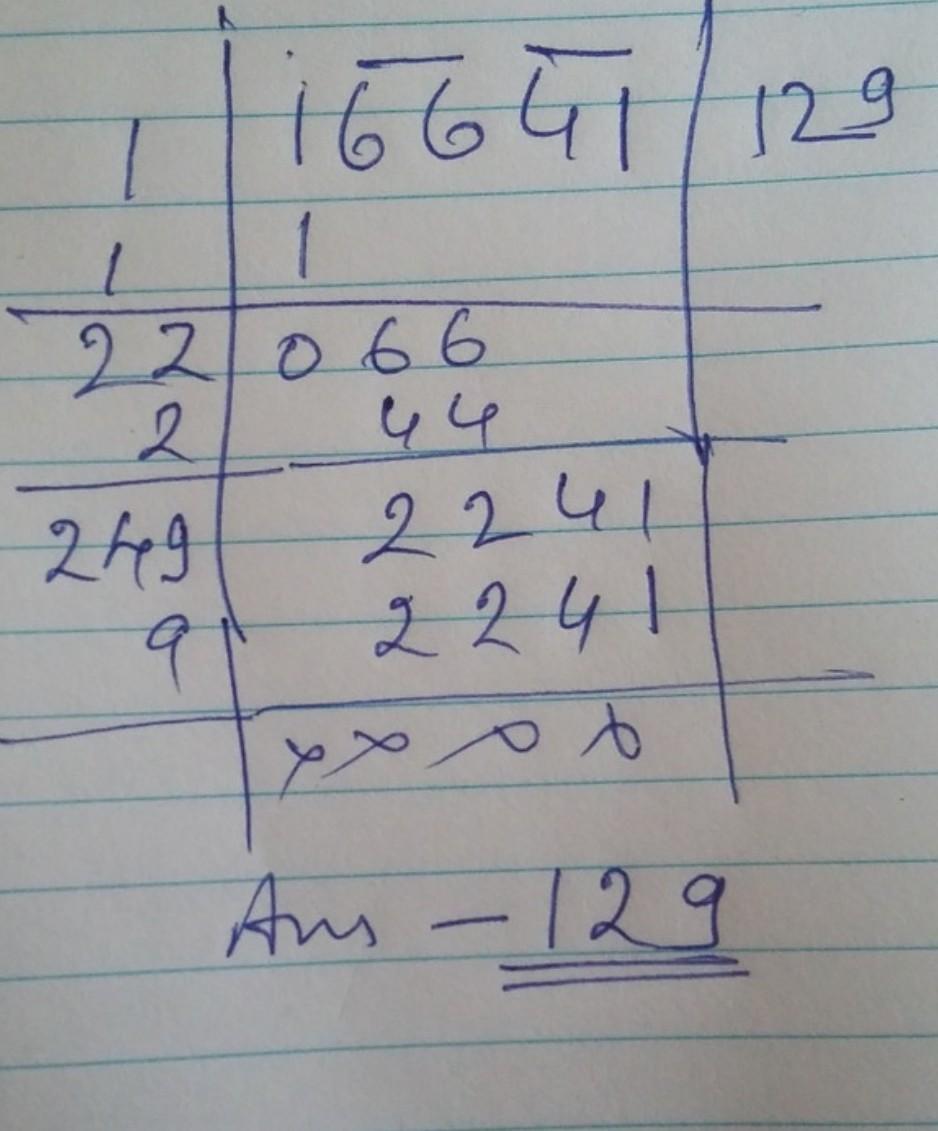
Answer: Indeed, 16,641 is a perfect square.
Step-by-step explanation: 16641 is the 129th perfect square number
__________________________________________
1 2 9
1 1 66 41
1
22 66
44
249 22 41
22 41
258 0
Number = 16641
Square Root = 129
________________________________
Step-1:
Form pairs of digits from the number starting with the digit at the one's place. Bar each pair.
1 66 41
Step-2:
Now we need to multiply a number by itself so that the product ≤ 1
Here 1×1=1≤1, So the divisor is 1 and the quotient is 1. Now perform the division and obtain the remainder.
1
1 1 66 41
1
0
Step-3:
Next, we bring down 66 and multiply the quotient 1 by 2 to get 2, starting the new divisor.
1
1 1 66 41
1
2 66
Step-4:
The new divisor's one's place digit should be 2, as multiplying 22 by 2 gives 44.
This makes the new divisor 22 and the next quotient digit is 2. Now conduct the division and compute the remainder.
1 2
1 1 66 41
1
22 66
44
22
Step-5:
Now we bring down 41 and 12 (quotient) multiplied by 2 becomes 24, starting the new divisor's first digit.
1 2
1 1 66 41
1
22 66
44
24 22 41
Step-6:
The new divisor's one's place digit must be 9 since 249 multiplied by 9 results in 2241.
This makes the new divisor 249 and the quotient’s next digit is 9. Now conduct the division and get the remainder.
1 2 9
1 1 66 41
1
22 66
44
249 22 41
22 41
0
Answer: 129 (as proof, 129^2) = 16,641 or 129 x 129 = 16,641
______________________________
Secondary Solution shortcut:
A perfect square is a number expressible as the product of two identical integers.
The only way to accurately determine if a number is a perfect square is to identify the factors. Before we exert effort into finding factors, a quick method exists to help ascertain whether further work is warranted.
A perfect square never concludes in 2, 3, 7, or 8. If your number ends with any of these digits, you can stop here as it is not a perfect square.
Obtain the digital root of your number, which is merely the sum of all the digits. If you're confused, don't fret; we’ll clarify each point further below.
Any potential perfect square numbers must possess a digital root of 1, 4, 7, or 9.
Let’s put it to the test...
Step 1:
What is the last digit of 16,641? It is 1. Is 1 part of the digits that can never be perfect squares (2, 3, 7, or 8)?
Answer: NO, 1 isn’t in the digits incapable of being perfect squares. Let's proceed.
Step 2:
We now need to compute the digital root:
Split the number into its digits and compute their total:
1 + 6 + 6 + 4 + 1 = 18
Should the outcome have more than one digit, add the digits of the resultant again:
1 + 8 = 9
What’s the digital root of 16,641?
Answer: 9
Step 3:
So now we ascertain that the digital root of 16,641 is 9. Does 9 intersect with the confirmed list of digital roots inherently square (1, 4, 7, or 9)?
Answer: YES, 9 is listed as one of the possible digital roots for perfect squares. Thus, we conclude that 16,641 might be a perfect square!
Factoring
Alright, now we know for certain that 16,641 might be a perfect square. We need to find factors to ensure this.
Here are the factors of 16,641:
1 x 16,641, 3 x 5,547, 9 x 1,849, 43 x 387, 129 x 129
The highlighted combination confirms 16,641 as a perfect square. Do you understand why? A number can only qualify as a perfect square if the product of two identical numbers equals it.
Proof: 129 x 129 = 16,641
For a rectangle, the perimeter can be calculated as P=2l+2w. Assuming the length is horizontal and the width is vertical, the span between the x coordinates will give the length, while the span between the y coordinates will determine the width. Once these measurements are obtained, you can apply them to the perimeter formula. |7 -(-7)| = 14 gives l = 14, |5-(-2)| = 7 gives w=7. Therefore, P=2(14)+2(7), which results in P= 28+14, thus, P= 42.
To find the solution, you need to add 27 and 8 together, which results in 35. After calculating that, you should subtract 32 from 35, leading to a remainder of 3, indicating that 3 extra pallets will be remaining as your answer.
Multiply 132 feet by 60 seconds to get 7920. Subtract 5280, the number of feet in a mile, leaving you with 1 mile and an additional 2640 feet, which amounts to half a mile.
In this case, the method of sampling employed by the poll
Explanation:
Convenience sampling, often referred to as grab, opportunity, or accidental sampling, is a non-probability sampling technique where the sample is collected from the part of the population that is easily accessible. This technique proves to be particularly useful for preliminary investigations.
This type of sampling makes selections based on ease of access, willingness of individuals to participate, and availability at specific times.
Consequently, this approach can lead to biased results and may not yield the expected outcomes.