answer.
Ask question
Login Signup
Ask question
All categories
  • English
  • Mathematics
  • Social Studies
  • Business
  • History
  • Health
  • Geography
  • Biology
  • Physics
  • Chemistry
  • Computers and Technology
  • Arts
  • World Languages
  • Spanish
  • French
  • German
  • Advanced Placement (AP)
  • SAT
  • Medicine
  • Law
  • Engineering
QveST
17 days ago
14

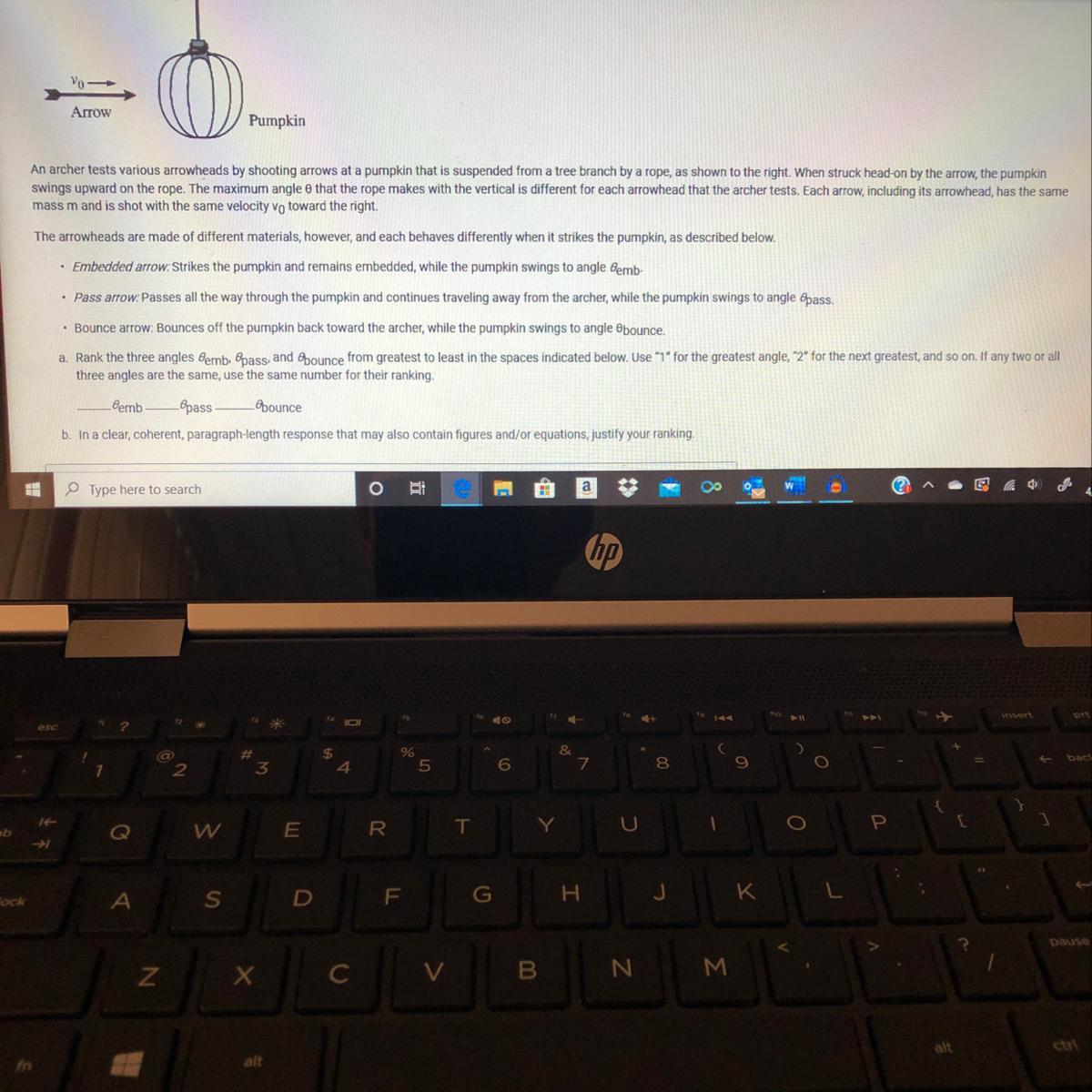
An archer tests various arrowheads by shooting arrows at a pumpkin that is suspended from a tree branch by a rope, as shown to t

he right. When struck head on by the arrow, the pumpkin
swings upward on the rope. The maximum angle that the rope makes with the vertical is different for each arrowhead that the archer tests. Each arrow, including its arrowhead, has the same
mass mand is shot with the same velocity vo toward the right
The arrowheads are made of different materials, however, and each behaves differently when it strikes the pumpkin, as described below.
- Embedded arrow Strikes the pumpkin and remains embedded, while the pumpkin swings to angle &emb
• Pass arrow Passes all the way through the pumpkin and continues traveling away from the archer, while the pumpkin swings to angle bass
- Bounce arrow. Bounces off the pumpkin back toward the archer, while the pumpkin swings to angle bounce
a Rank the three angles Gemb Bass and bounce from greatest to least in the spaces indicated below. Use"
three angles are the same, use the same number for their ranking
for the greatest angle, "2" for the next greatest and so on. If any two or all
_Gemb—_Bass_Bounce
b. In a clear, coherent, paragraph-length response that may also contain figures and/or equations, justify your ranking

Physics
1 answer:
Maru [1K]17 days ago
6 0

Answer:

Bounce 1, pass 3, embedded 2

Explanation:

(By the way, I'm also tackling that problem on the College Board physics page.) The Bounce arrow indicates a collision with the object and a reversal, reflecting it now possesses negative momentum, thus imparting greater momentum to the object. From P=mv, this implies a higher velocity for the object and a corresponding increase in kinetic energy, leading to a greater change in potential energy. Given that K=0.5mv²=U=mgh, an increase in potential energy corresponds to a larger height change, which translates to a larger angle θ with respect to the vertical. In contrast, the embedded arrow transfers all its momentum to the two objects instantly (the arrow and the pumpkin), resulting in a higher velocity. The pass arrow, however, only transfers a portion of its momentum while retaining some for its own movement, leading to diminished momentum for the pumpkin, and consequently lower velocity and kinetic energy transferred to potential energy, resulting in less height change and a smaller θ angle. Hence, the ranking is Bounce 1, Pass 3, Embedded 2.

You might be interested in
A box of mass 3.1kg slides down a rough vertical wall. The gravitational force on the box is 30N . When the box reaches a speed
Ostrovityanka [942]

Answer:

Explanation:

a) La fuerza neta que actúa sobre la caja en la dirección vertical es:

Fnet=Fg−f−Fp *sin45 °

aquí Fg representa la fuerza gravitacional, f es la fuerza de fricción, y Fp es la fuerza de empuje.

Fnet=ma

ma=Fg−f−Fp *sin45 °

​a=\frac{30-13-23*sin(45)}{3.1}

=0.24 m/s²

Vf =Vi +at

=0.48+0.24*2

Vf=2.98 m/s

b)

Fnet=Fg−f−Fp *sin45 °

=Fg−0.516Fp−Fp *sin45 °

=30-1.273Fp

Fnet=0 (Ya que la velocidad es constante)

Fp=30/1.273

=23.56 N

5 0
7 days ago
Read 2 more answers
Jack pulls a sled across a level field by exerting a force of 110 n at an angle of 30 with the ground. what are the parallel and
Softa [913]
<span>A force of 110 N is applied at an angle of 30</span>°<span> to the horizontal. Because the force does not align directly either vertically or horizontally with the sled, it can be broken down into two components based on sine and cosine.

For the component parallel to the ground:
x = rcos</span>β
<span>x = 110cos30</span>°
<span>x = 95.26

For the component perpendicular to the ground:
y = rsin</span>β
<span>y = 110sin30</span>°
<span>y = 55</span>
3 0
6 days ago
Read 2 more answers
For a projectile, which of the following quantities are constant during the flight: x, y, vx, vy, v, ax, ay? Check all that appl
Yuliya22 [1153]

Response:

C. vx

F. ax

G. ay

Clarification:

The projectile follows a curved trajectory toward the ground, causing changes in x and y positions.

Since there is no external force acting in the x-direction, the acceleration in x remains at zero. Consequently, ax and vx remain unchanged.

The projectile is subject to the force of gravity, directed downwards, leading to an increase in its velocity due to the rise in its y-component.

Meanwhile, the y-component of acceleration remains constant due to gravitational acceleration.

5 0
7 days ago
The height of a typical playground slide is about 6 ft and it rises at an angle of 30 ∘ above the horizontal.
Maru [1053]

Answer:

The coefficient of kinetic friction is found to be 0.432.

Explanation:

Comprehensive steps and derivations with necessary substitutions are detailed in the attached document.

6 0
14 days ago
Compare the momentum of a 6,300-kg elephant walking 0.11 m/s and a 50-kg dolphin swimming 10.4 m/s. your answer
inna [987]
<span>First, apply Newton's second law of motion: F = ma. Force equals mass times acceleration. This law describes force as the product of mass multiplied by acceleration (which is different from velocity). As acceleration is the variation in velocity over time, we have force = (mass * velocity) / time, leading us to conclude that (mass * velocity) / time will equal momentum / time. Hence, we derive the equation mass * velocity = momentum. Momentum = mass * velocity. For the elephant, with a mass of 6300 kg and velocity of 0.11 m/s, Momentum = 6300 * 0.11, resulting in P = 693 kg (m/s). For the dolphin, having a mass of 50 kg and moving at 10.4 m/s, Momentum = 50 * 10.4, yielding P = 520 kg (m/s). Thus, the elephant has a greater momentum (P) due to its larger size.</span>
5 0
10 days ago
Other questions:
  • State two advantages of a lead-acid accumulator over a leclanche cell​
    8·1 answer
  • Find the object's speeds v1, v2, and v3 at times t1=2.0s, t2=4.0s, and t3=13s.
    6·2 answers
  • 3. A 3.0 × 10⁻³ kg copper penny drops a distance of 50.0 m to the ground. If 65 percent of the initial potential energy goes int
    6·1 answer
  • When Jim and Rob ride bicycles, Jim can only accelerate at three-quarters the acceleration of Rob. Both startfrom rest at the bo
    15·1 answer
  • Which, if any, of the following statements concerning the work done by a conservative force is NOT true? All of these statements
    8·1 answer
  • A roller coaster, traveling with an initial speed of 15 meters per second, decelerates uniformly at â7.0 meters per second2 to a
    11·1 answer
  • Charge q is accelerated starting from rest up to speed v through the potential difference V. What speed will charge q have after
    11·1 answer
  • Calculate the average time it took the car to travel 0.25 and 0.50 meters with three washers attached to the pulley. Record the
    10·3 answers
  • Suppose that 8 turns of a wire are wrapped around a pipe with a length of 60 inches and a circumference of 4​ inches, so that th
    7·2 answers
  • 1. Si comprimes un globo hasta reducir su volumen a un tercio de su valor original, ¿cuánto aumenta la presión en su interior?
    7·1 answer
Add answer
Login
Not registered? Fast signup
Signup
Login Signup
Ask question!