Answer:
Step-by-step explanation:
Keep in mind that parallel lines have identical slopes, while the slopes of perpendicular lines are negative reciprocals of one another.
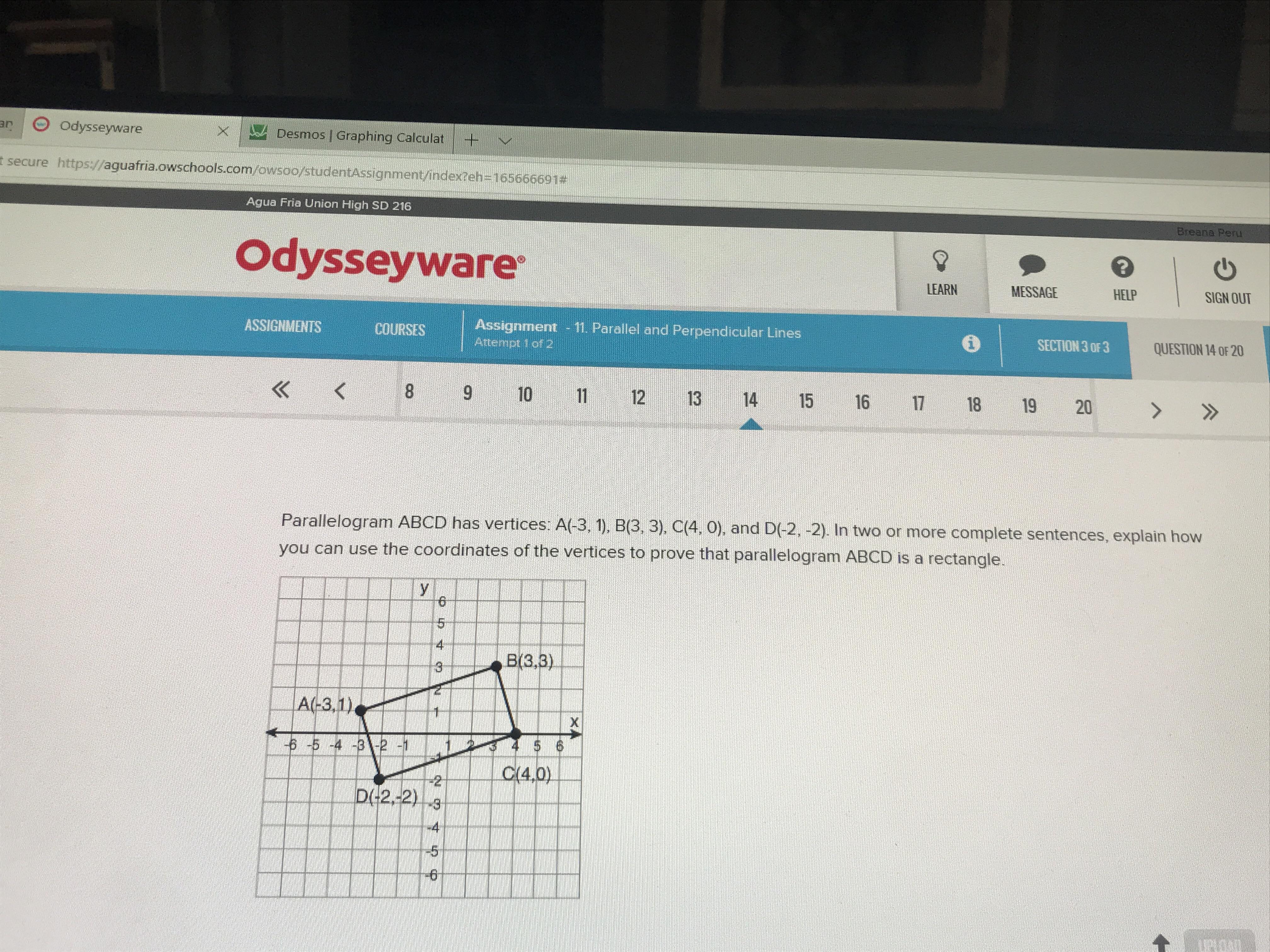
We have the points a(-3,1), b(3,3), c(4,0), and d(-2,-2). First, let's identify the relationships among the lines that create the sides of rectangle ABCD.
Lines AD and BC are parallel.
Lines AB and DC also run parallel.
Lines AB and AD are perpendicular.
Lines BC and DC are perpendicular as well.
Lines AD and BC share a slope of -3, indicating they are parallel.
Lines AB and DC have a slope of 1/3, confirming their parallel nature.
Lines CD and BC are perpendicular due to their slopes being negative reciprocals—CD has a slope of 1/3, and BC has a slope of -3.
Similarly, lines DC and AD are also perpendicular, with DC at 1/3 and AD at -3.
With this information, we conclude that the parallel lines DC and AB intersect with the parallel lines BC and AD. The intersection points of these parallel line pairs form the sides of rectangle ABCD, thus proving that the coordinates of the parallelogram indeed create a rectangle.