answer.
Ask question
Login Signup
Ask question
All categories
  • English
  • Mathematics
  • Social Studies
  • Business
  • History
  • Health
  • Geography
  • Biology
  • Physics
  • Chemistry
  • Computers and Technology
  • Arts
  • World Languages
  • Spanish
  • French
  • German
  • Advanced Placement (AP)
  • SAT
  • Medicine
  • Law
  • Engineering
prisoha
13 days ago
6

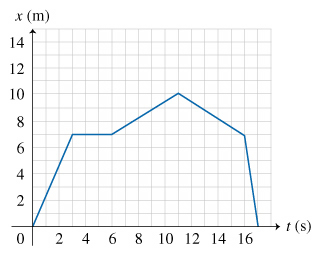
Find the object's speeds v1, v2, and v3 at times t1=2.0s, t2=4.0s, and t3=13s.

Physics
2 answers:
inna [987]13 days ago
7 0
The gradient of a line is a numerical value that indicates both the angle and incline of the line. On a distance versus time graph, this value represents the speed.

At t1=2.0 seconds
v = 7/3 meters per second

At t2=4.0 seconds
v = 0 meters per second

At t3=13 seconds
v = -0.6 meters per second

I hope this clarifies your question. Have a wonderful day.
Softa [913]13 days ago
7 0
As this graph shows distance versus time, the object's speed at any moment corresponds to the slope of the graph's section directly above that instant on the x-axis.

At t1 = 2.0 s
This point lies halfway through the initial portion of the graph from 0 to 3 seconds.
The slope here equals 7 divided by 3. v1 = 7/3 m/s.

At t2 = 4.0 s
This moment is located at the center of the flat segment spanning 3 to 6 seconds.
The slope during this interval is 0. v2 = 0.

At t3 = 13 s
This time falls in the middle of the descending segment from 11 to 16 seconds.
The slope for this segment is -3 divided by 5. v3 = -0.6 m/s.
You might be interested in
The spring in a retractable ballpoint pen is 1.8 cm long, with a 300 N/m spring constant. When the pen is retracted, the spring
Sav [1095]

Answer:

The pen requires 7.2 mJ of energy to extend.

Explanation:

Provided:

Length = 1.8 cm

Spring constant = 300 N/m

Initial compression = 1.0 mm

Additional compression = 6.0 mm

Total compression = 1.0 + 6.0 = 7.0 mm

We need to determine the energy needed

This energy is equivalent to the variation in spring potential energy

E=PE_{2}-PE_{1}

E=\dfrac{1}{2}kx_{2}^2-\dfrac{1}{2}kx_{1}^2

Substitute the values into the formula

E=\dfrac{1}{2}\times300\times(7.0\times10^{-3})^2-\dfrac{1}{2}\times300\times(1.0\times10^{-3})^2

E=0.0072\ J

E=7.2\ mJ

Therefore, a total of 7.2 mJ is needed to extend the pen.

7 0
11 days ago
Read 2 more answers
A careful photographic survey of Jupiter’s moon Io by the spacecraft Voyager 1 showed active volcanoes spewing liquid sulfur to
Sav [1095]

Answer:

529.15 m/s

Explanation:

h = Highest point = 70000 m

g = Gravitational acceleration = 2 m/s²

m = Sulfur's mass

Since both potential and kinetic energies are conserved

mgh=\dfrac{1}{2}mv^2\\\Rightarrow h=\dfrac{v^2}{2g}\\\Rightarrow v=\sqrt{2gh}\\\Rightarrow v=\sqrt{2\times 2\times 70000}\\\Rightarrow v=529.15\ m/s

The velocity at which the liquid sulfur exited the volcano is 529.15 m/s

7 0
3 days ago
The amount of electric energy consumed by a 60.0-watt lightbulb for 1.00 minute could lift a
Sav [1095]

Answer:

Explanation:

For a 60W light bulb used for 1 minute:

P = 60 W

t = 1 minute = 60 seconds

This energy is capable of lifting an object weighing 10N.

W = 10N

This indicates conversion of electrical energy into potential energy.

Let's calculate the electrical energy:

Power describes the rate of work done.

Power = Work / time

Thus, work = power × time

Work = 60 × 60

Work = 3600 J

Potential energy calculation:

P.E = mgh

Where the weight is given by:

W = mg

Therefore, P.E = W·h

P.E = 10·h

Thus, we equate:

Potential energy = Electrical energy

P.E = Work

10·h = 3600

Dividing both sides by 10 gives:

h = 3600 / 10

h = 360m

The object can be lifted to a height of 360m.

6 0
6 days ago
A group of students collected the data shown below while attempting to measure the coefficient of static friction (of course, it
Ostrovityanka [942]

Answer:

0.130

Explanation:

The coefficients of static friction recorded for each trial are listed as follows:

1. 0.053

2. 0.081

3. 0.118

4. 0.149

5. 0.180

6. 0.198

Adding these coefficients together results in: 0.053 + 0.081 + 0.118 + 0.149 + 0.180 + 0.198

                                              = 0.779

Consequently;

the mean coefficient of static friction = \frac{sum of coefficient of static friction}{number of trials}

                                              = \frac{0.779}{6}

                                              = 0.12983

The mean coefficient of static friction is 0.130

8 0
6 days ago
A transformer is to be designed to increase the 30 kV-rms output of a generator to the transmission-line voltage of 345 kV-rms.
inna [987]

Answer:

n_s = 920 \turns

Explanation:

Given,

Voltage of the primary coil (V_p) = 30 kV-rms

Voltage of the secondary coils (V_s) = 345 kV-rms

number of turns in the primary coil (n_p) = 80 turns

number of turns in the secondary coil (n_s) =?

the ratio of turns between primary and secondary coils

     \dfrac{n_p}{n_s} = \dfrac{V_p}{V_s}

     \dfrac{n_s}{n_p} = \dfrac{V_s}{V_p}

     n_s = n_p \dfrac{V_s}{V_p}

     n_s = 80\times \dfrac{345}{30}

     n_s = 80\times 11.5

     n_s = 920 \turns

The number of turns in the secondary coil is equal to n_s = 920 \turns

4 0
1 day ago
Other questions:
  • In an amusement park rocket ride, cars are suspended from 3.40-m cables attached to rotating arms at a distance of 5.90 m from t
    10·1 answer
  • Find an expression for the acceleration a of the red block after it is released. use mr for the mass of the red block, mg for th
    6·2 answers
  • In this problem you are to consider an adiabaticexpansion of an ideal diatomic gas, which means that the gas expands with no add
    6·1 answer
  • A kettle heats 1.75 kg of water. The specific latent heat of vaporisation of water is 3.34 x 10⁶ J/kg. How much energy would be
    7·1 answer
  • If low CVP precipitates a suction alarm, rapid infusion of volume can remedy the situation after dropping the P-level.
    15·1 answer
  • You are an employee of the city of Chicago. A city official declares that all cables holding traffic lights in the city should b
    8·1 answer
  • A very long uniform line of charge has charge per unit length λ1 = 4.80 μC/m and lies along the x-axis. A second long uniform li
    14·1 answer
  • A 6.0-kg object moving 5.0 m/s collides with and sticks to a 2.0-kg object. after the collision the composite object is moving 2
    13·1 answer
  • Compressed air is used to fire a 60 g ball vertically upward from a 0.70-m-tall tube. The air exerts an upward force of 3.0 N on
    8·1 answer
  • Six pendulums of mass m and length L as shown are released from rest at the same angle (theta) from vertical. Rank the pendulums
    5·2 answers
Add answer
Login
Not registered? Fast signup
Signup
Login Signup
Ask question!