answer.
Ask question
Login Signup
Ask question
All categories
  • English
  • Mathematics
  • Social Studies
  • Business
  • History
  • Health
  • Geography
  • Biology
  • Physics
  • Chemistry
  • Computers and Technology
  • Arts
  • World Languages
  • Spanish
  • French
  • German
  • Advanced Placement (AP)
  • SAT
  • Medicine
  • Law
  • Engineering
miss Akunina
12 days ago
8

An 8.0 m, 240 N uniform ladder rests against a smooth wall. The coefficient of static friction between the ladder and the ground

is 0.55, and the ladder makes a 50.0° angle with the ground. How far up the ladder can an 710 N person climb before the ladder begins to slip?

Physics
1 answer:
Ostrovityanka [3K]12 days ago
7 0

Answer:

5.7 m

Explanation:

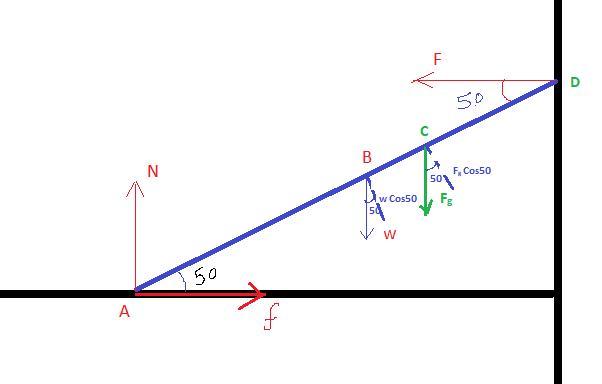
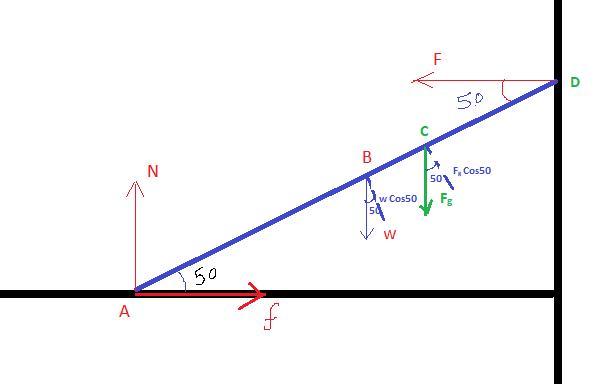
AD = length of the ladder = L = 8 m

AB = the position of the ladder's center of mass = (0.5) L = (0.5) 8 = 4 m

AC = distance of the climber from the bottom of the ladder = x

W = weight of the ladder = 240 N

F_{g} = weight of the climber = 710 N

F = force exerted by the wall on the ladder

N = normal force acting on the ladder from the ground =?

By applying force equilibrium in the vertical direction

N = F_{g} + W

N = 710 + 240

N = 950 N

μ = Coefficient of static friction = 0.55

f = static friction force on the ladder

Static friction force can be expressed as

f = μ N

f = (0.55) (950)

f = 522.5 N

The equation for force along the horizontal axis reads

F = f

F = 522.5 N

using torque equilibrium around point A

F Sin50 (AD) = W Cos50 (AB) + (F_{g} Cos50 (AC))

(522.5) Sin50 (8) = (240) Cos50 (4) + (710) Cos50 (x)

x = 5.7 m
You might be interested in
A small block of mass 200 g starts at rest at A, slides to B where its speed is vB=8.0m/s,vB=8.0m/s, then slides along the horiz
serg [3462]

Answer

Data provided:

mass of the block = 200 g = 0.2 Kg

Velocity at A = 0 m/s

Velocity at B = 8 m/s

distance of slide = 10 m

height of the block = 4 m

calculation for the block's potential energy

    P = m g h

    P = 0.2 x 9.8 x 4

    P = 7.84 J

kinetic energy calculated as

    KE = \dfrac{1}{2}mv^2

    KE = \dfrac{1}{2}\times 0.2 \times 7.84^2

    KE =6.14 J

Work done = P - KE

work = 7.84 - 6.14

work = 1.7 J

b) using the formula v² = u² + 2 a s

   0 = 8² - 2 x a x 10

   a = 3.2 m/s²

ma - μ mg = 0

 \mu = \dfrac{a}{g}

 \mu = \dfrac{3.2}{9.8}

 \mu = 0.327

7 0
1 month ago
A small sphere of radius R is arranged to pulsate so that its radius varies in simple harmonic motion between a minimum of R−x a
Softa [2918]
The sound wave intensity at the sphere's surface is described as follows: B = Bulk modulus. The oscillation amplitude of the sphere can be represented as: Substitute velocity and amplitude into Pmax. The intensity of the sound wave at a distance is determined by:
5 0
7 days ago
What is the maximum mass that can hang without sinking from a 20-cm diameter Styrofoam sphere in water? Assume the volume of the
Maru [3242]
The greatest mass that can hang without submerging is 2.93 kg. The provided details are as follows: sphere diameter = 20 cm, hence the radius r = 10 cm = 0.10 m. The density of the Styrofoam sphere is 300 kg/m³. The sphere's volume calculates to 4.18 * 10⁻³ m³. Mass M = Density * Volume results in (300)(4.18 * 10⁻³ m³) = 1.25 kg. The displaced water mass is computed as volume * water density, yielding 4.18 * 10⁻³ m³ * 1000 = 4.18 kg. The additional mass the sphere can hold is the difference between the two mass calculations: 4.18 kg - 1.25 kg = 2.93 kg.
3 0
26 days ago
g Suppose Howard is pulling a bucket of bricks up along the side of a building with a rope. The bricks have a mass of 20 kg and
ValentinkaMS [3332]
The tension calculated is 236 N. The formula for tension is T = mg + ma. With the following values: m = 20 kg, g = 9.8 m/s², and a = 2.0 m/s², we find T = m(g + a) = 20(9.8 + 2.0) = 20(11.8) = 236 N.
4 0
1 day ago
After soccer practice coach Miller goes to the roof of the school to retrieve the event soccer balls the height of the school is
Yuliya22 [3215]

Answer:

50.2 cm

Explanation:

We have the following data:

Height, h=3.5 m

Initial horizontal velocity, u_x=15 m/s

Time, t=0.32 s

We need to determine how far the ball is from the ground after 0.32 s.

Initial vertical velocity, u_y=0

s=u_yt+\frac{1}{2}gt^2

Where g=9.8 m/s^

s=0+\frac{1}{2}(9.8)(0.32)^2

s=0.502 m

s=0.502\times 100=50.2 cm

4 0
1 month ago
Other questions:
  • You and your friend Peter are putting new shingles on a roof pitched at 20degrees . You're sitting on the very top of the roof w
    5·1 answer
  • To avoid an accident, a driver steps on the brakes to stop a 1000-kg car traveling at 65km/h. if the braking distance is 35 m, h
    7·1 answer
  • There are two different size spherical paintballs and the smaller one has a diameter of 5 cm and the larger one is 9 cm in diame
    13·1 answer
  • If the coefficient of static friction between a table and a uniform massive rope is μs, what fraction of the rope can hang over
    6·2 answers
  • Two basketball teams are resting during halftime. While they are resting, a truck driver asks them for help pushing his broken d
    15·1 answer
  • The human heart is a powerful and extremely reliable pump. Each day it takes in and discharges about 7500 L of blood. Assume tha
    6·1 answer
  • a 62.0 kg curler runs into a stationary 78.1 kg curler and they hold on to each other. Together they move away at 1.29 m/s, west
    9·1 answer
  • A fisherman has caught a very large, 5.0kg fish from a dock that is 2.0m above the water. He is using lightweightfishing line th
    12·1 answer
  • A 2.0-kg ball with an initial velocity of (4i + 3j) m/s collides with a wall and rebounds with a velocity of (–4i + 3j) m/s. Wha
    14·1 answer
  • Exactly one pound of bread dough is placed in a baking tin. The dough is cooked in an oven at 350°F, releasing a wonderful aroma
    15·1 answer
Add answer
Login
Not registered? Fast signup
Signup
Login Signup
Ask question!