answer.
Ask question
Login Signup
Ask question
All categories
  • English
  • Mathematics
  • Social Studies
  • Business
  • History
  • Health
  • Geography
  • Biology
  • Physics
  • Chemistry
  • Computers and Technology
  • Arts
  • World Languages
  • Spanish
  • French
  • German
  • Advanced Placement (AP)
  • SAT
  • Medicine
  • Law
  • Engineering
Serga
17 hours ago
13

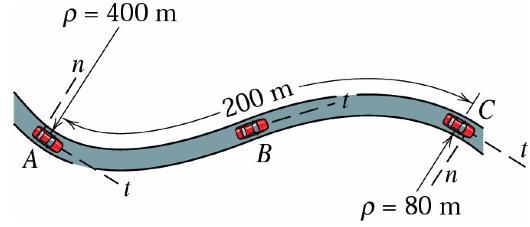
A 1500 kg car enters a section of curved road in the horizontal plane and slows down at a uniform rate from a speed of 100 km/h

at A to a speed of 50 km/h as it passes C.
The radius of curvature p of the road at A is 400 m and at C is 80 m.

Determine the total horizontal force exerted by the road on the tires at positions A, B, and C.

Point B is the inflection point where the curvature changes direction, s is the length of the road ABC in meters

Physics
1 answer:
Yuliya22 [2.4K]17 hours ago
6 0

Answer:

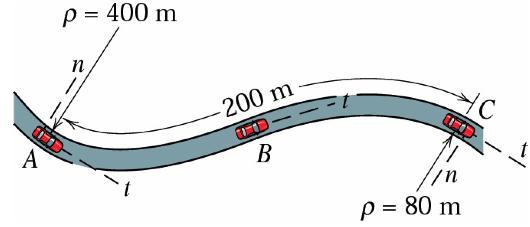
The question is incomplete; refer to the attachment for the diagram

Explanation:

Provided that,

The mass of the car

M = 1500kg

Entering the curve at Point A with a speed of

Va = 100km/hr = 100× 1000/3600

Va = 27.78m/s

The car slows down at a constant rate until it reaches point C at a speed of

Vc = 50km/hr = 50×1000/3600

Vc = 13.89m/s

Radius of curvature at point A

p = 400m

Radius of curvature at point B

p = 80m

The distance from point A to point B as indicated in the attachment is

S=200m

We need to determine the total horizontal forces at points A, B, and C applied by the road on the tire

The constant tangential acceleration can be computed using the equation of motion

Vc² = Va² + 2as

13.89² = 27.78² + 2 × a × 200

192.9 = 771.6 + 400a

400a = 192.9—771.6

400a = -578.7

a = -578.7 / 400

a = —1.45 m/s²

at = —1.45m/s²

The tangential acceleration is -1.45m/s² and it is negative due to the car decelerating

Since the vehicle is decreasing speed at a uniform rate, the tangential acceleration remains the same at every point

At point A

at = -1.45m/s²

At point B

at = -1.45m/s²

At point C

at = -1.45m/s²

Now,

We can compute the normal component of acceleration (centripetal acceleration) at each point since we know the radius of curvature

The centripetal acceleration can be calculated using

ac = v²/ p

At point A ( p = 400)

an = Va²/p = 27.78² / 400

an = 1.93 m/s²

At point B (p = ∞), since point B is the inflection point

Then,

an = Vb²/p =  Vb/∞ = 0

an = 0

At point C ( p = 80m)

an = Vc²/p = 13.89² / 80 = 2.41m/s²

an = 2.41 m/s²

Then,

The tangential force is

Ft = M•at

Ft = 1500 × 1.45

Ft = 2175 N.

Given that the tangential acceleration remains constant, this represents the tangential force at A, B, and C

Next, the normal force

At point A ( an = 1.93m/s²)

Fn = M•an

Fn = 1500 × 1.93

Fn = 2895 N

At point B (an=0)

Fn = M•an

Fn = 0 N

At point C (an= 2.41m/s²)

Fn = M•an

Fn = 1500 × 2.41

Fn = 3615 N.

Thus, the horizontal force acting at each point is

Using the right triangle vector method

F = √(Fn² + Ft²)

At point A

Fa = √(2895² + 2175²)

Fa = √13,111,650

Fa = 3621 N

At point B

Fb = √(0² + 2175²)

Fb = √2175²

Fb = 2175 N

At point C

Fc = √(3615² + 2175²)

Fc = √17,798,850

Fc = 4218.88 N

Fc ≈ 4219N
You might be interested in
A 10-turn conducting loop with a radius of 3.0 cm spins at 60 revolutions per second in a magnetic field of 0.50T. The maximum e
kicyunya [2264]

Answer:

Maximum emf = 5.32 V

Explanation:

Provided data includes:

Number of turns, N = 10

Radius of loop, r = 3 cm = 0.03 m

It made 60 revolutions each second

Magnetic field, B = 0.5 T

We are tasked to determine the maximum emf produced in the loop, which is founded on Faraday's law. The induced emf can be calculated by:

\epsilon=\dfrac{d(NBA\cos\theta)}{dt}\\\\\epsilon=NBA\dfrac{d(\cos\theta)}{dt}\\\\\epsilon=NBA\omega \sin\omega t\\\\\epsilon=NB\pi r^2\omega \sin\omega t

For the maximum emf, \sin\omega t=1

Therefore,

\epsilon=NB\pi r^2\omega \\\\\epsilon=NB\pi r^2\times 2\pi f\\\\\epsilon=10\times 0.5\times \pi (0.03)^2\times 2\pi \times 60\\\\\epsilon=5.32\ V

Hence, the maximum emf generated in the loop is 5.32 V.

3 0
28 days ago
Suppose an electrical wire is replaced with one having every linear dimension doubled (i.e., the length and radius have twice th
Softa [2029]

Response:

The new resistance is half of the original resistance.

Explanation:

Resistance in a wire is represented by:

R=\dfrac{\rho L}{A}

\rho = resistivity of the material

L and A are the physical dimensions

If a wire is exchanged for one where all linear dimensions are doubled, i.e. l' = 2l and r' = 2r

The updated resistance of the wire can be calculated as follows:

R'=\dfrac{\rho L'}{A'}

R'=\dfrac{\rho (2L)}{\pi (2r)^2}

R'=\dfrac{1}{2}\dfrac{\rho L}{A}

R'=\dfrac{1}{2}R

The new resistance equals half of the original resistance. Thus, this provides the solution needed.

4 0
10 days ago
What happens to the particles of a liquid when energy is removed from them?
Softa [2029]

Response:

D: The distance among the particles diminishes

Clarification:

Removing energy reduces the activity of molecules, similar to how one slows down in cold temperatures (I believe).

3 0
1 month ago
Which statements describe the relationship between the area and the biodiversity of an ecosystem? Check all that apply. Large ec
Yuliya22 [2420]
A larger section of a forest is likely to support more diverse species compared to a smaller section of the same forest. Additionally, a half acre of rainforest is expected to exhibit more biodiversity than a full acre of desert. Biodiversity refers to the variety found within an ecosystem, which encompasses differences among living organisms based on their species and habitats. Generally, ecosystems with larger areas tend to have greater biodiversity; hence, a substantial forest area would likely harbor more biodiversity than a smaller area within it. Similarly, the previous example illustrates that a half acre of rainforest would likely have a higher level of biodiversity compared to one acre of a desert.
3 0
1 month ago
Read 2 more answers
A 1000-kg car is moving along a straight road down a 30∘30∘ slope at a constant speed of 20.0m/s20.0m/s. What is the net force a
Softa [2029]

The overall force acting on the vehicle is zero

Explanation:

Let's evaluate the situation separately for the vertical direction and the horizontal direction along the slope.

Considering the direction perpendicular to the slope, two forces are in effect:

  • The weight component acting perpendicular to the slope, mgcos \theta, directed into the slope
  • The normal force N, directed outward from the slope

Equilibrium exists here, indicating the net force in this direction is zero.

Now let’s examine the parallel direction to the slope. We have two forces present:

  • The weight component aligned with the slope, mgsin \theta, directed down the slope
  • The frictional force F_f, acting up the slope

The car moves at a constant speed in this direction, indicating that its acceleration is zero.

a=0

Thus, according to Newton's second law,

F=ma

implying the net force is zero:

F=0

Learn more about slopes and friction:

5 0
21 day ago
Other questions:
  • In an amusement park rocket ride, cars are suspended from 3.40-m cables attached to rotating arms at a distance of 5.90 m from t
    10·1 answer
  • To avoid an accident, a driver steps on the brakes to stop a 1000-kg car traveling at 65km/h. if the braking distance is 35 m, h
    7·1 answer
  • A 7.0-kilogram cart, A, and a 3.0-kilogram cart, B, are initially held together at rest on a horizontal, frictionless surface. W
    7·1 answer
  • On a foggy day, you are driving at 70 mph and Granny is driving at 50 mph. As you try to pass her, you both see an overturned tr
    14·1 answer
  • In a game of egg-toss, you and a partner are throwing an egg back and forth trying not to break it. Given your knowledge of mome
    8·1 answer
  • A car is moving with a speed of 32.0 m/s. the driver sees an accident ahead and slams on the brakes, causing the car to slow dow
    5·1 answer
  • Use Wien’s Law to calculate the peak wavelength of Betelgeuse, based on the temperature found in Question #8. Note: 1 nanometer
    14·1 answer
  • A good quarterback can throw a football at 27 m/s (about 60 mph). If we assume that the ball is caught at the same height from w
    8·1 answer
  • While an emf source supplies energy to a circuit, that energy is dissipated when the current passes through resistance. In deali
    12·1 answer
  • What types of atoms compose each type of compound – only metals
    14·1 answer
Add answer
Login
Not registered? Fast signup
Signup
Login Signup
Ask question!