answer.
Ask question
Login Signup
Ask question
All categories
  • English
  • Mathematics
  • Social Studies
  • Business
  • History
  • Health
  • Geography
  • Biology
  • Physics
  • Chemistry
  • Computers and Technology
  • Arts
  • World Languages
  • Spanish
  • French
  • German
  • Advanced Placement (AP)
  • SAT
  • Medicine
  • Law
  • Engineering
Kobotan
17 days ago
15

A pole-vaulter is nearly motionless as he clears the bar, set 4.2 m above the ground. he then falls onto a thick pad. the top of

the pad is 80 cm above the ground, and it compresses by 50 cm as he comes to rest. what is the magnitude of his accelerations he comes to rest on the pad

Physics
2 answers:
Yuliya22 [1.1K]17 days ago
8 0
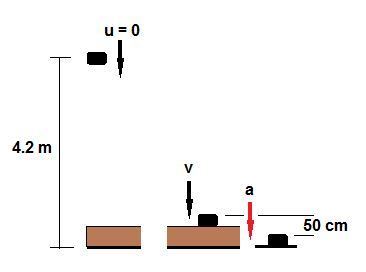
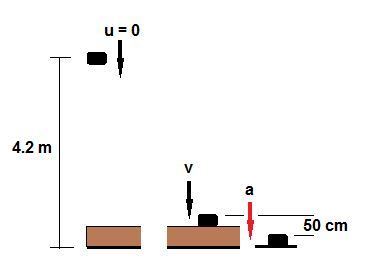
Refer to the diagram below.

Ignoring air resistance, use gravitational acceleration g = 9.8 m/s².

The pole vaulter drops with an initial vertical speed u = 0.
At impact with the pad, velocity v satisfies:
v² = 2 × (9.8 m/s²) × (4.2 m) = 82.32 (m/s)²
v = 9.037 m/s

As the pad compresses by 0.5 m to bring the vaulter to rest,
let the average acceleration (deceleration) be a m/s². Then:
0 = (9.037 m/s)² + 2 × a × 0.5 m
Solving for a gives:
a = - 82.32 / (2 × 0.5) = -82 m/s²

Thus, the deceleration magnitude is 82 m/s².
Yuliya22 [1.1K]17 days ago
8 0

The magnitude of the pole-vaulter's acceleration on the pad is 66.64 m/s².

Explanation

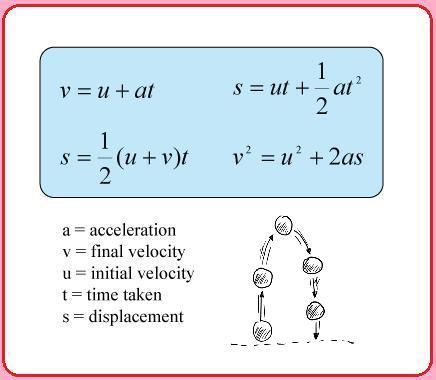
Acceleration represents how quickly velocity changes.

\large {\boxed {a = \frac{v - u}{t} } }

\large {\boxed {d = \frac{v + u}{2}~t } }

a = acceleration (m/s²)

v = final speed (m/s)

u = initial speed (m/s)

t = time interval (s)

d = displacement (m)

Let's solve the problem step by step!

Given:

Height above pad: H = 4.2 m - 0.8 m = 3.4 m

Pad compression distance: d = 0.5 m

Find:

Acceleration, a

Solution:

First, calculate velocity just before hitting the pad.

v^2 = u^2 + 2gH

v^2 = 0^2 + 2 \times 9.8 \times 3.4

v^2 = 1666/25

v = \frac{7 \sqrt{34}}{5} ~ m/s

Next, find the magnitude of acceleration decelerating the vaulter within the compressed pad.

v^2 = u^2 + 2gH

0^2 = 1666/25 + 2 \times a \times 0.5

a = -1666/25

\large {\boxed {a = -66.64 ~ m/s^2} }

You might be interested in
A simple harmonic wave of wavelength 18.7 cm and amplitude 2.34 cm is propagating along a string in the negative x-direction at
Ostrovityanka [942]

Answer

Given:

Wavelength = λ = 18.7 cm

                  = 0.187 m

Amplitude, A = 2.34 cm

Velocity, v = 0.38 m/s

A)  Calculate the angular frequency.

     f = \dfrac{v}{\lambda}

     f = \dfrac{0.38}{0.187}

     f =2.03\ Hz

Angular frequency,

ω = 2π f

ω = 2π x 2.03

ω = 12.75 rad/s

B) Calculate the wave number:

      K = \dfrac{2\pi}{\lambda}

     K= \dfrac{2\pi}{0.187}

    K =33.59\ m^{-1}

C)

Since the wave is traveling in the -x direction, the sign is positive between x and t

y (x, t) = A sin(k x - ω t)

y (x, t) = 2.34 sin(33.59 x - 12.75 t)

4 0
9 days ago
How many electrons must be removed from a neutral, isolated conducting sphere to give it a positive charge of 8.0 x 10 8 C? [Q=n
inna [987]

The new charge of the ball will amount to 8x10^8C after removing 5x10^27 electrons.

Explanation:

Initially, if the sphere is electrically neutral, its charge stands at 0C.

When an electron with a charge of (-1.6*10^-19 C) is taken away, we effectively add a positive charge, leading to:

1.6*10^-19 C as the sphere's new charge.

For a total of N electrons removed, the sphere's overall charge now becomes:

N*1.6*10^-19 C.

To calculate N when:

N*1.6*10^-19 C = 8.0x 10^8 C.

We find that N is: (8.0/1.6)x10^(8 + 19) = 5x10^27 electrons.

7 0
11 days ago
Uzupełnij zdania właściwymi sformułowaniami. Wyobraź sobie, że między linę a siodełko karuzeli łańcuchowej wmontowany jest siłom
ValentinkaMS [1149]

Explanation:

Here’s a revised version of the requirements;

Fill in the blanks with the appropriate terms. Picture a force gauge fixed between the rope and the saddle of the chain carousel. If you keep your feet off the ground while the vehicle is not in motion, the dynamometer shows A / B. When the carousel is spinning, you’ll see C / D displayed on the dynamometer.

A. Your weight including the saddle

C. Value of the rope's strength

B. Your weight

D. Value of the centripetal force

3 0
15 days ago
Which statements about inertia and centripetal force are correct? Check all that apply. Inertia is always present. Inertia cause
kicyunya [1025]
Inertia is universally present. It's important to note that inertia doesn't serve as the force keeping objects in circular paths; that role belongs to centripetal force, which is not always present. Centripetal force actively pulls objects towards the center of a circle. Both inertia and centripetal force contribute to the phenomenon of circular motion. Thank you, and enjoy your day;)
6 0
5 days ago
Read 2 more answers
A hiker walks 200m west and then walks 100m north. What is the magnitude and direction of her resulting displacement?
Maru [1056]

A hiker proceeds 200 m west and subsequently another 100 m north, resulting in a displacement of 223 m. The direction can be determined using the trigonometric function where sin(angle) = opposite/hypotenuse, yielding an angle of 26.6 degrees. Therefore, the total displacement is 223 m at an angle of 26.6 degrees north of west.

7 0
4 days ago
Read 2 more answers
Other questions:
  • An aluminum wire of length 1.0 meter has a resistance of 9.0x10^-3 ohm. If the wire were cut into two equal lengths, each length
    11·2 answers
  • Part A
    10·1 answer
  • Suppose a 0.04-kg car traveling at 2.00 m/s can barely break an egg. What is the min
    7·1 answer
  • A mouse runs along a baseboard in your house. The mouse's position as a function of time is given by x(t)=pt2+qt, with p = 0.36
    9·1 answer
  • Assume that you stay on the earth's surface. what is the ratio of the sun's gravitational force on you to the earth's gravitatio
    15·2 answers
  • How many electrons does it take to make 80 μc (microcoulombs) of charge?
    10·1 answer
  • You are an employee of the city of Chicago. A city official declares that all cables holding traffic lights in the city should b
    8·1 answer
  • 4. Susan observed that different kinds and amounts of fossils were present in a cliff behind her house. She wondered why changes
    5·2 answers
  • f a car is speeding down a road at 40 miles/hour (mph), how long is the stopping distance D40 compared to the stopping distance
    6·1 answer
  • The acceleration of the car with two washers added to the string would be what?
    14·2 answers
Add answer
Login
Not registered? Fast signup
Signup
Login Signup
Ask question!