answer.
Ask question
Login Signup
Ask question
All categories
  • English
  • Mathematics
  • Social Studies
  • Business
  • History
  • Health
  • Geography
  • Biology
  • Physics
  • Chemistry
  • Computers and Technology
  • Arts
  • World Languages
  • Spanish
  • French
  • German
  • Advanced Placement (AP)
  • SAT
  • Medicine
  • Law
  • Engineering
RideAnS
12 days ago
12

A basketball center holds a basketball straight out, 2.0 m above the floor, and releases it. It bounces off the floor and rises

to a height of 1.5 m. a) What is the ball's velocity just before it hits the floor? b) What is the ball's velocity just after it leaves the floor? c) If the ball is in contact with the floor for 0.02 seconds, what are the magnitude and direction of the ball's average acceleration while in contact with the floor?
Physics
1 answer:
Softa [2.9K]12 days ago
4 0

Answer:

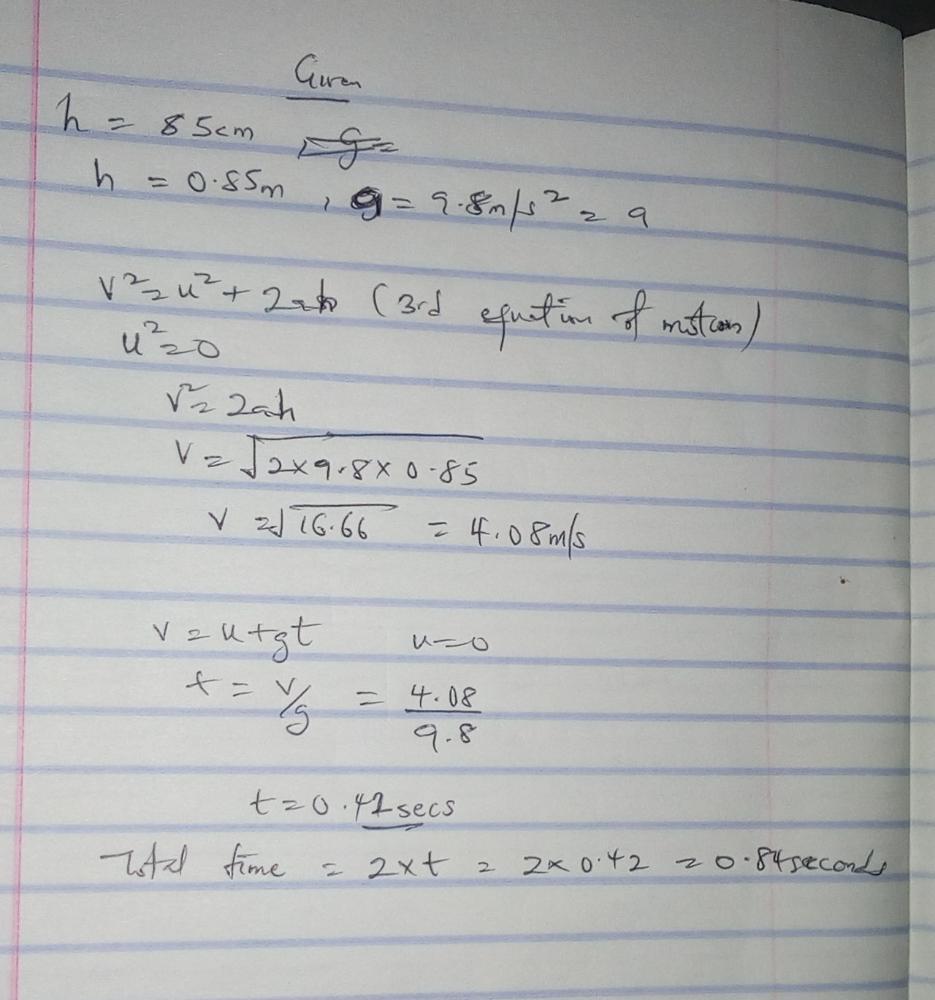
a) The ball's velocity just prior to hitting the ground measures -6.3 m/s

b) The ball's velocity right after bouncing off the ground registers at 3.1 m/s

c) The average acceleration's magnitude is 470 m/s², and its direction is upward, forming a 90º angle with the ground.

Explanation:

To begin, let’s assess the time it takes for the ball to reach the floor:

The equation outlining the ball's position is:

y = y0 + v0 * t + 1/2 g * t²

Where:

y = position at given time t

y0 = initial position

v0 = initial velocity

t = time

g = acceleration triggered by gravity

We establish the ground as the reference origin.

a) Since the ball is released rather than thrown, the initial velocity v0 is 0. The direction of acceleration is downward, directed towards the origin; thus, “g” is treated as negative. When the ball contacts the ground, its position will be 0. Therefore:

0 = 2.0 m + 0 m/s *t - 1/2 * 9.8 m/s² * t²

-2.0 m = -4.9 m/s² * t²

t² = -2.0 m / - 4.9 m/s²

t = 0.64 s

The motion equation for a falling body is:

v = v0 + g * t      where "v" denotes the velocity

Since v0= 0:

v = g * t = -9.8 m/s² * 0.64 s = -6.3 m/s

b) The pebble's speed reaches 0 during its maximum height. To find the time taken for the pebble to achieve that height, we can use the velocity equation and then substitute that time in the position equation to derive the initial velocity:

v = v0 + g * t

0 = v0 + g * t

-v0/g = t

Replacing t in the position equation, knowing the maximum height is 1.5 m:

y = y0 + v0 * t + 1/2* g * t² y = 1.5 m y0 = 0 m t = -v0/g

1.5 m = v0 * (-v0/g) + 1/2 * g (-v0/g)²

1.5 m = - v0²/g - 1/2 * v0²/g

1.5 m = -3/2 v0²/g

1.5 m * (-2/3) * g = v0²

1.5 m * (-2/3) * (-9.8 m/s²) = v0²

v0 = 3.1 m/s

c) The average acceleration can be determined by:

a = final velocity - initial velocity / time

a = 3.1 m/s - (-6.3 m/s) / 0.02 s = 470 m/s²

The direction of the acceleration is upward, perpendicular to the ground.

The vector average acceleration will be:

a = (0, 470 m/s²) or (470 m/s² * cos 90º, 470 m/s² * sin 90º)

You might be interested in
A baseball thrown at an angle of 60.0° above the horizontal strikes a building 16.0 m away at a point 8.00 m above the point fro
Ostrovityanka [3053]

Answer:

a) v_{o} =16m/s

b) v=9.8m/s

c) \beta =-35.46º

Explanation:

According to the problem, the distance from the building where the ball hits is 16m, and its final elevation exceeds the initial height by 8m.

With this information, we can compute the ball’s starting speed.

a) Let's first assess the horizontal trajectory.

x=v_{ox}t

x=v_{o}cos(60)t

v_{o}=\frac{x}{tcos(60)}=\frac{16m}{tcos(60)} (1)

This gives us our initial equation.

Next, we need to examine the vertical trajectory.

y=y_{o}+v_{oy}t+\frac{1}{2}gt^2

y_{o}+8=y_{o}+v_{o}sin(60)t-\frac{1}{2}(9.8)t^2

Utilizing v_{o} in our first equation (1)

8=\frac{16}{tcos(60)}sin(60)t-\frac{1}{2}(9.8)t^2

\frac{1}{2}(9.8)t^2=16tan(60)-8

Now let’s solve for t.

t=\sqrt{\frac{2(16tan(60)-8)}{9.8} } =2s

The ball takes two seconds to reach the adjacent building, allowing us to compute its initial speed.

v_{o}=\frac{16m}{(2s)cos(60)}=16m/s

b) To determine the velocity magnitude just before impact, we must calculate both x and y components.

v_{x}=v_{ox}+at=16cos(60)=8m/s

v_{y}=v_{oy}+gt=16sin(60)-(9.8)(2)=-5.7m/s

The computed velocity magnitude is:

v=\sqrt{v_{x}^{2}+v_{y}^{2}}=\sqrt{(8m/s)^2+(-5.7m/s)^2}=9.8m/s

c) The ball's angle is:

\beta=tan^{-1}(\frac{v_{y} }{v_{x}})=tan^{-1}(\frac{-5.7}{8})=-35.46º

4 0
1 month ago
Three pendulums with strings of the same length and bobs of the same mass are pulled out to angles θ1, θ2, and θ3, respectively,
Sav [3041]

Answer:

All three pendulums will have the same angular frequencies.

Explanation:

For a simple pendulum, the time period using the approximation sin(\theta )\approx \thetais expressed as:

T=2\pi\sqrt{\frac{l}{g}}

The angular frequency \omega is defined as

\omega =\frac{2\pi }{T}\\\\\omega =\frac{2\pi}{2\pi \sqrt{\frac{l}{g}}}\\\\\therefore \omega =\sqrt{\frac{g}{l}}

Since the angular frequency remains unaffected by the initial angle (valid strictly for small angle approximations), we deduce that the angular frequencies of the three pendulums are identical.

6 0
19 days ago
A rotating beacon is located 2 miles out in the water. Let A be the point on the shore that is closest to the beacon. As the bea
serg [3462]

Answer:

v = 3369.2 m/s

Explanation:

The beacon is rotating at an angular speed of

f = 10 rev/min

so we have

\omega = 2\pi f

\omega = 2\pi(\frac{10}{60})

\omega = 1.047 rad/s

We know that

v = r \omega

At this point we have

r = 2 miles = 2(1609 m)

r = 3218 m

So we can conclude with

v = 3218(1.047)

v = 3369.2 m/s

6 0
1 month ago
When listening to tuning forks of frequency 256 Hz and 260 Hz, one hears the following number of beats per second. (A) 0 (B) 2 (
inna [2982]
The answer is (C) 4 beats per second. The number of beats is computed as the difference between the frequencies of the two tuning forks. Plugging in the frequency values yields a result. Thus, the number of observable beats per second will be 4.
3 0
21 day ago
Suppose a new asteroid was recently discovered which takes 557 months to orbit the Sun once (that's equal to 16,700 days or 46.4
Keith_Richards [3141]

Answer:

The average distance of the new asteroid from the Sun is estimated to be (2.02 × 10⁶) km.

Explanation:

The orbital speed of planets varies based on their distance from the Sun, which also affects their orbital period.

With its 557 months, equivalent to 46.4 years for an orbit around the Sun, the new asteroid's speed is situated between the orbital speeds of Saturn and Uranus.

Uranus orbits the Sun in 84 years at 24.61 km/hour,

while Saturn completes its orbit in 29.4 years at 34.82 km/hour.

To interpolate the speed for our asteroid at 46.4 years,

we denote its speed as x.

84 years ----> 24.61 km/h

46.4 years ----> x km/h

29.4 years -----> 34.82 km/h

Setting up the proportion:

(84 - 46.4)/(46.4 - 29.4) = (24.61 - x)/(x - 34.82)

Solving for x gives the asteroid's speed as 31.64 km/hr.

To find the average speed, use the formula:

Average speed = (total distance)/(time taken).

The total distance covered equals the circumference of the orbit around the Sun = 2πR,

where R = distance from the asteroid to the Sun.

Time taken = 16700 days = 16700 × 24 hours = 400800 hours.

Thus, we find that 31.64 = (2πR)/400800.

From this, we get 2πR = 31.64 × 400800 = 12681312 km.

And, R = 12681312/(2π) = 2018293.5 km = (2.02 × 10⁶) km.

8 0
1 month ago
Other questions:
  • While looking at bromine (Br) on the periodic table, a student needs to find another element with very similar chemical properti
    13·2 answers
  • A carmaker has designed a car that can reach a maximum acceleration of 12 meters/second2. The car’s mass is 1,515 kilograms. Ass
    8·1 answer
  • A student must design an experiment to determine the relationship between the mass of an object and the resulting acceleration w
    8·1 answer
  • What wavelength of light contains enough energy in a single photon to ionize a hydrogen atom?
    5·2 answers
  • What is meant in astronomy by the phrase "adaptive optics?
    11·1 answer
  • A biker travels at an average speed of 18 km/hr along a 0.30 km straight segment of a bike path. How much time (in hours) does t
    12·1 answer
  • A negatively charged object is located in a region of space where the electric field is uniform and points due north. the object
    7·1 answer
  • A plane has an average air speed (this is the speed the plane moves through air) of 750 mph. The plane flies a route of 5000 mil
    14·1 answer
  • Why is the more cumbersome Two's complement representation preferred instead of the more intuitive sign bit magnitude approach?
    14·1 answer
  • A piece of a metal alloy with a mass of 114 g was placed into a graduated cylinder that contained 25.0 mL of water, raising the
    13·1 answer
Add answer
Login
Not registered? Fast signup
Signup
Login Signup
Ask question!