
answer.
Ask question
Login Signup
Ask question
All categories
  • English
  • Mathematics
  • Social Studies
  • Business
  • History
  • Health
  • Geography
  • Biology
  • Physics
  • Chemistry
  • Computers and Technology
  • Arts
  • World Languages
  • Spanish
  • French
  • German
  • Advanced Placement (AP)
  • SAT
  • Medicine
  • Law
  • Engineering
ArbitrLikvidat
11 days ago
10

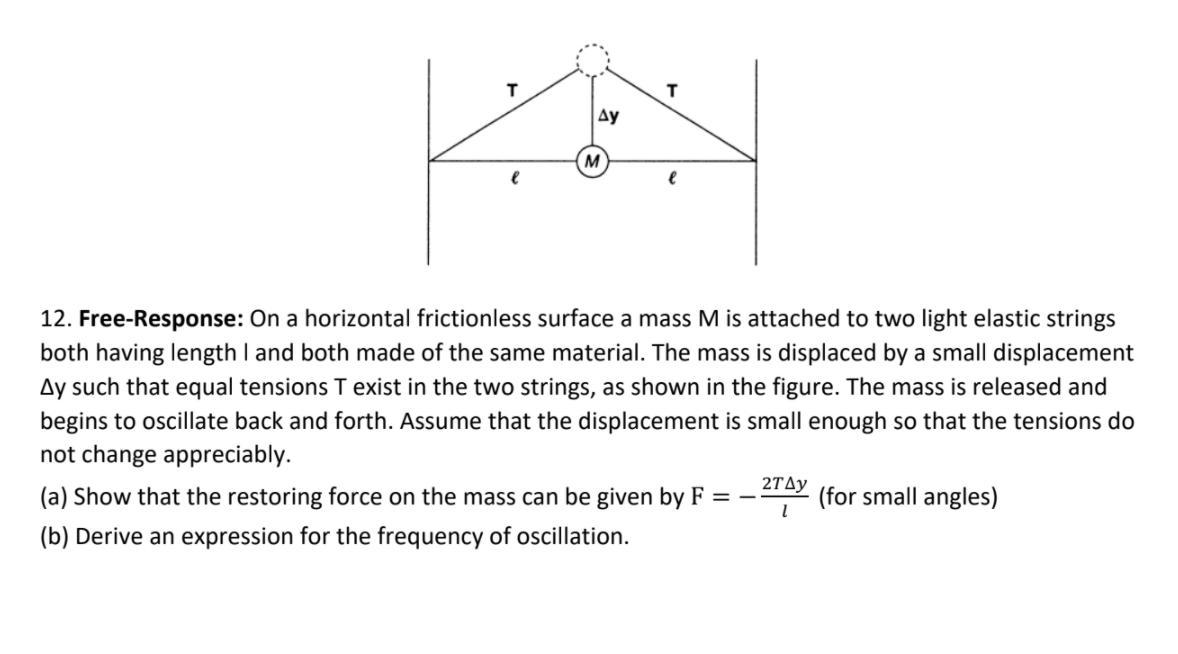
On a horizontal frictionless surface a mass M is attached to two light elastic strings both having length l and both made of the

same material. The mass is displaced by a small displacement Δy such that equal tensions T exist in the two strings, as shown in the figure. The mass is released and begins to oscillate back and forth. Assume that the displacement is small enough so that the tensions do not change appreciably. (a) Show that the restoring force on the mass can be given by F = -(2T∆y)/l (for small angles) (b) Derive an expression for the frequency of oscillation.

Physics
1 answer:
Yuliya22 [3.2K]11 days ago
6 0

Answer:

ω = √(2T / (mL))

Explanation:

(a) Create a free body diagram for the mass. There are two tension forces at play, one acting downwards and to the left, while the other acts downwards and to the right.

The horizontal components of the tensions cancel each other, resulting in a net force directed vertically:

∑F = -2T sin θ, with θ representing the angle from the horizontal.

For small angles, we can assume sin θ ≈ tan θ.

Thus, we have: ∑F = -2T tan θ

and ∑F = -2T (Δy / L)

(b) In the case of a spring, the restoring force is defined as F = -kx, and the frequency is given by ω = √(k/m). (This is derived from solving a second order differential equation.) In this instance, k = 2T/L, thus the frequency can be expressed as:

ω = √((2T/L) / m)

ω = √(2T / (mL))

You might be interested in
An infinite sheet of charge, oriented perpendicular to the x-axis, passes through x = 0. It has a surface charge density σ1 = -2
Maru [3267]

1) For x = 6.6 cm, E_x=3.47\cdot 10^6 N/C

2) For x = 6.6 cm, E_y=0

3) For x = 1.45 cm, E_x=-3.76\cdot 10^6N/C

4) For x = 1.45 cm, E_y=0

5) Surface charge density at b = 4 cm: +62.75 \mu C/m^2

6) At x = 3.34 cm, the x-component of the electric field equals zero

7) Surface charge density at a = 2.9 cm: +65.25 \mu C/m^2

8) None of these regions

Explanation:

1)

The electric field from an infinite charge sheet is perpendicular to it:

E=\frac{\sigma}{2\epsilon_0}

where

\sigma is the surface charge density

\epsilon_0=8.85\cdot 10^{-12}F/m represents vacuum permittivity

Outside the slab, the electric field behaves like that of an infinite sheet.

Consequently, the electric field at x = 6.6 cm (situated to the right of both the slab and sheet) results from the combination of the fields from both:

E=E_1+E_2=\frac{\sigma_1}{2\epsilon_0}+\frac{\sigma_2}{2\epsilon_0}

where

\sigma_1=-2.5\mu C/m^2 = -2.5\cdot 10^{-6}C/m^2\\\sigma_2=64 \muC/m^2 = 64\cdot 10^{-6}C/m^2

The field from the sheet points left (negative, inward), and the slab’s field points right (positive, outward).

Thus,

E=\frac{1}{2\epsilon_0}(\sigma_1+\sigma_2)=\frac{1}{2(8.85\cdot 10^{-12})}(-2.5\cdot 10^{-6}+64\cdot 10^{-6})=3.47\cdot 10^6 N/C

and the negative sign indicates a rightward direction.

2)

Both the sheet’s and slab’s fields are perpendicular to their surfaces, directing along the x-axis, hence there's no y-component for the total field.

<pThus, the y-component totals zero.

This happens because both the sheet and slab stretch infinitely along the y-axis. Choosing any x-axis point reveals that the y-component of the field, generated by a surface element dS of either the sheet or slab, dE_y, will be equal and opposite to the corresponding component from the opposite side, -dE_y. Thus, the combined y-direction field is always zero.

3)

This scenario resembles part 1), but the point here is

x = 1.45 cm

which lies between the sheet and the slab. The fields from both contribute leftward as the slab has a negative charge (resulting in an outward field). Thus, the total field computes to

E=E_1-E_2

Replacing with expressions from part 1), we get

E=\frac{1}{2\epsilon_0}(\sigma_1-\sigma_2)=\frac{1}{2(8.85\cdot 10^{-12})}(-2.5\cdot 10^{-6}-64\cdot 10^{-6})=-3.76\cdot 10^6N/C

where the negative illustrates a leftward direction.

4)

This portion parallels part 2). Since both fields remain perpendicular to the slab and sheet, no component exists along the y-axis, thus the electric field's y-component is zero.

5)

Notably, the slab behaves as a conductor, signifying charge mobility within it.

The net charge on the slab is positive, indicating a surplus of positive charge. With the negatively charged sheet on the left of the slab, positive charges shift towards the left slab edge (at a = 2.9 cm), while negative charges move to the right edge (at b = 4 cm).

The surface charge density per unit area of the slab is

\sigma=+64\mu C/m^2

This average denotes the surface charge density on both slab sides at points a and b:

\sigma=\frac{\sigma_a+\sigma_b}{2} (1)

Additionally, the infinite sheet at x = 0 negatively charged \sigma_1=-2.5\mu C/m^2, induces an opposite net charge on the slab's left surface, thus

\sigma_a-\sigma_b = +2.5 \mu C/m^2 (2)

Having equations (1) and (2) allows for solving the surface charge densities at a and b, yielding:

\sigma_a = +65.25 \mu C/m^2\\\sigma_b = +62.75 \mu C/m^2

6)

We aim to compute the x-component of the electric field at

x = 3.34 cm

This point lies inside the slab, bounded at

a = 2.9 cm

b = 4.0 cm

In a conducting slab, the electric field remains at zero owing to charge equilibrium; thus, the x-component thereof in the slab is zero

7)

From part 5), we determined the surface charge density at x = a = 2.9 cm is \sigma_a = +65.25 \mu C/m^2

8)

As mentioned in part 6), conductors have zero electric fields internally. Since the slab is conductive, the electric field inside remains zero; therefore, the regions where the electric field is null are

2.9 cm < x < 4 cm

Thus, the suitable answer is

"none of these regions"

Learn more about electric fields:

8 0
1 month ago
Large and small numbers are often best entered in exponential notation. For example, the mass of the earth is 5.98x1024 kg and t
Maru [3267]
We are required to find the charge-to-mass ratio.
4 0
3 days ago
Read 2 more answers
Ben walks 500 meters from his house to the corner store. He then walks back toward his house, but continues 200 meters past his
Keith_Richards [3146]
Velocity = 71 meters per minute (MPM)
S stands for Speed
D means Distance
T represents Time
To calculate Speed, divide Distance by Time.
6 0
1 month ago
Read 2 more answers
Write a hypothesis about the effect of increasing voltage on the current in the circuit. Use the "if . . . then . . . because .
Yuliya22 [3234]

Hypothesis: An increase in voltage should result in a corresponding rise in current because according to Ohm's Law,

I \propto V

I=\frac{V}{R}

Ohm's Law indicates that current is proportional to voltage when resistance remains constant. Hence, if resistance stays the same, elevating the voltage will lead to an increase in current. Conversely, if voltage remains unchanged and resistance increases, current will decrease.

3 0
1 month ago
Read 2 more answers
Feng and Isaac are riding on a merry-ground. Feng rides on a horse at the outer rim of the circular platform, twice as far from
Ostrovityanka [3082]
The question lacks complete details or specifications. Here is the missing information: 1. impossible to establish 2. half of Isaac's 3. identical to Isaac's 4. double Isaac's The angular velocity of Feng will match that of Isaac. Thus, the correct choice is option 3.
4 0
16 days ago
Other questions:
  • A particle's position as a function of time t is given by r⃗ =(5.0t+6.0t2)mi^+(7.0−3.0t3)mj^.
    5·2 answers
  • Rita has two small containers, one holding a liquid and one holding a gas. Rita transfers the substances to two larger container
    10·2 answers
  • A shell is launched with a velocity of 100 m/s at an angle of 30.0° above horizontal from a point on a cliff 50.0 m above a leve
    13·1 answer
  • A 4.0-mF capacitor initially charged to 50 V and a 6.0-mF capacitor charged to 30 V are connected to each other with the positiv
    12·2 answers
  • In the demolition of an old building, a 1,300 kg wrecking ball hits the building at 1.07 m/s2. Calculate the amount of force at
    15·2 answers
  • During a hockey game on a pond, the defenseman passes a 114-g hockey puck over the ice to the center, who fails to catch it. the
    15·1 answer
  • Four particles with masses 2 kg, 5 kg, 2 kg, and 2 kg are connected by rigid rods of negligible mass as shown. assume the system
    11·1 answer
  • If the current in a wire increases from 5 A to 10 A, what happens to its magnetic field? If the distance of a charged particle f
    14·2 answers
  • A satellite that weighs 4900 N on the launchpad travels around the earth's equator in a circular orbit with a period of 1.667 h.
    14·1 answer
  • The relatively high resistivity of dry skin, about 1×10⁶Ω⋅m, can safely limit the flow of current into deeper tissues of the bod
    6·1 answer
Add answer
Login
Not registered? Fast signup
Signup
Login Signup
Ask question!