answer.
Ask question
Login Signup
Ask question
All categories
  • English
  • Mathematics
  • Social Studies
  • Business
  • History
  • Health
  • Geography
  • Biology
  • Physics
  • Chemistry
  • Computers and Technology
  • Arts
  • World Languages
  • Spanish
  • French
  • German
  • Advanced Placement (AP)
  • SAT
  • Medicine
  • Law
  • Engineering
Gala2k
1 month ago
12

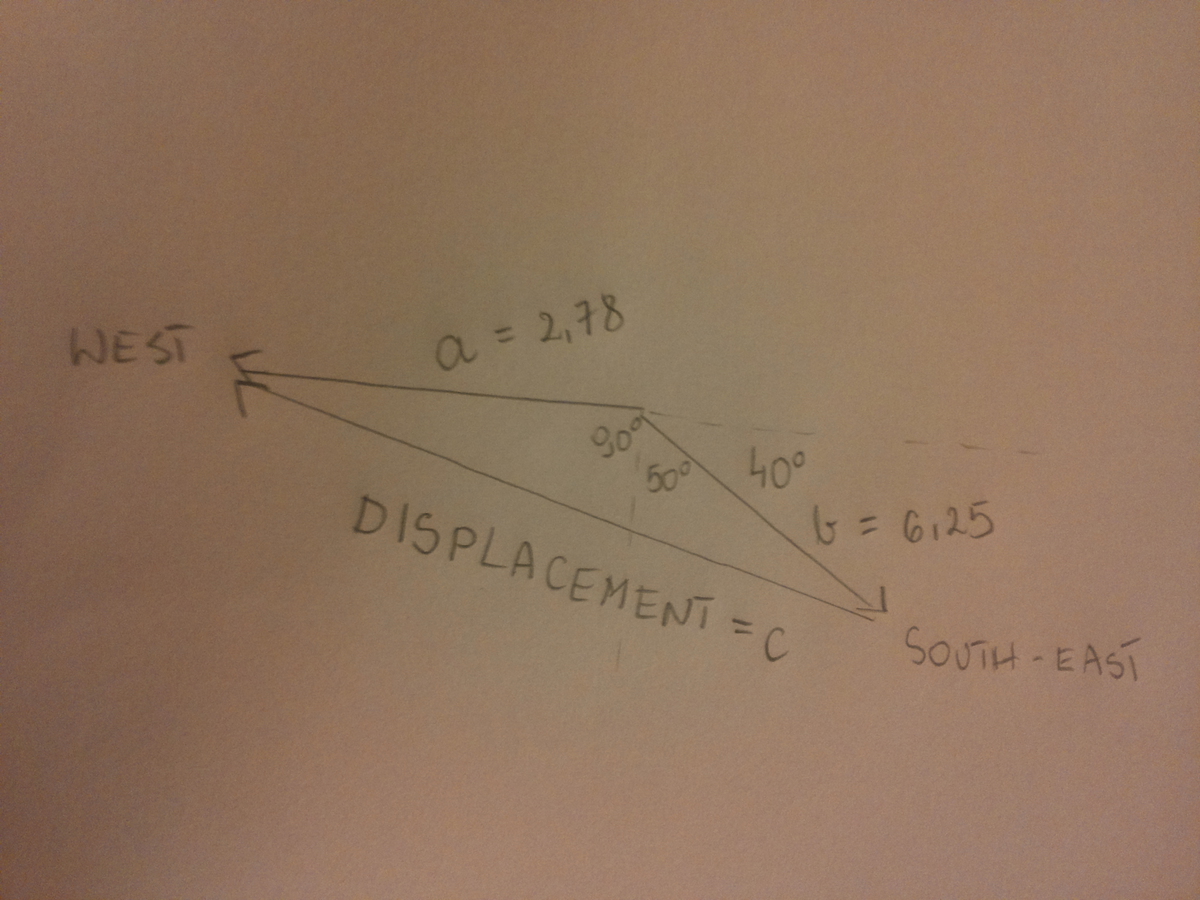
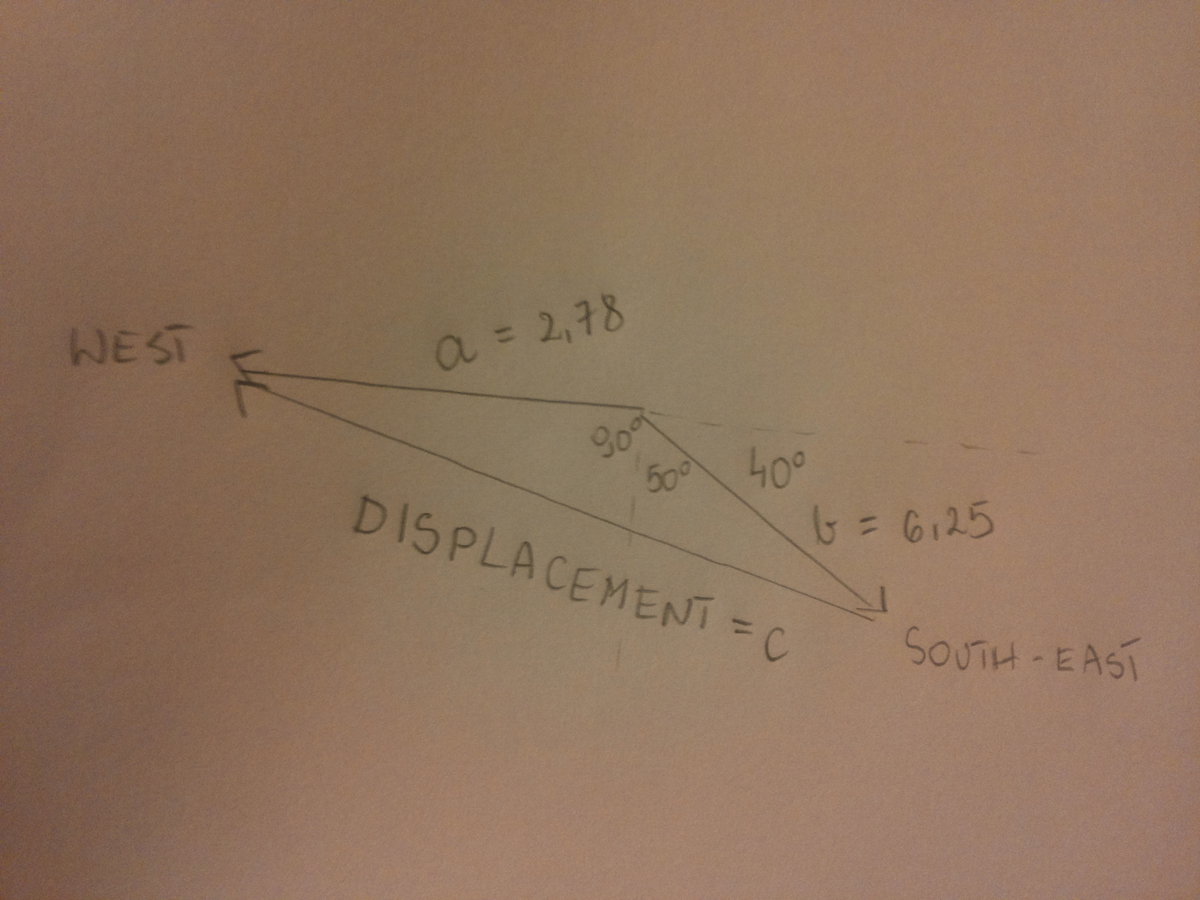
An ant travels 2.78 cm (West) and then turns and travels 6.25 cm (South 40 degrees East). What is the ant's total displacement?

Physics
1 answer:
Ostrovityanka [3.2K]1 month ago
5 0
From\ cosine\ theorem:\\\\
c^2=a^2+b^2-2abcos(\angle between\ a\ and\ b)\\\\
a=2,78\\b=6,25\\
\angle between\ a\ and\ b=90+50=140^{\circ}\\\\
c^2=2,78^2+6,25^2-2*2,78*6,25cos(140^{\circ})\\\\
c^2=7,7284+39,0625-34,75*(-0,77)\\\\c^2=46,7909+26,7575\\\\c^2=735484\\\\c=8,58cm\\\\Total\ displacement\ is\ equal\ to\ 8,58cm.

You might be interested in
If the potential difference across the bulb in a certain flashlight is 3.0 V, What is the potential difference across the combin
Yuliya22 [3333]

Answer:

The voltage across the bulb measures 3.0 V,

Explanation:

The bulb's voltage aligns with the voltage of the batteries, as they are the only power source for the bulb. Therefore, the voltage across the batteries is 3.0 V.

3 0
2 months ago
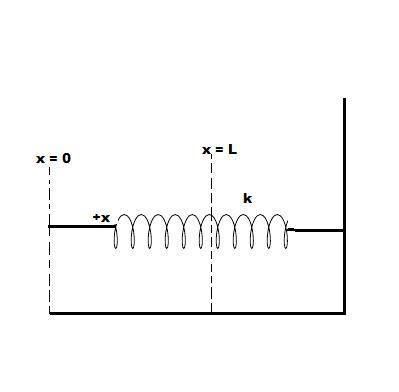
The spring is now compressed so that the unconstrained end moves from x=0 to x=L. Using the work integral W=∫xfxiF⃗ (x⃗ )⋅dx⃗ ,
Sav [3153]

solution:

the spring force applied by a spring with spring constant k can be expressed as

F(x)=-kx

where k acts as the spring constant

and x indicates the spring's deformation

to determine the work completed by the spring

W=\int\limits^L_0 {} \, dW

the amount of work done by the spring when moving from x=0 to x=L

W=-kx^2/2

substituting the limits x=0 and x=L

we derive the work done in terms of k and L

ANSWER

W=-kL^2/2

4 0
1 month ago
At a given point on a horizontal streamline in flowing air, the static pressure is â2.0 psi (i.e., a vacuum) and the velocity is
Softa [3030]
Bernoulli's equation at a point on the streamline is
p/ρ + v²/(2g) = constant
where
p = pressure
v = velocity
ρ = air density, 0.075 lb/ft³ (under standard conditions)
g = 32 ft/s²

Point 1:
p₁ = 2.0 lb/in² = 2*144 = 288 lb/ft²
v₁ = 150 ft/s

Point 2 (stagnation):
The velocity at the stagnation point is zero.

The density stays constant.
Let p₂ denote the pressure at the stagnation location.
Then,
p₂ = ρ(p₁/ρ + v₁²/(2g))
p₂ = (288 lb/ft²) + [(0.075 lb/ft³)*(150 ft/s)²]/[2*(32 ft/s²)
     = 314.37 lb/ft²
     = 314.37/144 = 2.18 lb/in²

Thus, the answer is 2.2 psi

5 0
2 months ago
Jack pulls a sled across a level field by exerting a force of 110 n at an angle of 30 with the ground. what are the parallel and
Softa [3030]
<span>A force of 110 N is applied at an angle of 30</span>°<span> to the horizontal. Because the force does not align directly either vertically or horizontally with the sled, it can be broken down into two components based on sine and cosine.

For the component parallel to the ground:
x = rcos</span>β
<span>x = 110cos30</span>°
<span>x = 95.26

For the component perpendicular to the ground:
y = rsin</span>β
<span>y = 110sin30</span>°
<span>y = 55</span>
3 0
2 months ago
Read 2 more answers
Other questions:
  • Charge q is accelerated starting from rest up to speed v through the potential difference V. What speed will charge q have after
    11·1 answer
  • It takes 56.5 kilojoules of energy to raise the temperature of 150 milliliters of water from 5°C to 95°C. If you
    6·1 answer
  • A graph of the net force F exerted on an object as a function of x position is shown for the object of mass M as it travels a ho
    8·1 answer
  • A pulley in the shape of a solid cylinder of mass 1.50 kg and radius 0.240 m is free to rotate around a horizontal shaft along t
    10·1 answer
  • The sound source of a ship’s sonar system operates at a frequency of 22.0 kHz . The speed of sound in water (assumed to be at a
    9·1 answer
  • A 70kg man spreads his legs as shown calculate the tripping force​
    6·1 answer
  • You catch a volleyball (mass 0.270 kg) that is moving downward at 7.50 m/s. In stopping the ball, your hands and the volleyball
    10·1 answer
  • Suppose you are talking by interplanetary telephone to your friend, who lives on the Moon. He tells you that he has just won a n
    11·1 answer
  • A solar-powered car has a kinetic energy of 110250 J. Its mass is 180 kg. Work out how fast the car is travelling.
    9·2 answers
  • A car engine burns gas at 495 K, and exhausts to the air at 293 K. If it ran at the highest possible efficiency, how much input
    7·1 answer
Add answer
Login
Not registered? Fast signup
Signup
Login Signup
Ask question!