answer.
Ask question
Login Signup
Ask question
All categories
  • English
  • Mathematics
  • Social Studies
  • Business
  • History
  • Health
  • Geography
  • Biology
  • Physics
  • Chemistry
  • Computers and Technology
  • Arts
  • World Languages
  • Spanish
  • French
  • German
  • Advanced Placement (AP)
  • SAT
  • Medicine
  • Law
  • Engineering
kvv77
1 month ago
6

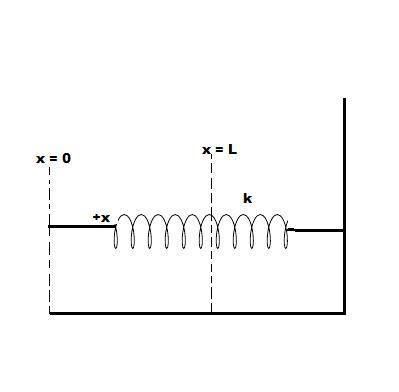
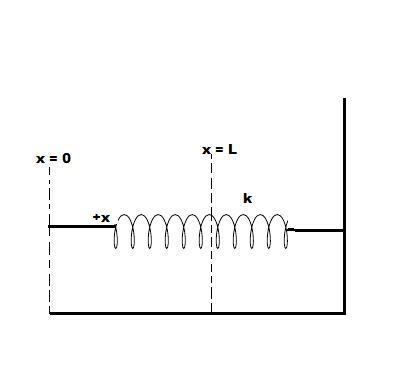
The spring is now compressed so that the unconstrained end moves from x=0 to x=L. Using the work integral W=∫xfxiF⃗ (x⃗ )⋅dx⃗ ,

find the work done by the spring as it is compressed. Express the work done by the spring in terms of k and L?

Physics
1 answer:
Sav [3.1K]1 month ago
4 0

solution:

the spring force applied by a spring with spring constant k can be expressed as

F(x)=-kx

where k acts as the spring constant

and x indicates the spring's deformation

to determine the work completed by the spring

W=\int\limits^L_0 {} \, dW

the amount of work done by the spring when moving from x=0 to x=L

W=-kx^2/2

substituting the limits x=0 and x=L

we derive the work done in terms of k and L

ANSWER

W=-kL^2/2

You might be interested in
Ariel dropped a golf ball from her second story window. The ball starts from rest and hits the sidewalk 3.5 s later with a veloc
inna [3103]
Utilizing the acceleration formula,
4 0
2 months ago
The image shows the displacement of a motorboat. The data table shows the magnitudes of the components of each displacement vect
serg [3582]
Rx= 3.5 km

Ry= 2.9 km
4 0
2 months ago
Read 2 more answers
a stomp rocket takes 1.5 seconds to reach its maximum height what was the initial velocity and what was the maximum height ?
inna [3103]
1) Vf = Vo - gt; Setting Vf = 0 gives Vo = gt, resulting in Vo = 9.8 m/s^2 * 1.5 s = 14.7 m/s. 2) The displacement is calculated as d = Vo*t - gt^2 / 2 = 14.7 m/s * 1.5 - 9.8 m/s^2 * (1.5 s)^2 / 2 = 11.02 m.
5 0
1 month ago
Read 2 more answers
Sonia was experimenting with electric charges. She tied two inflated balloons together, held them next to each other, and rubbed
Keith_Richards [3271]
When Sonia rubs the balloon with a wool cloth, electrons from the balloon move to the wool because of the friction. This process causes the balloon to become positively charged. Since both balloons are treated similarly, they acquire positive charges. It’s a known principle of physics that like charges repel one another, so the two balloons will push away from each other after being rubbed with the wool.
6 0
1 month ago
Read 2 more answers
A bicycle rider has a speed of 19.0 m/s at a height of 55.0 m above sea level when he begins coasting down hill. The mass of the
ValentinkaMS [3465]
The total mechanical energy of the rider at any height amounts to 6.34 × 10⁴ J. The rider's mechanical energy is computed as the total of gravitational potential energy and kinetic energy. Assuming no forces are lost (like friction), this mechanical energy remains constant at different heights, as potential energy lost translates into kinetic energy gained, in accordance with the conservation of energy principle. Calculating both potential and kinetic energy at 55.0 m and 19 m/s allows us to derive the consistent mechanical energy: Mechanical energy = PE + KE Where: PE = potential energy, KE = kinetic energy. The potential energy calculation goes as follows: PE = m · g · h, Where: m is the mass, g is the gravitational acceleration, h represents the height. The calculation of the rider's potential energy yields: PE = 88.0 kg · 9.81 m/s² · 55.0 m = 4.75 × 10⁴ J. The kinetic energy is derived from: KE = 1/2 · m · v², Here "m" refers to the mass and "v" stands for velocity. Thus, KE = 1/2 · 88.0 kg · (19.0 m/s)² = 1.59 × 10⁴ J. Consequently, the rider's mechanical energy calculates as: Mechanical energy = PE + KE = 4.75 × 10⁴ J + 1.59 × 10⁴ J = 6.34 × 10⁴ J. This mechanical energy remains unchanged since when the rider descends, potential energy is converted into kinetic energy, keeping the total sum of these energies constant.
5 0
2 months ago
Other questions:
  • A 248-g piece of copper is dropped into 390 mL of water at 22.6 °C. The final temperature of the water was measured as 39.9 °C.
    10·1 answer
  • A 2600-m-high mountain is located on the equator. how much faster does a climber on top of the mountain move than a surfer at a
    14·1 answer
  • A hiker walks 200m west and then walks 100m north. What is the magnitude and direction of her resulting displacement?
    7·2 answers
  • If you are anchored in a fixed spot, and a set of six waves pass underneath you during a 60 second time interval, what is the wa
    11·1 answer
  • True or False: Molecules in a gas resist crowding and get as far apart as possible. Free electrons also resist crowding and get
    6·1 answer
  • A 120-kg refrigerator that is 2.0 m tall and 85 cm wide has its center of mass at its geometrical center. You are attempting to
    14·1 answer
  • What mass needs to be attached to a spring with a force constant of 7N/m in order to make a simple harmonic oscillator oscillate
    9·1 answer
  • To a cyclist riding due west with a speed of 4 m/s a wind appears to
    9·1 answer
  • An object has kinetic energy of 324 J. If it’s speed is 9m/s, what is it’s mass?
    7·2 answers
  • A 1 mg ball carrying a charge of 2 x 10⁻⁸ C hangs from a
    5·1 answer
Add answer
Login
Not registered? Fast signup
Signup
Login Signup
Ask question!