answer.
Ask question
Login Signup
Ask question
All categories
  • English
  • Mathematics
  • Social Studies
  • Business
  • History
  • Health
  • Geography
  • Biology
  • Physics
  • Chemistry
  • Computers and Technology
  • Arts
  • World Languages
  • Spanish
  • French
  • German
  • Advanced Placement (AP)
  • SAT
  • Medicine
  • Law
  • Engineering
Mama L
1 month ago
12

A 1.00 l sample of a gas at 25.0◦c and 1.00 atm contains 50.0 % helium and 50.0 % neon by mass. what is the partial pressure of

the neon. express your answer in atmospheres.
Physics
2 answers:
kicyunya [3.2K]1 month ago
8 0
The neon's partial pressure amounts to 0.16 atm. Explanation: A 1.00 L gas sample at 25.0°C and 1.00 atm has 50.0 % helium and 50.0 % neon by mass. The partial pressure represents what the pressure of a single gas would be if it occupied the whole volume alone at the same temperature. Given the 50.0 % helium and 50.0 % neon by mass, we utilize the ideal gas equation to determine the moles and mass of the gases involved. The molar volume is defined as the volume occupied by one mole of a gas under specified temperature and pressure.
inna [3.1K]1 month ago
5 0
V = Volume of gas sample = 1.00 L = 0.001 m³T = temperature of gas = 25.0 °C = 25 + 273 = 298 K P = pressure = 1.00 atm = 101325 Pa n = number of moles of gas using ideal gas law:PV = n RT101325 (0.001) = n (8.314) (298)n = 0.041 n₁ = moles of heliumn₂ = moles of neonm₁ = mass of helium = n₁ (4) = 4 n₁m₂ = mass of neon = n₂ (20.2) = 20.2 n₂given that:m₁ = m₂4 n₁ = 20.2 n₂n₁ = 5.05 n₂also n₁ + n₂ = n5.05 n₂ + n₂ = 0.041n₂ = 0.0068mole fraction of neon is mole fraction = n₂ /n = 0.0068/0.041 = 0.166P₂ = partial pressure of neon =(mole fraction) P P₂ = (0.166) (1)P₂ = 0.166 atm
You might be interested in
Consider an electron with charge −e and mass m orbiting in a circle around a hydrogen nucleus (a single proton) with charge +e.
kicyunya [3294]

Result:

v=\sqrt{k\frac{e^2}{m_e r}}, 2.18\cdot 10^6 m/s

Explanation:

The electromagnetic attraction between the electron and the proton in the nucleus is equivalent to the centripetal force:

k\frac{(e)(e)}{r^2}=m_e \frac{v^2}{r}

where

k represents the Coulomb constant

e denotes the charge of the electron

e denotes the charge of the proton in the nucleus

r signifies the distance from the electron to the nucleus

v indicates the velocity of the electron

is the mass of the electron

Rearranging for v, we determine

v=\sqrt{k\frac{e^2}{m_e r}}

Inside a hydrogen atom, the distance separating the electron from the nucleus is roughly

r=5.3\cdot 10^{-11}m

while the mass of the electron is

m_e = 9.11\cdot 10^{-31}kg

and the charge is

e=1.6\cdot 10^{-19} C

By plugging in the values into the formula, we achieve

v=\sqrt{(9\cdot 10^9 m/s) \frac{(1.6\cdot 10^{-19} C)^2}{(9.11\cdot 10^{-31} kg)(5.3\cdot 10^{-11} m)}}=2.18\cdot 10^6 m/s

7 0
1 month ago
A resistor with resistance R and an air-gap capacitor of capacitance C are connected in series to a battery (whose strength is "
kicyunya [3294]

Answer:

a) Q = C*emf

b)  Decrease in electric field strength and electric potential

c) Initial current through the resistor = emf/R

d) The final charge = K*C*emf

Explanation:

a) The resistors and capacitors are linked in series with the battery

According to Kirchoff's voltage law, the total voltage in the circuit must equal zero

Let V_{R}represent the Voltage across the Resistor

V_{c}and

represent the Voltage across the capacitor

Implementing KVL;

emf - V_{R} - V_{c} = 0\\

.........................(1)

Since this is a series connection, the same current traverses through the circuit

V_{R} = IR\\Q = CV_{c} \\V_{c} = Q/C

Integrating V_{c}and V_{R}into equation (1)

emf - IR - Q/C = 0

Initially, as the capacitor reaches full charge, the current will drop to zero because of equilibrium

I = 0A\\emf = Q/C\\Q = C* emf

b) When the plastic sheet is inserted between the plates, current begins to flow because both the electric field intensity and electric potential decrease. As a result, charge diminishes, leading to current flow

c) The current through the resistor equates to the total current within the circuit (given the series connection)

I = I_{o} \exp(\frac{-t}{RC} )\\At time the initial time, t\\t = 0\\ I_{o} = \frac{emf}{R} \\

Substituting the values of t and I₀ into the aforementioned formula for I

I = \frac{emf}{R} \exp(0)\\I = \frac{emf}{R}

d) Note: The initial charge on the capacitor equals C * emf

Following the insertion of the plastic, the new charge will be:

Q = K* Q_{initial} \\Q_{initial} = C *emf\\Q_{final} = KCemf

4 0
1 month ago
Two astronauts, A and B, both with mass of 60Kg, are moving along a straight line in the same direction in a weightless spaceshi
Keith_Richards [3271]

The answer is:

V=14m/s

Details are as follows:

According to the problem, we have

The combined mass of A and B is 60kg

A's speed is 2m/s

B's speed is 1m/s

The mass of the bag is 5kg

Typically, the momentum of astronaut A along with the bag is defined by

M_A=(60+5)*2

M_A=130kgm/s

To prevent a collision, astronaut A should maintain a speed that is either equal to or less than astronaut B's speed

Thus, the minimum speed astronaut A should achieve corresponds to that of astronaut B, which is 1

Consequently,

130=(60*1)=(5*v)

V=14m/s

7 0
2 months ago
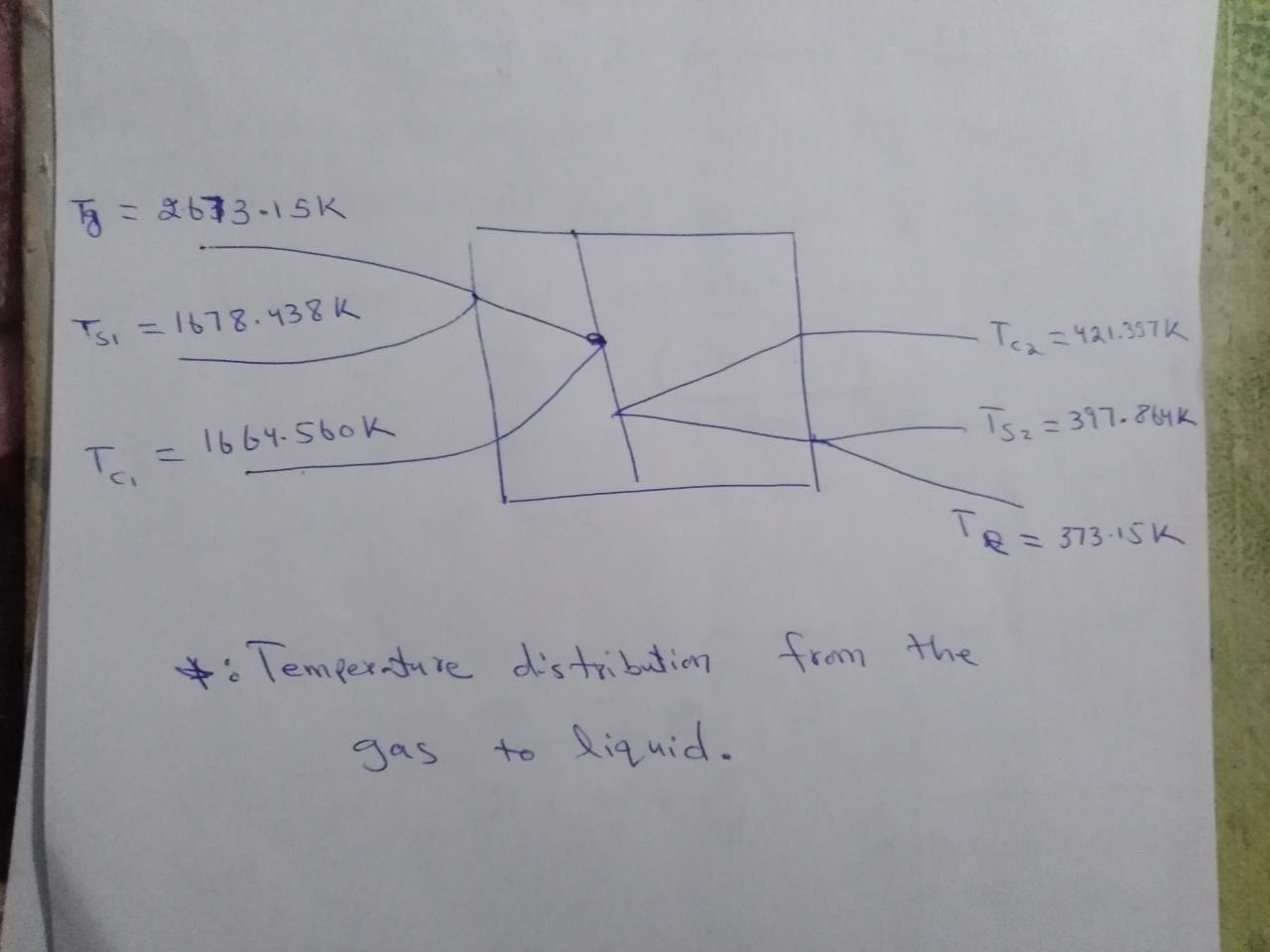
A composite wall separates combustion gases at 2400°C from a liquid coolant at 100°C, with gas and liquid-side convection coeffi
Ostrovityanka [3204]

Response:

\text{heat loss} = 24864.05 \ W/m^2

Clarification:

If

  • T_1, T_2 represent the temperatures of gases and liquids in Kelvins,
  • t_1 and t_2 denote the thicknesses of the gas layer and steel slab in meters,
  • h_1, h_2 are the convection coefficients for gas and liquid in W/m^2 \cdot K,
  • R_c represents the contact resistance in m^2 \cdot K/W,
  • and k_1, k_2 signify thermal conductivities of gas and steel in W/m \cdot K,

then: part(a):

\text{heat loss } = \frac{T_1 - T_2} { \frac{1}{h_1} + \frac{t_1}{t_2} + R_c + \frac{t_2}{k_2} + \frac{1}{h_2}}

by employing known values:

\text {heat loss} = 2486.05 W/m^2

part(b): Utilizing the rate equation:

\text {heat loss} = h_1 (T_1 - T_{s1})

the surface temperature is T_{s1} = 1678.438 \ K

and T_{c1} = T_{s1} - \frac {t_1 (\text{heat loss})}{k_1} = 1664.560 \ K

Correspondingly

T_{c2} = T_{c1} - R_c (\text{heat loss}) = 421.357 \ K

T_{s2} = T_{c2} - \frac {t_2 (\text{heat loss})}{ k_2} = 397.864 \ K

The temperature profile is depicted in the image provided

3 0
2 months ago
A Labrador retriever breeder needs to determine if three male pups who were born to Sadie, his black Labrador retriever, are the
Ostrovityanka [3204]

Answer: Known facts are:

Sadie, the dam, is a black Labrador.

Sam, the potential sire, is a yellow Labrador.

Putting aside technical methods, the breeder can inspect the puppies for traits.

For instance, yellow coat color is recessive to black, so yellow pups would suggest Sam is likely the father; however black pups could also have Sam as sire if they inherited the mother's color alleles.

Examining coat color, conformation, and similar features is a reasonable starting point.

Ultimately these observations are probabilistic; the only definitive (scientific) method is a paternity (DNA) test.

7 0
1 month ago
Other questions:
  • A kettle heats 1.75 kg of water. The specific latent heat of vaporisation of water is 3.34 x 10⁶ J/kg. How much energy would be
    7·1 answer
  • A 15.7-g aluminum block is warmed to 53.2 °c and plunged into an insulated beaker containing 32.5 g of water initially at 24.5 °
    13·2 answers
  • In pulling two identical carry-on bags through the airport, Mr. Myers and his 13 year old grandson, Vincent, do the same amount
    15·1 answer
  • Question #2
    12·1 answer
  • During a workout at the gym, you set the treadmill at a pase of 55.0 m/min. How many minutes will you walk if you cover a distan
    7·2 answers
  • A charge is placed on a spherical conductor of radius r1. This sphere is then connected to a distant sphere of radius r2 (not eq
    14·1 answer
  • Fiber optic (FO) cables are based upon the concept of total internal reflection (TIR), which is achieved when the FO core and cl
    8·1 answer
  • While watching the crane in operation, an observer mentions to you that for a given load there is a maximum angle θmax between 0
    7·1 answer
  • How is earth outer layer different from a cracked hard-boiled egg?
    11·1 answer
  • (10 points) A spring with a 7-kg mass and a damping constant 12 can be held stretched 1 meters beyond its natural length by a fo
    14·1 answer
Add answer
Login
Not registered? Fast signup
Signup
Login Signup
Ask question!