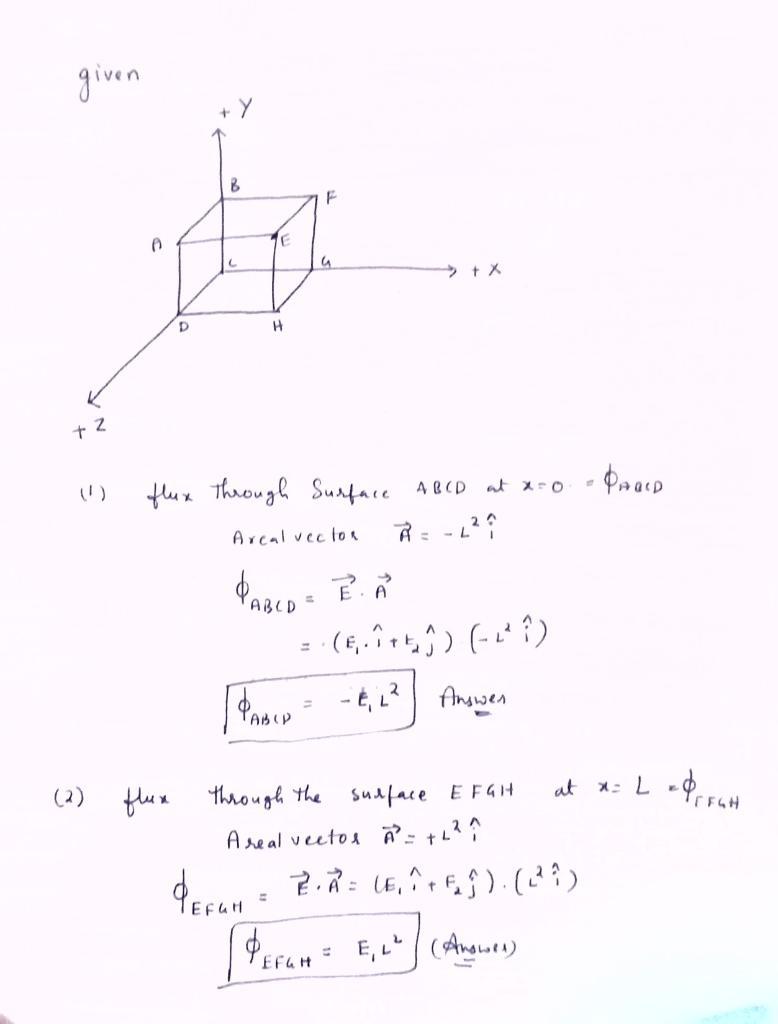
answer.
Ask question
Login Signup
Ask question
All categories
  • English
  • Mathematics
  • Social Studies
  • Business
  • History
  • Health
  • Geography
  • Biology
  • Physics
  • Chemistry
  • Computers and Technology
  • Arts
  • World Languages
  • Spanish
  • French
  • German
  • Advanced Placement (AP)
  • SAT
  • Medicine
  • Law
  • Engineering
daser333
8 days ago
14

An infinite charged wire with charge per unit length lambda lies along the central axis of a cylindrical surface of radius r and

length . What is the flux through the surface due to the electric field of the charged wire?
Physics
1 answer:
inna [3.1K]8 days ago
3 0
The electric flux through the cylindrical surface surrounding the infinite charged wire is given by the formula ∅E = E x 2πrl. To analyze this, we consider an infinitely long straight wire with a uniform linear charge density of λ Cm⁻¹. The electric field at a distance r from this charge can be evaluated using a cylindrical Gaussian surface of radius r and length l, oriented along the wire. Only the curved surface of the cylinder contributes to the total flux since the other surfaces are perpendicular to E.
You might be interested in
What is the kinetic energy of a 100 kg object that is moving with a speed of 12.5m/s
Softa [3030]

The formula for the kinetic energy of any object in motion is

                           (1/2) (mass) (velocity²).

For the object you've mentioned, it translates to

                            (1/2) (100 kg) (12.5 m/s)²

                         =      (50 kg)  (156.25 m²/s²)

                         =              7,812.5 joules  
______________________________

Beware that your attachment is heavily blurred and unreadable.

7 0
14 days ago
A projectile is fired from ground level with a speed of 150 m/s at an angle 30.° above the horizontal on an airless planet where
Yuliya22 [3333]

Answer:

130 m/s (to two significant figures)

Explanation:

In projectile motion, the launching velocity and launch angle help to determine both the horizontal and vertical velocity components.

u represents the initial projectile velocity = 150 m/s

uₓ = u cos θ = 150 cos 30° = 129.9 m/s

uᵧ = u sin θ = 150 sin 30° = 75.0 m/s

A projectile's motion can be viewed as made up of independent vertical and horizontal elements.

The vertical motion is affected by gravitational acceleration (which pulls down on the projectile), altering the vertical velocity component due to this acting force.

Conversely, there is no acting force in the horizontal direction, which means the horizontal component maintains a steady velocity throughout the projectile's flight.

Thus, at t = 4 s, the horizontal component of the projectile's speed remains equal to the initial horizontal velocity component.

At t = 4 s, the horizontal component of velocity is uₓ = u cos θ = 150 cos 30° = 129.9 m/s ≈ 130 m/s

6 0
1 month ago
Read 2 more answers
Lien is pushing a box across a table. She used a force of 100 N to get the box moving. Which force did she overcome to get the b
Yuliya22 [3333]
I will analyze each option. My assumption is that the answer is C.

Option A states that gravity acts downward on the box but does not affect its horizontal acceleration, provided there is no friction.

Option B indicates that the normal force goes upward on the box, which also does not influence horizontal acceleration.

In option C, the reaction force discussed relates to Newton’s 3rd law. This reaction force acts on Lien rather than the box itself, meaning she must overcome this force to set the box in motion. I believe this is the correct choice.

Option D refers to the push force applied by her; she wouldn’t have to counteract her own force regarding the box, but must address the reaction force as I mentioned in option C.
4 0
1 month ago
A soft drink (mostly water) flows in a pipe at a beverage plant with a mass flow rate that would fill 220 cans, 0.355 - l each,
Keith_Richards [3271]
Flow rate calculations yield 220 cans, each with a volume of 0.355 l, leading to 78.1 l/min or 1.3 l/s or 0.0013 m³/s.

At Point 2:
A2 = 8 cm² = 0.0008 m²
V2 = Flow rate/A2 = 0.0013/0.0008 = 1.625 m/s
P1 = 152 kPa = 152000 Pa

At Point 1:
A1 = 2 cm² = 0.0002 m²
V1 = Flow rate/A1 = 0.0013/0.0002 = 6.5 m/s
P1 =?
Height = 1.35 m

Using Bernoulli’s principle;
P2 + 1/2 * V2² / density = P1 + 1/2 * V1² / density + density * gravitational acceleration * height
=> 152000 + 0.5 * (1.625)² * 1000 = P1 + 0.5 * (6.5)² * 1000 + (1000 * 9.81 * 1.35)
=> 153320.31 = P1 + 34368.5
=> P1 = 1533210.31 - 34368.5 = 118951.81 Pa = 118.95 kPa
3 0
1 month ago
Read 2 more answers
Can pockets of vacuum persist in an ideal gas? Assume that a room is filled with air at 20∘C and that somehow a small spherical
kicyunya [3294]

Answer:

The time required is 20 μs

Explanation:

Here is the data provided:

temperature = 20°C  = 293 K

radius = 1 cm

atomic mass of air = 29 u

To determine

the duration for air to refill the vacuum space

solution:

We calculate the root mean square velocity of air particles. This can be expressed as:

\frac{1}{2}mv^2 = \frac{3}{2}RT

where m indicates mass, t is temperature, v is speed, and R is the ideal gas constant, which is approximately 8.3145 (kg·m²/s²)/K·mol.

v = \sqrt{\frac{3RT}{M} }............................1

v = \sqrt{\frac{3(8.314)293}{29*10{-3}kg} }

Resulting in v = 501.99 m/s.

<pNow, to cover the distance of 1 cm,<pThe duration needed for air is calculated as:

time taken = \frac{r}{v}

which gives us:

time taken = \frac{1*10^{-2}m}{501.99}

so, time taken = 19.92 × 10^{6} seconds = 20μs.

Thus, the required time is 20 μs.

3 0
1 month ago
Other questions:
  • A BMX bicycle rider takes off from a ramp at a point 2.4 m above the ground. The ramp is angled at 40 degrees from the horizonta
    11·1 answer
  • A cart moves along a track at a velocity of 3.5 cm/s. When a force is applied to the cart, its velocity increases to 8.2 cm/s. I
    6·2 answers
  • Estimate the monthly cost of using a 700-W refrigerator that runs for 10 h a day if the cost per kWh is $0.20.
    12·1 answer
  • A golf course sprinkler system discharges water from a horizontal pipe at the rate of 7200 cm3/s. At one point in the pipe, wher
    15·1 answer
  • Two experiments are performed on an object to determine how much the object resists a change in its state of motion while at res
    11·1 answer
  • A person holds a 4.0 kg block at position A shown above on the left, in contact with an uncompressed vertical spring with a spri
    9·1 answer
  • A block spring system oscillates on a frictionless surface with an amplitude of 10\text{ cm}10 cm and has an energy of 2.5 \text
    5·1 answer
  • Use Wien’s Law to calculate the peak wavelength of Betelgeuse, based on the temperature found in Question #8. Note: 1 nanometer
    14·1 answer
  • Two balls, each with a mass of 0.5 kg, collide on a pool table. Is the law of conservation of momentum satisfied in this collisi
    6·2 answers
  • Using the formula for kinetic energy of a moving particle k=12mv2, find the kinetic energy ka of particle a and the kinetic ener
    14·1 answer
Add answer
Login
Not registered? Fast signup
Signup
Login Signup
Ask question!