answer.
Ask question
Login Signup
Ask question
All categories
  • English
  • Mathematics
  • Social Studies
  • Business
  • History
  • Health
  • Geography
  • Biology
  • Physics
  • Chemistry
  • Computers and Technology
  • Arts
  • World Languages
  • Spanish
  • French
  • German
  • Advanced Placement (AP)
  • SAT
  • Medicine
  • Law
  • Engineering
meriva
3 days ago
8

The concrete slab of a basement is 11 m long, 8 m wide, and 0.20 m thick. During the winter, temperatures are nominally 17°C and

10°C at the top and bottom surfaces, respectively. If the concrete has a thermal conductivity of 1.4 W/m · K, what is the rate of heat loss through the slab? If the basement is heated by a gas furnace operating at an efficiency of ηf = 0.9
Physics
You might be interested in
A 0.050-kg lump of clay moving horizontally at 12 m/s strikes and sticks to a stationary 0.15-kg cart that can move on a frictio
Ostrovityanka [3204]

Answer:

Explanation:

According to the parameters provided,

mass of the clay lump, m₁ = 0.05 kg

initial velocity of the lump, u₁ = 12 m/s

mass of the cart, m₂ = 0.15 kg

initial speed of the cart, u₂ = 0

As the clay adheres to the cart, we have an inelastic collision scenario. Let v represent the combined speed of both the cart and lump post-collision. Given that momentum is conserved, we have:

m_1u_1+m_2u_2=(m_1+m_2)v

v=\dfrac{m_1u_1+m_2u_2}{(m_1+m_2)}

v=\dfrac{0.05\ kg\times 12\ m/s+0}{0.05\ kg+0.15\ kg}

The resultant speed is v = 3 m/s.

Thus, the final speed of both cart and lump following the collision is 3 m/s. This concludes the solution.

3 0
2 months ago
A square loop of wire with initial side length 10 cm is placed in a magnetic field of strength 1 T. The field is parallel to the
kicyunya [3294]

Answer:

Induced EMF is 2 x 10⁻³ volts

Explanation:

B = strength of the magnetic field aligning with the loop's axis = 1 T

\frac{dA}{dt} = area change rate of the loop = 20 cm²/s = 20 x 10⁻⁴ m²

θ = the angle formed by the magnetic field and area vector = 0

E = the induced EMF across the loop

EMF can be calculated using the formula

E = B \frac{dA}{dt}

E = (1) (20 x 10⁻⁴ )

E = 2 x 10⁻³ volts

E = 2 mV

7 0
1 month ago
The magnitude of the electric current is inversely proportional to the _____ of the circuits in R2D2.
Keith_Richards [3271]
The essential principle for this question is Ohm’s Law: V=IR, I=V/R, R=V/I. Therefore, the answer is (3) Resistance, as it is inversely related to Current (I=V/R).
4 0
1 month ago
A metal, M, forms an oxide having the formula M2O3 containing 52.92% metal by mass. Determine the atomic weight in g/mole of the
ValentinkaMS [3465]

Answer:

The molar mass of the metal in grams per mole is calculated to be 8.87.

Explanation:

Initially, we can consider a sample of the compound weighing 100 g. This results in:

  • 52.92% metal: 52.92 g M
  • 47.80% oxygen: 47.80 g O

 By utilizing the molar mass of oxygen, which is 16 g / mol, we can determine the quantity of moles of oxygen in the sample via the rule of three:

moles of oxygen=\frac{47.8g*1mol}{16g}

moles of oxygen=2.9875

The formula for the metal oxide indicates that:

2 M⁺³ + 3 O²⁻ ⇒ M₂O₃

From the previous equation, it is evident that 3 oxygen ions are necessary to react with 2 metal ions. Hence:

2.9875 moles of oxygen*\frac{2 moles of metal M}{1 mol of oxygen} = 5.975 moles of metal M

Given 52.92 g of metal in the sample, the molar mass of the metal is:

molar mass=\frac{52.92 g}{5.975 mol}

molar mass≅ 8.87 g/mol

The molar mass of the metal in grams per mole is 8.87.

The value that most closely corresponds to this is Beryllium (Be), which has an atomic mass of 9.0122 g / mol.

3 0
2 months ago
A transition metal complex in solution has an absorption peak at 450 nm, in the blue region of the visible spectrum. What color
Maru [3345]

Response:

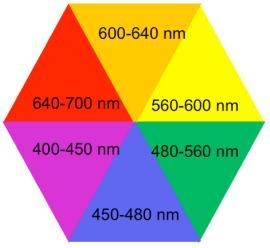
For a transition metal complex in solution exhibiting an absorption peak at 450 nm, which falls within the blue section of the visible spectrum, the corresponding (complementary) color of this solution is orange (option B).


Rationale:

The amount of UV-visible light absorbed indicates that some electromagnetic radiation successfully passes through the sample and is perceivable by the human eye. Thus, the color apparent in the visible spectrum of a complex aligns with the wavelengths of light it allows to pass rather than those it absorbs. The color that is absorbed will be complementary to the one that is transmitted.

In the accompanying image, you can view the associated wavelengths alongside their respective colors. By identifying the wavelength associated with the absorbed color, you will be able to see the complementary color that is visible or reflected.

For a transition metal complex in solution exhibiting an absorption peak at 450 nm, which falls within the blue section of the visible spectrum, the corresponding (complementary) color of this solution is orange (option B).
7 0
1 month ago
Other questions:
  • The figure above represents a stick of uniform density that is attached to a pivot at the right end and has equally spaced marks
    13·1 answer
  • A fox locates rodents under the snow by the slight sounds they make. The fox then leaps straight into the air and burrows its no
    10·1 answer
  • "If E = 7.50V and r=0.45Ω, find the minimum value of the voltmeter resistance RV for which the voltmeter reading is within 1.0%
    10·1 answer
  • A charged particle (q = −8.0 mC), which moves in a region where the only force acting on the particle is an electric force, is r
    8·1 answer
  • A microprocessor scans the status of an output I/O device every 20 ms. This is accomplished by means of a timer alerting the pro
    8·1 answer
  • A ceiling fan has five blades, each with a mass of 0.34 kg and a length of 0.66 m. The fan is operating in its "low" setting at
    6·1 answer
  • The light waves have that particular interference from question #1 because they are emitted _____.
    9·2 answers
  • A turtle takes 3.5 minutes to walk 18 m toward the south along a deserted highway. A truck driver stops and picks up the turtle.
    11·1 answer
  • A 524-Hz longitudinal wave in air has a speed of 345 m/s. (a) What is the wavelength? (b) How much time is required for the phas
    12·1 answer
  • A charged particle is moving perpendicular to a magnetic field in a circle with a radius r. An identical charge particle enters
    10·1 answer
Add answer
Login
Not registered? Fast signup
Signup
Login Signup
Ask question!