answer.
Ask question
Login Signup
Ask question
All categories
  • English
  • Mathematics
  • Social Studies
  • Business
  • History
  • Health
  • Geography
  • Biology
  • Physics
  • Chemistry
  • Computers and Technology
  • Arts
  • World Languages
  • Spanish
  • French
  • German
  • Advanced Placement (AP)
  • SAT
  • Medicine
  • Law
  • Engineering
rjkz
2 months ago
13

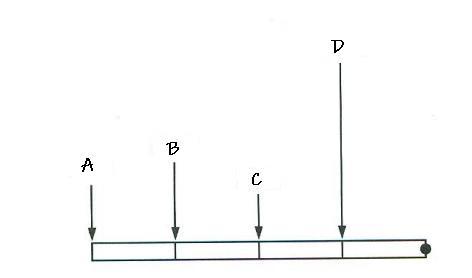
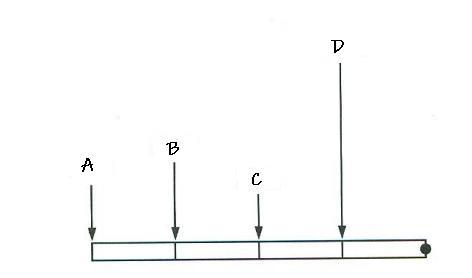
The figure above represents a stick of uniform density that is attached to a pivot at the right end and has equally spaced marks

along its length. Any one or a combination of the four forces shown can be exerted on the stick as indicated. All four forces are exerted on the stick that is initially at rest. What is the angular momentum of the stick after 2.0s ?

Physics
1 answer:
Sav [3.1K]2 months ago
5 0

Answer:

After a duration of 2.0 seconds, the angular momentum of the system is L= 2(4A+3B+2C+D)x.

Explanation:

Let’s denote the forces acting on the rod as A, B, C, and D, and the distance between them as x.

The torque produced by force A can be expressed as

\tau_a = 4Ax,

for force B the torque is

\tau_b = 3Bx,

the torque for force C is

\tau_c = 2Cx,

and the torque due to force D is

\tau_d = Dx.

This leads to a total torque on the stick as

\tau_{tot} =\tau_a+\tau_b+\tau_c+\tau_d

\tau_{tot} =4Ax+3Bx+2Cx+Dx

\tau_{tot} =x(4A+3B+2C+D)

Subsequently, this torque results in an angular acceleration \alpha in accordance with the formula

I \alpha = \tau_{tot}

where I represents the moment of inertia of the stick, which has a value of

I = \dfrac{1}{3} m(4x)^2.

Thus, the angular acceleration calculates to

\alpha = \dfrac{\tau_{tot} }{I}

\alpha =\dfrac{x(4A+3B+2C+D)}{\dfrac{1}{3}m(4x)^2 }

\boxed{\alpha =\dfrac{3(4A+3B+2C+D)}{16mx } .}.

Now, the angular momentum L of the rod is given by

L = I\omega,

where \omega is considered the angular velocity.

Given \omega = \alpha t, we conclude that

$L = \dfrac{1}{3}m (4x)^2  *\dfrac{3(4A+3B+2C+D)}{16mx }* t$

L= (4A+3B+2C+D)x t

Thus, t = 2.0s, the angular momentum is

\boxed{ L= 2(4A+3B+2C+D)x. }

You might be interested in
A beaker contain 200mL of water<br> What is its volume in cm3 and m3
Sav [3153]
The volumes are 200cm3 and 0.0002m3
7 0
1 month ago
Read 2 more answers
Alicia intends to swim to a point straight across a 100 m wide river with a current that flows at 1.2 m/s. She can swim 2.5 m/s
Sav [3153]

Answer:

θ = 61.3°

Alicia must swim at an angle of 61.3°

Explanation:

Parameters given include:

Width of the river = 100 m

Alicia's speed in still water = 2.5 m/s

Speed of river's current = 1.2 m/s

The angle she needs to swim can be determined by combining the velocities, taking into account the current's influence.

Her swimming speed aimed against the current must offset the current's velocity;

2.5cosθ - 1.2 = 0

2.5cosθ = 1.2

cosθ = 1.2/2.5

θ = cosinverse(1.2/2.5)

θ = 61.3°

4 0
1 month ago
A spinning wheel is slowed down by a brake, giving it a constant angular acceleration of 25.60 rad/s2. During a 4.20-s time inte
Yuliya22 [3333]

We will use the equations of rotational kinematics,

\theta =\theta _{0} + \omega_{0} t+ \frac{1}{2}\alpha t^2             (A)

\omega^2= \omega^2_{0} +2\alpha\theta                                     (B)                                          

Here, \theta and \theta _{0} denote the final and initial angular displacements, respectively, whereas \omega and \omega_{0} represent final and initial angular velocities, and \alpha is the angular acceleration.

We are provided with \alpha = - 25.60 \ rad/s^2, \theta = 62.4 \ rad and t = 4.20 \ s.

By substituting these values into equation (A), we have

62.4 \ rad = 0 + \omega_{0} 4.20 \ s + \frac{1}{2} (- 25.60 \ rad/s^2) ( 4.20)^2 \\\\ \omega_{0} = \frac{220.5+ 62.4 }{4.20} =67.4 \ rad/s

Now, using equation (B),

\omega^2=(67.4 \ rad/s)^2 + 2 (- 25.60 \ rad/s^2)62.4 \ rad \\\\\ \omega = 36.7 \ rad/s

This indicates that the wheel's angular speed at the 4.20-second mark is 36.7 rad/s.

4 0
1 month ago
A center lane with solid and broken yellow lines that is used by vehicles making left turns in both directions is called a:
Sav [3153]
A left turn lane is designated for vehicles making left turns. Vehicles must completely enter this lane and wait for a clear path before proceeding with the turn. It is not permissible for a vehicle to be partially in and out of the lane, as this obstructs traffic and creates hazardous conditions.
7 0
15 days ago
The 1.5-in.-diameter shaft AB is made of a grade of steel with a 42-ksi tensile yield stress. Using the maximum-shearing-stress
Keith_Richards [3271]

Answer:T = 0.03 Nm.

Explanation:

d = 1.5 in = 0.04 m

r = d/2 = 0.02 m

P = 56 kips = 56 x 6.89 = 386.11 MPa

σ = 42 ksi = 42 x 6.89 = 289.58 MPa

To find Torque = T =?

Solution:σ = (P x r) / T

Thus, T = (P x r) / σ

Calculating T = (386.11 x 0.02) / 289.58

results in T = 0.03 Nm.

7 0
8 days ago
Other questions:
  •  A bartender slides a beer mug at 1.50 m/s toward a customer at the end of a frictionless bar that is 1.20 m tall. The customer
    7·1 answer
  • There are two different size spherical paintballs and the smaller one has a diameter of 5 cm and the larger one is 9 cm in diame
    13·1 answer
  • Two objects are placed in thermal contact and are allowed to come to equilibrium in isolation. The heat capacity of Object A is
    7·1 answer
  • Derive an algebraic equation for the vertical force that the bench exerts on the book at the lowest point of the circular path i
    10·1 answer
  • un tanque de gasolina de 40 litros fue llenado por la noche, cuando la temperatura era de 68 grados farenheit. Al dia siguiente
    12·1 answer
  • A small house was built on an island off a perfectly straight shoreline. The point B on the shoreline that is closest to the isl
    8·1 answer
  • Which device typically use DC current to operate?
    11·2 answers
  • Arm abcd is pinned at b and undergoes reciprocating motion such that θ=(0.3 sin 4t) rad, where t is measured in seconds and the
    15·1 answer
  • 1. A2 .7-kg copper block is given an initial speed of 4.0m/s on a rough horizontal surface. Because of friction, the block final
    10·1 answer
  • A cleaver physics professor wants to create a situation where a block starts from rest at the top of a 31.0° inclined plane and
    13·1 answer
Add answer
Login
Not registered? Fast signup
Signup
Login Signup
Ask question!