answer.
Ask question
Login Signup
Ask question
All categories
  • English
  • Mathematics
  • Social Studies
  • Business
  • History
  • Health
  • Geography
  • Biology
  • Physics
  • Chemistry
  • Computers and Technology
  • Arts
  • World Languages
  • Spanish
  • French
  • German
  • Advanced Placement (AP)
  • SAT
  • Medicine
  • Law
  • Engineering
pogonyaev
9 days ago
6

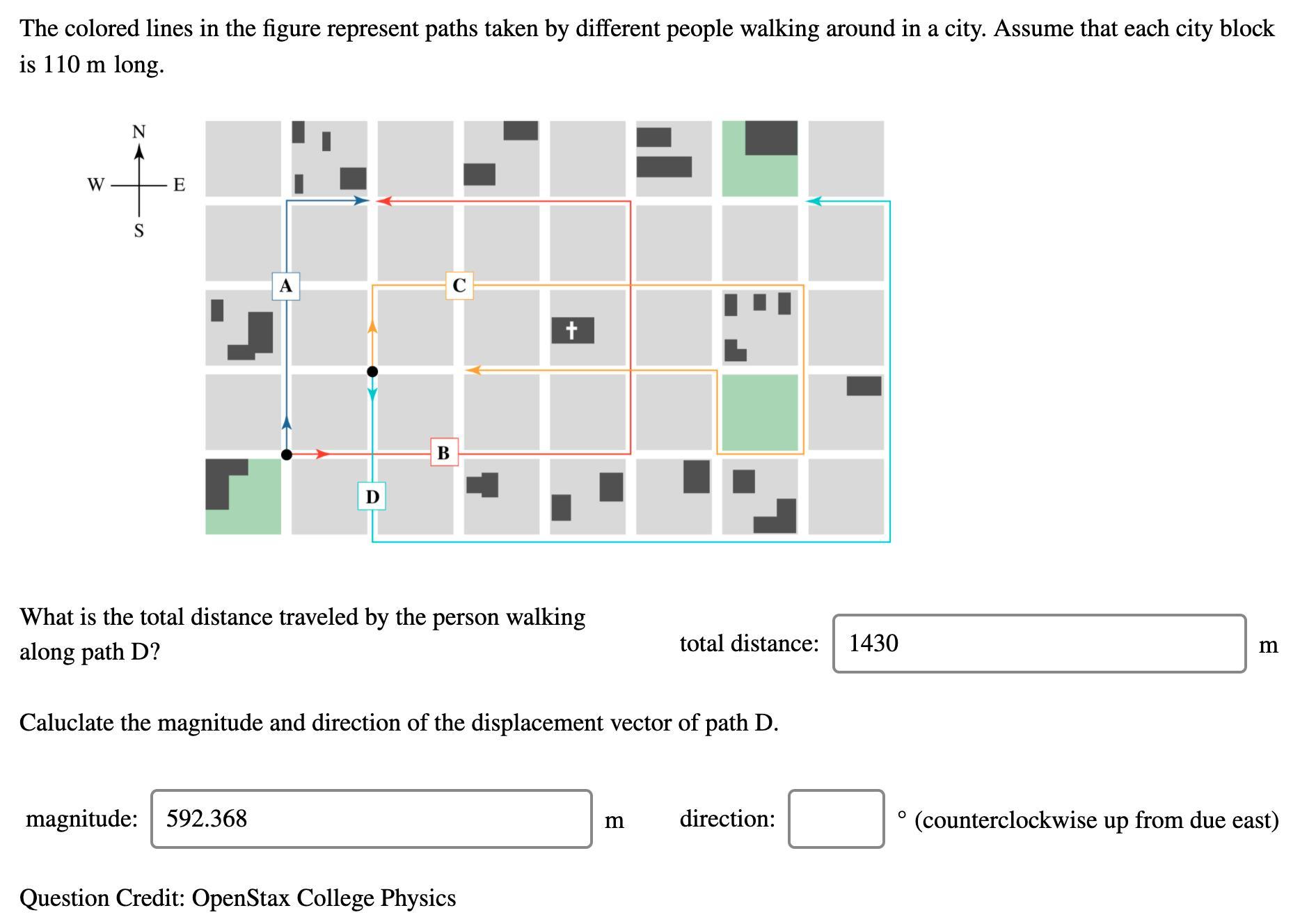
The colored lines in the figure represent paths taken by different people walking around in a city. Assume that each city block

is 110 m long.
Calculate the magnitude and direction of the displacement vector of path D. I cannot get the last part for direction

Physics
1 answer:
serg [1.1K]9 days ago
4 0

Answer: 592.37m

Explanation:

Person D is represented by the blue line.

The total displacement is calculated by subtracting the initial position from the final position. Starting at (0,0), the path consists of moving down two blocks, then right six blocks, followed by moving up four blocks, and finally left one block.

Here, I consider the positive direction of the x-axis to the right and the positive direction of the y-axis as upward.

Thus, the new coordinates will be, with B representing a block:

P =(6*B - 1*B, -2*B + 4*B) = (5*B, 2*B)

Given that B = 110m

P = (550m, 220m)

The displacement corresponds to the length of the vector, since the change from the initial position (0,0) to P is simply P:

P = √(550^2 + 220^2) = 592.37m
You might be interested in
Which model is used to describe the interaction of external forces that affect an organization's strategy and ability to compete
ValentinkaMS [1149]

Answer:

Competitive forces model

Explanation:

The Competitive forces model is a crucial instrument in strategic analysis aiming to assess an organization’s competitiveness. Commonly referred to as the "Five Force Model of Porter", this framework includes five key factors: the intensity of rivalry among existing competitors, the negotiating power of buyers, the threat posed by potential new entrants, the bargaining strength of suppliers, and the risk of substitute products or services.

These elements significantly influence an organization's competitive strategy and its likelihood of success.

5 0
4 days ago
A person is rowing across the river with a velocity of 4.5 km/hr northward. The river is flowing eastward at 3.5 km/hr (Figure 4
Yuliya22 [1153]

Answer: Her velocity magnitude (v) relative to the shore is 5.70 km/h.

Explanation:

Let Q be the speed of the boat, and P be the speed of the river flow.

R represents the resultant velocity combining boat velocity and river current.

According to vector addition using the law of triangles:

R=\sqrt{P^2+Q^2+2PQCos\theta}

From the diagram:

P = 3.5 km/h, Q = 4.5 km/h

\theta= 90^o

R=\sqrt{P^2+Q^2+2PQCos\theta}=\sqrt{(3.5)^2+(4.5)^2+3.5\times 4.5\times cos90^o}=5.70

(Cos90^o=0),(sin 90^o=1)

\alpha =tan^{-1}\frac{Qsin\theta}{P+Qcos\theta}=tan^{-1}\frac{4.5 sin 90^o}{3.5+4.5 cos90^o}=tan^{-1}\frac{4.5}{3.5}=52.12^o

Therefore, her velocity magnitude relative to the shore is 5.70 km/h.

8 0
17 days ago
The amount of electric energy consumed by a 60.0-watt lightbulb for 1.00 minute could lift a
Sav [1105]

Answer:

Explanation:

For a 60W light bulb used for 1 minute:

P = 60 W

t = 1 minute = 60 seconds

This energy is capable of lifting an object weighing 10N.

W = 10N

This indicates conversion of electrical energy into potential energy.

Let's calculate the electrical energy:

Power describes the rate of work done.

Power = Work / time

Thus, work = power × time

Work = 60 × 60

Work = 3600 J

Potential energy calculation:

P.E = mgh

Where the weight is given by:

W = mg

Therefore, P.E = W·h

P.E = 10·h

Thus, we equate:

Potential energy = Electrical energy

P.E = Work

10·h = 3600

Dividing both sides by 10 gives:

h = 3600 / 10

h = 360m

The object can be lifted to a height of 360m.

6 0
6 days ago
A delivery man starts at the post office, drives 40 km north, then 20 km west, then 60 km northeast, and finally 50 km north to
Yuliya22 [1153]


assuming north-south is along the Y-axis and east-west along the X-axis

X = total X-displacement

from the graph, total displacement in the X-direction is computed as

X = 0 - 20 + 60 Cos45 + 0

X = 42.42 - 20

X = 22.42 m


Y = total Y-displacement

from the graph, total displacement in the Y-direction is computed as

Y = 40 + 0 + 60 Sin45 + 50

Y = 90 + 42.42

Y = 132.42 m

To calculate the magnitude of the net displacement vector, we apply the Pythagorean theorem, yielding

magnitude: Sqrt(X² + Y²) = Sqrt(22.42² + 132.42²) = 134.31 m

Direction: tan⁻¹(Y/X) = tan⁻¹(132.42/22.42) = 80.4 deg north of east


4 0
6 days ago
An electrical short cuts off all power to a submersible diving vehicle when it is a distance of 28 m below the surface of the oc
Ostrovityanka [942]

Answer:

F=126339.5N

Explanation:

To compute the force required to escape, a free-body diagram for the hatch must be drawn. We will equate the downward and upward forces, thus applying the following equation:

Fw=W+Fi+F

where

Fw=   force or weight exerted by the water column above the submarine.

To calculate Fw, we can use:

Fw=h. γ. A

h=height

γ= specific weight of seawater = 10074N / m ^ 3

A=Area

Fw=28x10074x0.7=197467N

w represents the hatch weight = 200N

Fi denotes the internal pressure force in the submarine, which is 1 atm = 101325Pa. We can calculate this force using:

Fi=PA=101325x0.7=70927.5N

Finally, the force needed to open the hatch is determined by the original equation:

Fw=W+Fi+F

F=Fw-W+Fi

F=197467N-200N-70927.5N

F=126339.5N

6 0
9 days ago
Other questions:
  • Ben walks 500 meters from his house to the corner store. He then walks back toward his house, but continues 200 meters past his
    14·2 answers
  • Find the object's speeds v1, v2, and v3 at times t1=2.0s, t2=4.0s, and t3=13s.
    6·2 answers
  • Soot particles ("black carbon aerosols" generally cause ________ of earth's atmosphere by ________ solar energy.
    10·1 answer
  • While looking at bromine (Br) on the periodic table, a student needs to find another element with very similar chemical properti
    13·2 answers
  • On its own, a certain tow-truck has a maximum acceleration of 3.0 m/s2. what would be the maximum acceleration when this truck w
    9·2 answers
  • A 620-g object traveling at 2.1 m/s collides head-on with a 320-g object traveling in the opposite direction at 3.8 m/s. If the
    8·2 answers
  • A mechanical high-speed bat is flying along a path perpendicular to a wall. it emits a sound with a frequency f0 . the night is
    14·1 answer
  • Rita has two small containers, one holding a liquid and one holding a gas. Rita transfers the substances to two larger container
    10·2 answers
  • You apply the brakes of your car abruptly and your book starts sliding off the front seat. Three observers sitting in the car ex
    13·1 answer
  • The resultant of the concurrent forces is 300 lb pointing up along the Y axis. Compute the values of F and the angle required to
    12·2 answers
Add answer
Login
Not registered? Fast signup
Signup
Login Signup
Ask question!
