answer.
Ask question
Login Signup
Ask question
All categories
  • English
  • Mathematics
  • Social Studies
  • Business
  • History
  • Health
  • Geography
  • Biology
  • Physics
  • Chemistry
  • Computers and Technology
  • Arts
  • World Languages
  • Spanish
  • French
  • German
  • Advanced Placement (AP)
  • SAT
  • Medicine
  • Law
  • Engineering
In-s
7 days ago
10

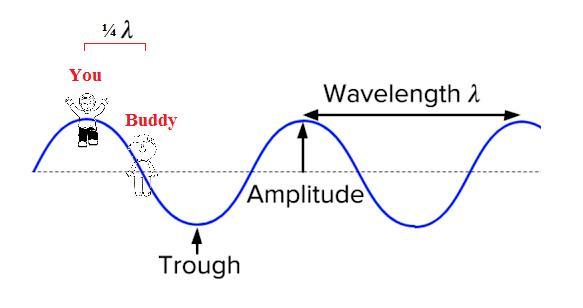
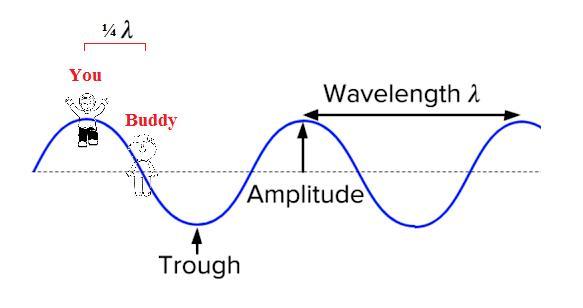
You and your surfing buddy are waiting to catch a wave a few hundred meters off the beach. The waves are conveniently sinusoidal

, and you notice that when you're on the top of one wave and moving toward your friend, she is exactly halfway between you and the trough of the wave. 1.50 seconds later, your friend is at the top of the wave. You estimate the horizontal distance between you and your friend at 8.00 m. (a) What is the frequency of the waves?

Physics
2 answers:
Softa [913]7 days ago
8 0

(a) The frequency of the waves is ¹/₆ Hz ≈ 0.167 Hz

(b) The speed of the waves is 5¹/₃ m/s ≈ 5.33 m/s

\texttt{ }

Additional explanation

Let's recall the wave speed and wave intensity formula:

\large {\boxed {v = \lambda f}}

f = frequency of the wave (Hz)

v = wave speed (m/s)

λ = wavelength (m)

\texttt{ }

\large {\boxed {I = 2 \pi^2 A^2 f^2 \rho v}}

I = wave intensity (W/m²)

A = wave amplitude (m)

f = wave frequency (Hz)

ρ = medium density (kg/m³)

v = wave speed (m/s)

Let’s solve the problem now!

\texttt{ }

Given:

Time period = t = 1.50 seconds

Distance traveled = d = 8.00 m

Question:

(a) What is the frequency of the waves?

(b) What is the wave speed?

Solution:

Question (a):

t = \frac{1}{4}T

1.50 = \frac{1}{4}T

T = 4 \times 1.50

T = 6 \texttt{ seconds}

\texttt{ }

f = \frac{1}{T}

f = \frac{1}{6} \texttt{ Hz}

\texttt{ }

Question (b):

d = \frac{1}{4}\lambda

8.00 = \frac{1}{4}\lambda

\lambda = 8.00 \times 4

\lambda = 32 \texttt{ m}

\texttt{ }

v = \lambda f

v = 32 \times \frac{1}{6}

v = 5\frac{1}{3} \texttt{ m/s}

\texttt{ }

Learn more

  • Doppler Effect:
  • Doppler Effect Example:
  • Sound Waves Can't Travel In Space:
  • Beat Frequency - Doppler Effect:

\texttt{ }

Answer details

Grade: College

Subject: Physics

Chapter: Sound Waves

Softa [913]7 days ago
6 0

Answer:

(a): The calculated wave frequency is f= 0.16 Hz

Explanation:

T/4= 1.5 s

T= 6 sec

f= 1/T

f= 0.16 Hz (a)

You might be interested in
An object is attached to a hanging unstretched ideal and massless spring and slowly lowered to its equilibrium position, a dista
Sav [1105]

Answer:

        h = 12.8 cm

Explanation:

The initial parameters are as follows:

distance = 6.4 cm

  • when the object descends, its weight matches the spring's force

        weight = spring force

         mg = ky... equation 1

  • potential energy stored in a stretched spring = work done by the spring

        mgh = 0.5 x k x h^{2}....equation 2

  • Substituting from equation 1 into equation 2

                kyh =  0.5 x k x h^{2}

                y =  0.5 x h

                2y = h

  • where y is 6.4, yielding the maximum elongation as

          h = 2 x 6.4 = 12.8 cm

6 0
5 days ago
Jack pulls a sled across a level field by exerting a force of 110 n at an angle of 30 with the ground. what are the parallel and
Softa [913]
<span>A force of 110 N is applied at an angle of 30</span>°<span> to the horizontal. Because the force does not align directly either vertically or horizontally with the sled, it can be broken down into two components based on sine and cosine.

For the component parallel to the ground:
x = rcos</span>β
<span>x = 110cos30</span>°
<span>x = 95.26

For the component perpendicular to the ground:
y = rsin</span>β
<span>y = 110sin30</span>°
<span>y = 55</span>
3 0
6 days ago
Read 2 more answers
Determine the final state and temperature of 100 g of water originally at 25.0°c after 50.0 kj of heat have been added to it.
inna [995]
The heat required to raise the temperature of a substance by \Delta T is represented by
Q=m C_p \Delta T
where m stands for the mass of the substance and C_p indicates the specific heat of the substance. In this situation, we possess m=100~g=0.1~Kg and C_p=4.19~KJ/(Kg K), the specific heat of water.
Consequently, we can ascertain the temperature rise \Delta T:
\Delta T = \frac{Q}{m C_p}= \frac{50~KJ}{0.1~Kg cdot 4.19~KJ/(Kg K)}=119~K =119^{\circ}C
Initially, the water's temperature was 25^{\circ}C, so the end temperature should be
T_f = 25^{\circ}C+119^{\circ}C=144^{\circ}C
Thus, the water is expected to be vapor by now.

However, to give a more accurate statement, during the liquid to vapor transition, the heat added to the system is used to break molecular bonds instead of raising the system's temperature. The heat necessary for the phase change from liquid to vapor is expressed as
Q=m C_L=0.1~Kg \cdot 2265~KJ/Kg=226.5~KJ
where C_L denotes the latent heat of vaporization for water.
Nevertheless, the initial heat input of 50 KJ is less than this requirement, indicating there isn't sufficient heat to finish the liquid-vapor transition. Therefore, the water will remain in the liquid-vapor change phase at a temperature of 100^{\circ}C (the temperature at which the phase change begins)

4 0
4 days ago
Approximately 1.000 g each of four gasses H2, Ne, Ar, and Kr are placed in a sealed container all under1.5 atm of pressure. Assu
serg [1202]

Answer:

The partial pressure of H2 is 0.375 atm.

The partial pressure of Ne also stands at 0.375 atm.

Explanation:

Mass of H2 = 1 g

Mass of Ne = 1 g

Mass of Ar = 1 g

Mass of Kr = 1 g

Overall mass of the gas mixture totals 4 g.

Pressure in the sealed container is 1.5 atm.

Calculating the partial pressure for H2 yields: (mass of H2/total mass of gas mixture) × pressure of sealed container = 1/4 × 1.5 = 0.375 atm.

Calculating the partial pressure for Ne similarly gives: (mass of Ne/total mass of gas mixture) × pressure of sealed container = 1/4 × 1.5 = 0.375 atm.

7 0
11 days ago
Calculate the buoyant force in air on a kilogram of titanium (whose density is about 4.5 grams per cubic centimeter). compare wi
ValentinkaMS [1149]
1) The buoyant force acting on an object submerged in a fluid can be described as:
B=d_f V_d g
where d_f indicates the fluid's density, V_d represents the volume of the fluid displaced, and g=9.81~m/s^2 signifies the gravitational acceleration.

2) To determine the volume of the displaced fluid, we note that the titanium object is entirely submerged in the fluid (air), thus this volume matches the volume of 1 Kg of titanium, which has a density of d=4.5~g/cm^3 = 4.5\cdot10^3~Kg/m^3. Using the correlation between density, volume, and mass, we derive
V_d= \frac{m}{d}= \frac{1~Kg}{4.5\cdot10^3Kg/m^3}=2.22\cdot10^{-4}~m^3

3) We can now revisit the equation in step 1) to compute the buoyant force. Given that the air density is d_f = 1~Kg/m^3, this provides us with
B=d_f V_d g=1~Kg/m^3 \cdot 2.22\cdot10^{-4}~m^3 \cdot 9.81~m/s^2=2.22\cdot10^{-3}~N

4) The weight of 1 Kg of titanium is:
W=mg=1~Kg \cdot 9.81~m/s^2=9.81~N
Therefore, the buoyant force is negligible when compared to the weight.
7 0
10 days ago
Other questions:
  • What is the maximum value the string tension can have before the can slips? The coefficient of static friction between the can a
    7·1 answer
  • A sheet of gold leaf has a thickness of 0.125 micrometer. A gold atom has a radius of 174pm. Approximately how many layers of at
    11·1 answer
  • A semi is traveling down the highway at a velocity of v = 26 m/s. The driver observes a wreck ahead, locks his brakes, and begin
    15·1 answer
  • On the earth, when an astronaut throws a 0.250-kg stone vertically upward, it returns to his hand a time T later. On planet X he
    10·1 answer
  • Write a hypothesis about the effects of magnetic and electric fields. Use the format of "if . . . then . . . because . . ." and
    8·2 answers
  • A mechanical high-speed bat is flying along a path perpendicular to a wall. it emits a sound with a frequency f0 . the night is
    14·1 answer
  • Assume that the cart is free to roll without friction and that the coefficient of static friction between the block and the cart
    15·2 answers
  • f a car is speeding down a road at 40 miles/hour (mph), how long is the stopping distance D40 compared to the stopping distance
    6·1 answer
  • Calculate the change in the kinetic energy (KE) of the bottle when the mass is increased. Use the formula KE = mv2, where m is t
    9·3 answers
  • A charge of uniform volume density (40 nC/m3) fills a cube with 8.0-cm edges. What is the total electric flux through the surfac
    12·1 answer
Add answer
Login
Not registered? Fast signup
Signup
Login Signup
Ask question!