answer.
Ask question
Login Signup
Ask question
All categories
  • English
  • Mathematics
  • Social Studies
  • Business
  • History
  • Health
  • Geography
  • Biology
  • Physics
  • Chemistry
  • Computers and Technology
  • Arts
  • World Languages
  • Spanish
  • French
  • German
  • Advanced Placement (AP)
  • SAT
  • Medicine
  • Law
  • Engineering
Anika
7 days ago
14

A camera operator is filming a nature explorer in the Rocky Mountains. The explorer needs to swim across a river to his campsite

. By watching debris flowing down the river, the operator estimates that the stream is flowing at
0.665
m
/
s
. In still water, the explorer can swim at
0.759
m
/
s
. At what angle, less than 90°, with respect to the shoreline should the operator advise him to swim so that he travels directly across the stream to his campfire?
angle:

°
The water is near freezing in temperature. Typically a human can only swim in such water for about
300
s
(or
5
min
) before hypothermia sets in. Calculate the time the explorer spends in the water if the river is
29.3
m
wide.
time in the water:

s
Based on the results, what should the camera operator's decision be about the explorer's swim?

Approved. He will get cold but he should be able to make it across.

Sorry, but the swim must be cancelled. He will never make it across in time.

Physics
1 answer:
inna [987]7 days ago
3 0

Answer:

a. Angle= 28.82°

b. Approved. Although he might feel cold, he should be able to cross.

Explanation:

Velocity Vector

Velocity is a measure of how quickly something is moving in a specific direction. It is represented as a vector that has both magnitude and direction. If an object can only move in one direction, then speed can serve as the scalar equivalent of that velocity (only focusing on magnitude).

a.

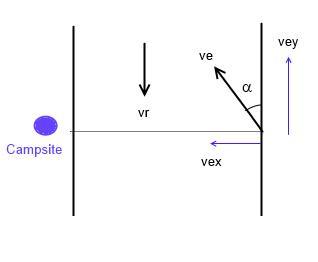
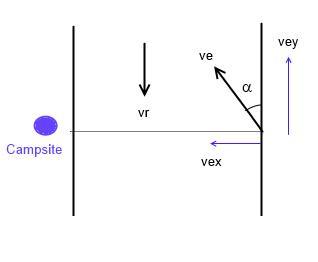
The explorer aims to swim across a river to reach his campsite, as depicted in the image below. The river's velocity is vr and the explorer's swimming speed in still water is ve. If he were to swim straight towards the campsite, he would end up downstream due to the river's current. Therefore, he must swim at an angle that allows him to overcome the current while still moving towards his goal. This angle relative to the shore is what we need to determine. The explorer's speed can be broken down into its horizontal (vx) and vertical (vy) components. In order to counteract the river's flow:

v_{ey}=v_r

We can calculate the vertical component of the explorer's swimming speed as

v_{ey}=|v_e|cos\alpha

Thus

v_r=|v_e|cos\alpha

Finding the value of \alpha

\displaystyle cos\alpha=\frac{v_r}{|v_e|}

\displaystyle cos\alpha=\frac{0.665}{0.759}=0.876

Then the angle is given by

\alpha=28.82^o

b.

The component of the explorer's velocity that goes horizontally is

v_{ex}=0.759sin28.82^o

v_{ex}=0.366\ m/s

This represents the actual velocity directed towards the campsite

Considering that

\displaystyle v=\frac{x}{t}

To find t

\displaystyle t=\frac{x}{v}

Calculating the duration for the explorer to cross the river

\displaystyle t=\frac{29.3}{0.366}

t=80\ sec

As this time is under the hypothermia threshold (300 seconds), the conclusion is

Approved. Although he will feel cold, he should manage to cross successfully.

You might be interested in
A closed system of mass 10 kg undergoes a process during which there is energy transfer by work from the system of 0.147 kJ per
Softa [913]

Result: -50.005 kJ

Details:

Provided Data

mass of the system = 10 kg

work done = 0.147 kJ/kg

Elevation change (\Delta h)=-50 m

initial speed (v_1)=15 m/s

Final Speed (v_2)=30 m/s

Specific internal Energy (\Delta U)=-5 kJ/kg

according to the first Law of thermodynamics

Q-W=\Delta H

\Delta H=\Delta KE+ \Delta PE +\Delta U

where KE represents kinetic energy

PE indicates potential energy

U denotes internal Energy

\Delta H=\frac{m(v_2^2-v_1^2)}{2}+mg(\Delta h)+\Delta U

Q=W+\Delta KE+ \Delta PE +\Delta U

Q=0.147\times 10+\frac{10\cdot (30^2-15^2)}{2}+10\cdot 9.81\cdot (-5)-5\times 10

Q = 1.47 + 3.375 - 4.850 - 50

Q = -50.005 kJ

5 0
13 days ago
A brick is dropped (zero initial speed) from the roof of a building. The brick strikes the ground in 1.90 s. You may ignore air
Sav [1105]

Answer:

Height (h) = 17 m

Velocity (v) = 18.6 m/s

Explanation: This problem can be solved using kinematic motion equations.

Given Data

Initial velocity (u) = 0

Acceleration (a) = g

Time (t) = 1.9 seconds

First, we calculate the height.

s=ut+0.5at^2\\h=ut+0.5at^2\\h=0*1.9+0.5*9.81*1.9^2\\h=17.707 m

Then, we find the final velocity

v=u+at\\v=0+9.81*1.9\\v=18.639

The acceleration graph is a linear representation described by y=9.8, as it remains constant:

The velocity graph can be represented by y=9.8x (where y signifies velocity and x indicates time):

The displacement graph can be described as y=4.9x^2 (with x as time and y as displacement):

These graphs apply exclusively from x=0 to x=1.9, so disregard other sections of the graphs.

5 0
15 days ago
To determine the height of a flagpole, Abby throws a ball straight up and times it. She sees that the ball goes by the top of th
Softa [913]

Answer:

H = 10.05 m

Explanation:

The stone reaches the top of the flagpole at both t = 0.5 s and t = 4.1 s

therefore, the total duration of the upwards motion above the peak of the pole is provided as

\Delta t = 4.1 - 0.5 = 3.6 s

now we have

\Delta t = \frac{2v}{g}

3.6 = \frac{2v}{9.8}

v = 17.64 m/s

this indicates the speed at the flagpole's top

at this point we have

v_f - v_i = at

17.64 - v_i = (-9.8)(0.5)

v_i = 22.5 m/s

the height of the flagpole is stated as

H = \frac{v_f + v_i}{2}t

H = \frac{22.5 + 17.64}{2} (0.5)

H = 10.05 m

5 0
12 days ago
Two blocks are attached to opposite ends of a massless rope that goes over a massless, frictionless, stationary pulley. One of t
Softa [913]

Answer:

1/7 kg

Explanation:

Refer to the attached diagram for enhanced clarity regarding the question.

One of the blocks weighs 1.0 kg and accelerates downward at 3/4g.

g denotes the acceleration due to gravity.

Let M represent the block with known mass, while 'm' signifies the mass of the other block and 'a' refers to the acceleration of body M.

Given M = 1.0 kg and a = 3/4g.

By applying Newton's second law; \sum fy = ma_y

For the body with mass m;

T - mg = ma... (1)

For the body with mass M;

Mg - T = Ma... (2)

Combining equations 1 and 2 gives;

+Mg -mg = ma + Ma

Ma-Mg = -mg-ma

M(a-g) = -m(a+g)

Substituting M = 1.0 kg and a = 3/4g into this equation leads to;

3/4 g-g = -m(3/4 g+g)

3/4 g-g = -m(7/4 g)

-g/4 = -m(7/4 g)

1/4 = 7m/4

Multiplying gives: 28m = 4

m = 1/7 kg

Hence, the mass of the other box is 1/7 kg

3 0
6 days ago
Which pair of graphs represent the same motion of an object
Ostrovityanka [942]
The correct choice is C
3 0
15 days ago
Read 2 more answers
Other questions:
  • An object is released from rest near and above Earth’s surface from a distance of 10m. After applying the appropriate kinematic
    8·1 answer
  • All students except one are cheating on a test. The one student who is not cheating on the test is exhibiting abnormal behavior.
    5·2 answers
  • Suppose you push a hockey puck of mass m across frictionless ice for a time 1.0 s, starting from rest, giving the puck speed v a
    13·2 answers
  • The summer camps had a field trip from the campus to the fragrance Hill they traveled at an average speed of 65 km an hour and t
    6·1 answer
  • A proton starts from rest and gains 8.35 x 10^-14 joule of kinetic energy as it accelerates between points A and B in an electri
    14·2 answers
  • An air hockey game has a puck of mass 30 grams and a diameter of 100 mm. The air film under the puck is 0.1 mm thick. Calculate
    9·1 answer
  • f a car is speeding down a road at 40 miles/hour (mph), how long is the stopping distance D40 compared to the stopping distance
    6·1 answer
  • Imagine you derive the following expression by analyzing the physics of a particular system: a=gsinθ−μkgcosθ, where g=9.80meter/
    6·1 answer
  • Daring Darless wishes to cross the Grand Canyon of the Snake River by being shot from a cannon. She wishes to be launched at 65
    14·1 answer
  • Peregrine falcons are known for their maneuvering ability. In a tight circular turn, a falcon can attain a centripetal accelerat
    13·1 answer
Add answer
Login
Not registered? Fast signup
Signup
Login Signup
Ask question!