answer.
Ask question
Login Signup
Ask question
All categories
  • English
  • Mathematics
  • Social Studies
  • Business
  • History
  • Health
  • Geography
  • Biology
  • Physics
  • Chemistry
  • Computers and Technology
  • Arts
  • World Languages
  • Spanish
  • French
  • German
  • Advanced Placement (AP)
  • SAT
  • Medicine
  • Law
  • Engineering
Art
1 month ago
12

A 1100kg car pulls a boat on a trailer. (a) what total force resists the motion of the car, boat,and trailer, if the car exerts

a 1900n force on the road and produces an acceleration of 0.550 m/s2? the mass of the boat plus trailer trailer is 700kg. (b) what is the force in the hitch betweenthe car and the trailer if 80% of the resisting forces are experienced by the boat and trailer?

Physics
1 answer:
inna [3.1K]1 month ago
3 0
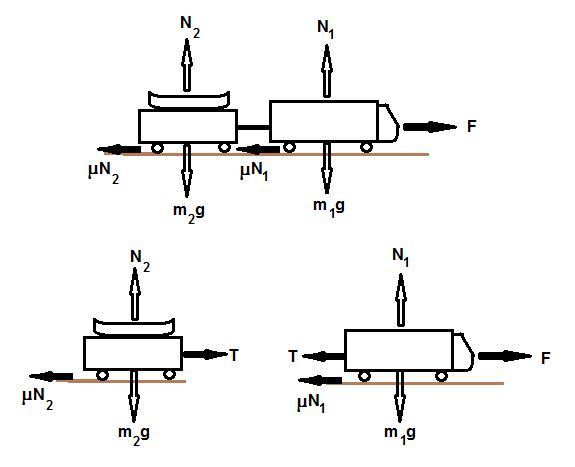
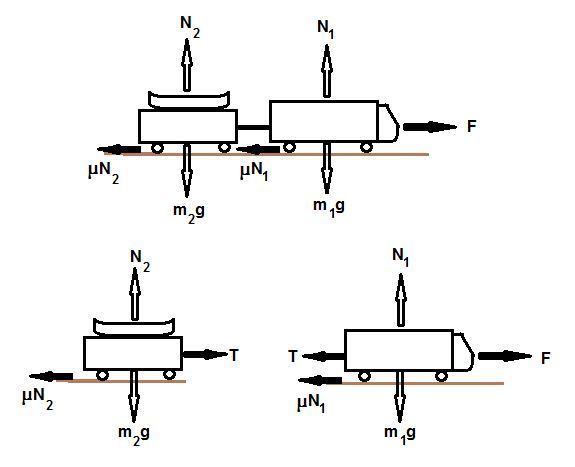
Refer to the diagram shown below.

m₁ = 1100 kg represents the mass of the car.
m₂ = 700 kg indicates the combined mass of the trailer and boat.
F = 1900 N is the driving force acting on the vehicle.
N₁ denotes m₁g, the normal force on the car.
N₂ corresponds to m₂g, the normal force on the trailer and boat.
Frictional forces are represented by μN₁ and μN₂, where μ is the coefficient of kinetic friction.
T signifies the force in the connection between the car and the trailer.

Part (a)
Let R₁ signify the total resistance acting against the motion of the car, boat, and trailer.
With the acceleration at 0.550 m/s², it follows that
(m₁ + m₂ kg)*(0.55 m/s²) = F
(1100 + 700 kg)*(0.55 m/s²) = (1900 - R₁) N.
This leads to the equation 990 = 1900 - R.
Therefore, R₁ = 910 N.

Answer: The total resistive force amounted to 910 N.

Part (b)
The trailer and boat experience 80% of the resisting forces.
Let R₂ denote this resistive force.
Thus,
R₂ = 0.8*R₁ = 728 N.
Assuming T is the tension in the hitch connecting the car and trailer, it follows:
T - R₂ = m₂(0.55 m/s²)
(T - 728 N) = (700 kg)*(0.55 m/s²).
This leads to T - 728 = 385.
Thus, T equals 1113 N.

Answer: The tension in the hitch is 1113 N.
You might be interested in
Exactly one pound of bread dough is placed in a baking tin. The dough is cooked in an oven at 350°F, releasing a wonderful aroma
Softa [3030]
The mass of the baked loaf will be lower than that of the dough.
7 0
17 days ago
A spinning wheel is slowed down by a brake, giving it a constant angular acceleration of 25.60 rad/s2. During a 4.20-s time inte
Yuliya22 [3333]

We will use the equations of rotational kinematics,

\theta =\theta _{0} + \omega_{0} t+ \frac{1}{2}\alpha t^2             (A)

\omega^2= \omega^2_{0} +2\alpha\theta                                     (B)                                          

Here, \theta and \theta _{0} denote the final and initial angular displacements, respectively, whereas \omega and \omega_{0} represent final and initial angular velocities, and \alpha is the angular acceleration.

We are provided with \alpha = - 25.60 \ rad/s^2, \theta = 62.4 \ rad and t = 4.20 \ s.

By substituting these values into equation (A), we have

62.4 \ rad = 0 + \omega_{0} 4.20 \ s + \frac{1}{2} (- 25.60 \ rad/s^2) ( 4.20)^2 \\\\ \omega_{0} = \frac{220.5+ 62.4 }{4.20} =67.4 \ rad/s

Now, using equation (B),

\omega^2=(67.4 \ rad/s)^2 + 2 (- 25.60 \ rad/s^2)62.4 \ rad \\\\\ \omega = 36.7 \ rad/s

This indicates that the wheel's angular speed at the 4.20-second mark is 36.7 rad/s.

4 0
1 month ago
An electric buzzer is activated, then sealed inside a glass chamber. When all of the air is pumped out of the chamber, how is th
ValentinkaMS [3465]
The intensity of the sound increases because sound waves are mechanical waves, meaning they cannot move through a vacuum and require a medium to propagate.
4 0
1 month ago
The weight of your car will also affect its _____.
inna [3103]
Stopping distance.
3 0
28 days ago
Read 2 more answers
A test car carrying a crash test dummy accelerates from 0 to 30 m/s and then crashes into a brick wall. Describe the direction o
Maru [3345]

Answer:

The direction in which a vehicle accelerates aligns with its velocity direction. However, the force of acceleration works against the car's speed.

Explanation:

The car’s initial acceleration can be found using:

v = v₀ + a t

a = (v-v₀) t

which assumes the initial speed is zero (v₀ = 0 m/s).

a = v / t

a = 300 / t

The acceleration vector matches the direction of the vehicle's movement.

Upon hitting the wall, a force is exerted in the reverse direction to halt the car, thus this acceleration opposes the vehicle’s speed. However, the module should be much greater since the stopping distance is minimal.

5 0
1 month ago
Other questions:
  • Find an expression for the acceleration a of the red block after it is released. use mr for the mass of the red block, mg for th
    6·2 answers
  • In this problem you are to consider an adiabaticexpansion of an ideal diatomic gas, which means that the gas expands with no add
    6·1 answer
  • A ball is fired at an angle of 45 degrees, the angle that yields the maximum range in the absence of air resistance. What is the
    6·2 answers
  • On a hot summer day, you decide to make some iced tea. First, you brew 1.50 LL of hot tea and leave it to steep until it has rea
    12·1 answer
  • When laser light of wavelength 632.8 nm passes through a diffraction grating, the first bright spots occur at ± 17.8 ∘ from the
    6·1 answer
  • A 0.5 kg cheeseburger is lobbed at a particularly unhappy customer with a force of 10 N. While it is being thrown, what is the a
    5·1 answer
  • An object with charge q = −6.00×10⁻⁹ C is placed in a region of uniform electric field and is released from rest at point A. Aft
    7·1 answer
  • A trolley of mass 200kg is travelling north at 2m\s. It collides head on with a second trolley of mass 500kg which is travelling
    7·1 answer
  • If a metal wire is 4m long and a force of 5000n causes it to stretch by 1mm, what is the strain?
    11·1 answer
  • A wind turbine works by slowing the air that passes its blades and converting much of the extracted kinetic energy to electric e
    13·1 answer
Add answer
Login
Not registered? Fast signup
Signup
Login Signup
Ask question!