answer.
Ask question
Login Signup
Ask question
All categories
  • English
  • Mathematics
  • Social Studies
  • Business
  • History
  • Health
  • Geography
  • Biology
  • Physics
  • Chemistry
  • Computers and Technology
  • Arts
  • World Languages
  • Spanish
  • French
  • German
  • Advanced Placement (AP)
  • SAT
  • Medicine
  • Law
  • Engineering
natita
6 days ago
14

Starting with only the Balmer series light (visible light), how could we ensure that the solar panels generate a current that Ma

rk can use for his power station? (It may help to look at the electromagnetic spectrum from week 3):
a. By gradually increasing the brightness (amount) of light that we shine on it.

b. By gradually increasing the frequency of the light we shine on it.

c. By gradually increasing the wavelength of the light that we shine on it.

Physics
2 answers:
ValentinkaMS [1.1K]6 days ago
8 0

The right answer is (a).

Solar panels create electric current through the photoelectric effect, which describes how photons strike certain material surfaces, resulting in the release of electrons when light with the correct frequency hits them. A photon will interact with an electron on the panel, causing it to be ejected from the panel's surface.

As the illumination on the panel becomes brighter, the intensity of the light rises, indicating an increase in the number of photons. Each photon has the potential to liberate an electron; thus, as the number of incoming photons rises, so does the quantity of freed electrons. Given that the photoelectric current reflects the rate at which these electrons flow, an increase in light intensity leads to a corresponding rise in the photoelectric current.

If the frequency of the light is increased without a change in brightness, the photoelectric current remains the same because the total number of photons does not increase. Yet, the electrons that are ejected do escape with higher kinetic energy. However, since the total number of electrons liberated stays unchanged, the current remains constant regardless of the electrons' increased energy. Thus, option b is incorrect.

Increasing the wavelength of the light means the energy of the photons decreases. This would cause the emitted electrons to have lower energy. However, if the brightness is consistent, the number of electrons remains the same, and as a result, there would be no change in the photoelectric current. Therefore, choice (c) is also incorrect.

The correct answer is (a). To generate the needed current, the brightness of the incident light must be increased.

inna [987]6 days ago
3 0

The generation of current in the solar panel occurs through increasing the brightness of the light shined upon it. Thus, option (a) is the right choice.

More Explanation:

Solar panels produce current based on the principles of photoelectric emission. This principle indicates that if light of an appropriate frequency strikes a photosensitive material, a photon will interact with an electron in that material and eject it from the surface.

(a)

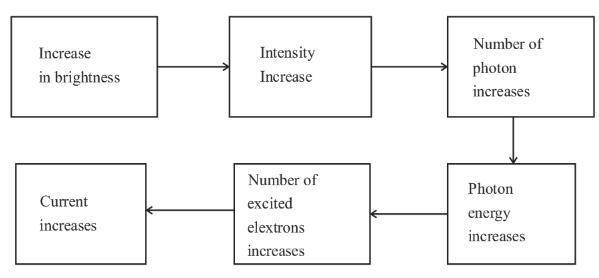
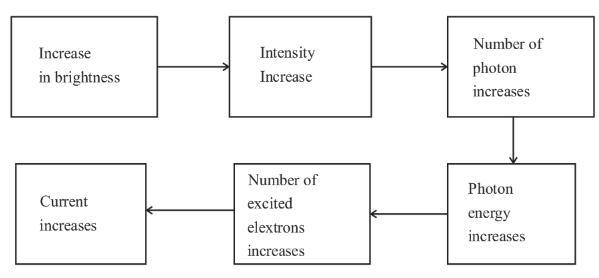
When the brightness enhances, the intensity becomes greater. As intensity grows, the incoming photon count rises. Additionally, with more photons, the energy per photon increases. Greater photon energy leads to an increase in the number of liberated electrons since more energy is required to excite or displace electrons. Therefore, an increase in released electrons correlates with an increase in current, as current is defined by the rate of electron flow over time. Thus, the current amplifies as brightness increases.

(b)

Increasing the frequency of light means the photon energy rises. Nonetheless, the count of incoming photons remains unchanged since the intensity is constant. Thus, electrons will leave with enhanced energy, but their total number remains the same, meaning the current remains stagnant regardless of increased frequency.

(c)

Increasing the wavelength leads to a situation where the photon energy decreases. However, the incoming photon count stays the same due to constant intensity. Therefore, although emitted electrons depart with less energy, their total number does not change, which means that the current does not alter with a rise in wavelength.

Learn More:

1. Volume of gas after expansion:

2. Principle of conservation of momentum:

3. Average translational kinetic energy:

Answer Details:

Grade: Middle School

Subject: Physics

Chapter: Atoms and nuclei

Keywords:

Balmer, series, light, visible, solar, panels, generate, current, Mark, power, station, electromagnetic, spectrum, week, gradually, increasing, brightness, shine, frequency, wavelength, energy, photon, liberated, electrons, unchanged and incident.
You might be interested in
A 5.8 × 10⁴-watt elevator motor can lift a total weight of 2.1 × 10⁴ newtons with a maximum constant speed of
Keith_Richards [1034]
Power is defined as the speed at which work is performed on an object. Like all rates, power is measured in relation to time. It reflects how quickly a task is completed. Two identical tasks can be executed at varying speeds - one slower and the other faster. The equation P = Fv can be used, where P symbolizes power, F denotes force, and V represents average velocity. Calculating the average velocity gives us V = P/F, or V = (5.8 x 10^4 W) / (2.1 x 10^4 N), resulting in V = 2.8 m/s.
8 0
10 days ago
An object is at rest on the ground. The object experiences a downward gravitational force from Earth. Which of the following pre
Yuliya22 [1153]

Answer:

A) and B) are valid.

Explanation:

When an object remains at rest, it is indicative that no net force acts upon it.

The downward gravitational force from Earth must be counterbalanced by an upward force of equal magnitude in order to maintain rest.

This upward force is provided by the normal force, which adjusts to satisfy Newton’s 2nd Law and is always perpendicular to the surface supporting the object (in this instance, the ground).

At the molecular level, this normal force comes from the ground's bonded molecules acting like tiny springs, compressed by the object’s molecules, providing an upward restorative force.

Thus, statements A) and B) are true.

6 0
2 days ago
Read 2 more answers
A metal object with a mass of 19g is heated to 96c, then transferred to a calorimeter containg 75g of water at 18c. the water an
Yuliya22 [1153]

Let Cp represent the specific heat of the metal object. To find this, we can set up a heat balance equation (heat lost by metal = heat gained by water):

- 19g * Cp * (22degC – 96degC) = 75g * 4.184J/g degC * (22degC - 18degC)

<span>Cp = 0.893 J/g degC</span>

6 0
7 days ago
Read 2 more answers
You decide it is time to clean your pool since summer is quickly approaching. Your pool maintenance guide specifies that the chl
Yuliya22 [1153]

Answer:

Cl2 concentration: 1,048 ppm

Explanation:

Molarity (M) is a unit that indicates how many moles of a substance are in one liter of solution, while ppm is similar to mg/L, representing the mass of the substance per liter. To convert M to ppm, we need to consider both mass and volume. The volume remains in liters in both cases, so no adjustments are needed there. The challenge arises when converting moles from molarity to milligrams for the mg/L conversion to find ppm.

First, we must recognize that the substance in question is Cl2, prompting the need to connect mole quantity to its mass. Referring to the periodic table, we find the atomic weight of Cl is 35.4 g/mole. This relationship allows us to establish moles' mass, as shown in the following equation:

mass=mole*atomic mass

We already know the moles of Cl2 in the solution is (moles=2.96x10^-5). Substituting this value, we can calculate:

m=2,96x10^-5 moles*35,4 g/mole\\ m=1,048x10^-3 g

Keep in mind that we're discussing the mass found per liter of solution, which gives us 1.048x10^-3 g/L. We previously established that ppm equals mg/L, so we need to convert grams to milligrams:

1 g = 1000 mg

Now multiplying both sides by 1.048x10^-3:

1 * 1.048x10^-3 g = 1000 * 1.048x10^-3 mg

Thus, 1,048x10^-3 g translates to 1,048 mg.

This amount of mass detected in one liter indicates that the concentration of the substance in the solution is:

1,048 mg/L

Since we know that mg/L=ppm, the conclusion is:

1,048 ppm

4 0
13 days ago
A group of students collected the data shown below while attempting to measure the coefficient of static friction (of course, it
Ostrovityanka [942]

Answer:

0.130

Explanation:

The coefficients of static friction recorded for each trial are listed as follows:

1. 0.053

2. 0.081

3. 0.118

4. 0.149

5. 0.180

6. 0.198

Adding these coefficients together results in: 0.053 + 0.081 + 0.118 + 0.149 + 0.180 + 0.198

                                              = 0.779

Consequently;

the mean coefficient of static friction = \frac{sum of coefficient of static friction}{number of trials}

                                              = \frac{0.779}{6}

                                              = 0.12983

The mean coefficient of static friction is 0.130

8 0
6 days ago
Other questions:
  • An aluminum wire of length 1.0 meter has a resistance of 9.0x10^-3 ohm. If the wire were cut into two equal lengths, each length
    11·2 answers
  • Part A
    10·1 answer
  • Uzupełnij zdania właściwymi sformułowaniami. Wyobraź sobie, że między linę a siodełko karuzeli łańcuchowej wmontowany jest siłom
    8·1 answer
  • A 6V radio with a current of 2A is turned on for 5 minutes. Calculate the energy transferred in joules
    12·1 answer
  • Sitting in a second-story apartment, a physicist notices a ball moving straight upward just outside her window. The ball is visi
    7·1 answer
  • A window washer on a hanging platform cleans the outside of windows on a skyscraper. The washer hoists the platform up the side
    11·1 answer
  • Rosa studies the position-time graph of two race cars. A graph titled Position versus Time shows time in hours on the x axis, nu
    6·2 answers
  • f a car is speeding down a road at 40 miles/hour (mph), how long is the stopping distance D40 compared to the stopping distance
    6·1 answer
  • Two loudspeakers 42.0 m apart and facing each other emit identical 115 Hz sinusoidal sound waves in a room where the sound speed
    5·1 answer
  • In a given city, the permissible limit of CO (carbon monoxide) in the air is 100 parts per million (ppm). The city monitors the
    8·2 answers
Add answer
Login
Not registered? Fast signup
Signup
Login Signup
Ask question!