answer.
Ask question
Login Signup
Ask question
All categories
  • English
  • Mathematics
  • Social Studies
  • Business
  • History
  • Health
  • Geography
  • Biology
  • Physics
  • Chemistry
  • Computers and Technology
  • Arts
  • World Languages
  • Spanish
  • French
  • German
  • Advanced Placement (AP)
  • SAT
  • Medicine
  • Law
  • Engineering
kolbaska11
3 months ago
10

A solid cylinder is radiating power. It has a length that is ten times its radius. It is cut into a number of smaller cylinders,

each of which has the same radius. Each small cylinder has the same temperature as the original cylinder. The total radiant power emitted by the pieces is twice that emitted by the original cylinder. How many smaller cylinders are there? Give your answer as a number with no units.
Physics
1 answer:
Ostrovityanka [3.2K]3 months ago
3 0

Answer:

The total count of small cylinders equals 7.

Explanation:

Let

the radius of the large cylinder equal R

and the length as L

L = 10 R

The overall area A = 2 π R² + π R L

The length of individual small cylinders is denoted as l

The number of small cylinders is n

L = n l

The total surface area of the smaller cylinders

A'=n (2 π R² + π R l)

Given that emissions power can be expressed as

P = A ε σ T⁴

For the large cylinder

P = A ε σ T⁴      -----------1

For the smaller cylinders

P'=A' ε σ T⁴    ------2

From 1 and 2

Given that

P'= 2 P

A' ε σ T⁴ =2 A ε σ T⁴

A'=2 A       (Other factors remain constant)

n (2 π R² + π R l) =(2 2 π R² + π R L)

n (2  R² +  R l) = (2  R² +  R L)

n(2R^2+R\times \dfrac{L}{n}) = 2(2R^2+RL)

L = 10 R

n(2R^2+R\times \dfrac{10R}{n}) =2 (2R^2+R\times 10R)

n(2+\dfrac{10}{n}) =2( 2+ 10)

2 n +10 = 2 x 12

2 n +10 = 24

2 n = 24 -10

2 n = 14

n = 7

The total number of small cylinders equals 7.

You might be interested in
Compare the light gathering power of a 1 meter diameter telescope to that of the human eye ,which has a diameter of roughly 2.5
Keith_Richards [3271]

Answer:

The telescope captures light at a rate 1600 times greater than the eyesight of humans!

Explanation:

The capability to gather light with an optical device correlates directly to the size of its aperture.

Thus, when assessing the light-gathering potential of two entities, it boils down to the ratio of their aperture sizes.

Assuming the telescope has a diameter of D = 1 m

And the diameter of a human eye is d = 2.5 cm = 0.025 m

The comparison of light-gathering powers between the telescope and the human eye is given by D² ÷ d²

= (D²/d²) = (1²/0.025²) = 1600 times.

<pindeed the="" telescope="" can="" capture="" light="" times="" more="" efficiently="" than="" human="" eye="">

I hope this information is helpful!

</pindeed>
7 0
3 months ago
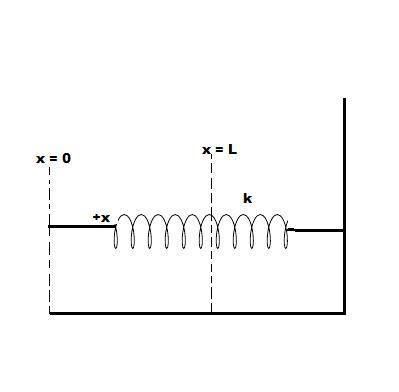
The spring is now compressed so that the unconstrained end moves from x=0 to x=L. Using the work integral W=∫xfxiF⃗ (x⃗ )⋅dx⃗ ,
Sav [3153]

solution:

the spring force applied by a spring with spring constant k can be expressed as

F(x)=-kx

where k acts as the spring constant

and x indicates the spring's deformation

to determine the work completed by the spring

W=\int\limits^L_0 {} \, dW

the amount of work done by the spring when moving from x=0 to x=L

W=-kx^2/2

substituting the limits x=0 and x=L

we derive the work done in terms of k and L

ANSWER

W=-kL^2/2

4 0
2 months ago
An object with charge q = −6.00×10⁻⁹ C is placed in a region of uniform electric field and is released from rest at point A. Aft
kicyunya [3294]

Response:

a) 80 V

b) The electric field has a strength of 100 N/C, directed from point B toward point A, where the charge is negative.

Clarification:

Given:

An object with a charge of q = -6.00 x 10^-9 C starts from rest at point A, making its kinetic energy zero ( K_{A}= 0) and moving to point B at a distance l = 0.500m where its kinetic energy is ( K_{B}= 5.00 x 10^-7J). Additionally, the electric potential of q at point A is VA = +30.0 v.

Required:

(a) We seek to find the electric potential VB

(b) We need to compute the magnitude and orientation of the electric field E.

Solution

(a) Utilizing the given values for VA,K_{B} and q, we derive a relationship among the three parameters and VB to compute VB.

At points A and B, the charge moves from A to B due to the electric field. The mechanical energy of the object remains conserved throughout this journey, allowing us to apply eq(1) in this context:

                                   K_{A} +U_{A} =K_{B} +U_{B}.........................................(1)                                          

Where K_{A}= 0, and the potential energy U of the charge is defined as U = q V

In this equation, V represents the electric potential. Thus, equation (1) can be expressed as:

                                  0+qVA=K_{B} +qVB                    (Dividing by q)

                                         VA=K_{B} /q + VB                  (Restructuring for VB)

                                         VB=VA- K_{B}/q.......................................(2)

We now have the relation between VB, VA, and K_{B}, allowing us to substitute our values for VA, K_{B}, and q into equation (2) to obtain VB

                                         VB=VA- K_{B}/q

                                              =30V-(5.00 x 10^-7J)/(-6.00 x 10^-9)

                                              =80 V

(b) After calculating VB, we may use equation a to derive the electric field E affecting the charge q, where the potential difference between the two points equals the integration of the electric field multiplied by the distance l between these points

                                   VA-VB =\int\limits^1_0 {E} \, dl...................................(a)

                                               =E\int\limits^1_0 {} \, dl

                                   VA-VB=El                      (Restructuring for E)

                                            E= VA-VB/l..................................(3)

Now, substituting our values for VA, Vs, and l into equation (3) allows us to compute the electric field E

                                            E= VA-VB/l

                                              =-100 N/C

The electric field's magnitude equals 100 N/C and it directs from point B to point A towards the negative charge.


5 0
2 months ago
"if a stream flow measures 12 meters in 60 seconds, what is the stream's average rate of flow?"
Yuliya22 [3333]
Discharge refers to the volume of water flowing down a river or stream within a specific timeframe, typically measured in cubic feet per second or gallons per day. Generally, the discharge of a river is calculated by taking the product of the cross-sectional area of water in the channel and the average velocity of water at that section: discharge = area * velocity. In this instance, the result is 0.2 m/s.
7 0
2 months ago
Other questions:
  • In which applications are sound waves reflected? Check all that apply.
    7·2 answers
  • You are an employee of the city of Chicago. A city official declares that all cables holding traffic lights in the city should b
    8·1 answer
  • A shell is launched with a velocity of 100 m/s at an angle of 30.0° above horizontal from a point on a cliff 50.0 m above a leve
    13·1 answer
  • While running these tests, crall notices a similarity in the velocity measured at the ground independent of whether the tennis b
    8·2 answers
  • Explain the versatility of epithelial tissue
    6·2 answers
  • A 3.50-meter length of wire with a cross-sectional area of 3.14 × 10⁻⁶ meter2 is at 20° Celsius. If the wire has a resistance of
    11·1 answer
  • You want to create a spotlight that will shine a bright beam of light with all of the light rays parallel to each other. you hav
    7·2 answers
  • 2.0 kg of solid gold (Au) at an initial temperature of 1000K is allowed to exchange heat with 1.5 kg of liquid gold at an initia
    5·1 answer
  • The headlights of a car emit light of wavelength 400 nm and are separated by 1.2 m. The headlights are viewed by an observer who
    10·2 answers
  • The following times are given using metric prefixes on the base SI unit of time: the second. Rewrite them in scientific notation
    9·2 answers
Add answer
Login
Not registered? Fast signup
Signup
Login Signup
Ask question!