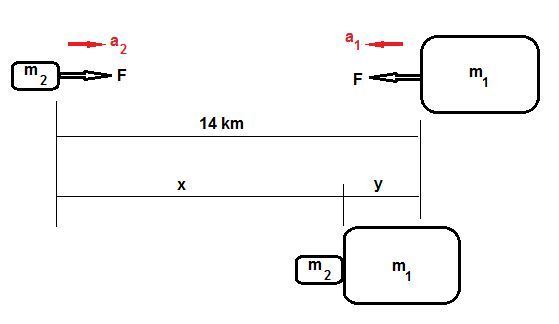
Consider the diagram below.
m₁ = 8.5 x 10⁶ kg, the starship's mass
m₂ = 10⁴ kg, the shuttlecraft's mass
a₁ = acceleration of the starship
a₂ = the acceleration of the shuttle
F = 4 x 10⁴ N, the force exerted
Let y represent the distance covered by the starship
Let x denote the distance covered by the shuttlecraft
If t indicates the travel time, then
y = 0.5a₁t² (1)
x = 0.5a₂t² (2)
F = m₁a₁ = m₂a₂ (3)
Additionally,
x + y = 14000 m (4)
From (2), we derive
a₁ = (4 x 10⁴ N)/(8.5 x 10⁶ kg) = 4.706 x 10⁻³ m/s²
a₂ = (4 x 10⁴ N)/(10⁴ kg) = 4 m/s²
From (1), (2) and (4), we find
0.5*(t s)²*(4 + 4.706 x 10⁻³ m/s²) = 14000 m
2.002353t² = 14000
t² = 6991.774 s²
t = 83.617 s
Thus
x = 0.5*4*6991.774 = 13984 m = 13.984 km
y = 0.5*4.706 x 10⁻³*6991.774 = 16.452 m
The starship moves roughly 16.5 meters while towing the shuttlecraft by 13.98 kilometers.
Result: The starship shifts by 16.5 m (to the nearest tenth)