answer.
Ask question
Login Signup
Ask question
All categories
  • English
  • Mathematics
  • Social Studies
  • Business
  • History
  • Health
  • Geography
  • Biology
  • Physics
  • Chemistry
  • Computers and Technology
  • Arts
  • World Languages
  • Spanish
  • French
  • German
  • Advanced Placement (AP)
  • SAT
  • Medicine
  • Law
  • Engineering
son4ous
2 months ago
10

A Federation starship (8.5 ✕ 106 kg) uses its tractor beam to pull a shuttlecraft (1.0 ✕ 104 kg) aboard from a distance of 14 km

away. The tractor beam exerts a constant force of 4.0 ✕104 N on the shuttlecraft. Both spacecraft are initially at rest. How far does the starship move as it pulls the shuttlecraft aboard?

Physics
1 answer:
Keith_Richards [3.2K]2 months ago
3 0
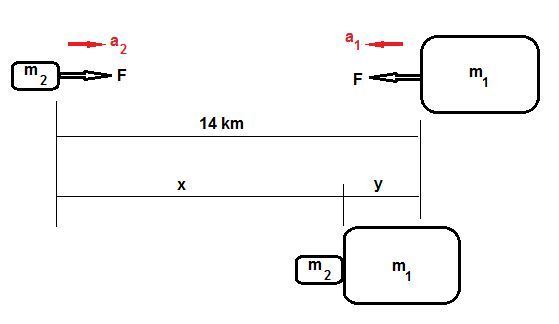
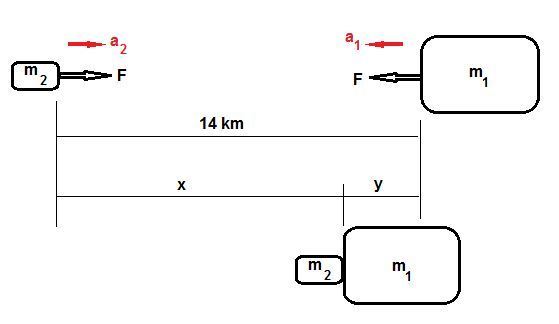
Consider the diagram below.

m₁ = 8.5 x 10⁶ kg, the starship's mass
m₂ = 10⁴ kg, the shuttlecraft's mass
a₁ =  acceleration of the starship
a₂ = the acceleration of the shuttle
F = 4 x 10⁴ N, the force exerted

Let y represent the distance covered by the starship
Let x denote the distance covered by the shuttlecraft
If t indicates the travel time, then
y = 0.5a₁t²                  (1)
x = 0.5a₂t²                  (2)

F = m₁a₁ = m₂a₂         (3)
Additionally,
x + y = 14000 m          (4)

From (2), we derive
a₁ = (4 x 10⁴ N)/(8.5 x 10⁶ kg) = 4.706 x 10⁻³ m/s²
a₂ = (4 x 10⁴ N)/(10⁴ kg) = 4 m/s²

From (1), (2) and (4), we find
0.5*(t s)²*(4 + 4.706 x 10⁻³ m/s²) = 14000 m
2.002353t² = 14000
t² = 6991.774 s²
t = 83.617 s

Thus
x = 0.5*4*6991.774 = 13984 m = 13.984 km
y = 0.5*4.706 x 10⁻³*6991.774 = 16.452 m

The starship moves roughly 16.5 meters while towing the shuttlecraft by 13.98 kilometers.

Result: The starship shifts by 16.5 m (to the nearest tenth)
You might be interested in
A baseball thrown at an angle of 60.0° above the horizontal strikes a building 16.0 m away at a point 8.00 m above the point fro
Ostrovityanka [3204]

Answer:

a) v_{o} =16m/s

b) v=9.8m/s

c) \beta =-35.46º

Explanation:

According to the problem, the distance from the building where the ball hits is 16m, and its final elevation exceeds the initial height by 8m.

With this information, we can compute the ball’s starting speed.

a) Let's first assess the horizontal trajectory.

x=v_{ox}t

x=v_{o}cos(60)t

v_{o}=\frac{x}{tcos(60)}=\frac{16m}{tcos(60)} (1)

This gives us our initial equation.

Next, we need to examine the vertical trajectory.

y=y_{o}+v_{oy}t+\frac{1}{2}gt^2

y_{o}+8=y_{o}+v_{o}sin(60)t-\frac{1}{2}(9.8)t^2

Utilizing v_{o} in our first equation (1)

8=\frac{16}{tcos(60)}sin(60)t-\frac{1}{2}(9.8)t^2

\frac{1}{2}(9.8)t^2=16tan(60)-8

Now let’s solve for t.

t=\sqrt{\frac{2(16tan(60)-8)}{9.8} } =2s

The ball takes two seconds to reach the adjacent building, allowing us to compute its initial speed.

v_{o}=\frac{16m}{(2s)cos(60)}=16m/s

b) To determine the velocity magnitude just before impact, we must calculate both x and y components.

v_{x}=v_{ox}+at=16cos(60)=8m/s

v_{y}=v_{oy}+gt=16sin(60)-(9.8)(2)=-5.7m/s

The computed velocity magnitude is:

v=\sqrt{v_{x}^{2}+v_{y}^{2}}=\sqrt{(8m/s)^2+(-5.7m/s)^2}=9.8m/s

c) The ball's angle is:

\beta=tan^{-1}(\frac{v_{y} }{v_{x}})=tan^{-1}(\frac{-5.7}{8})=-35.46º

4 0
2 months ago
A brick is dropped (zero initial speed) from the roof of a building. The brick strikes the ground in 1.90 s. You may ignore air
Sav [3153]

Answer:

Height (h) = 17 m

Velocity (v) = 18.6 m/s

Explanation: This problem can be solved using kinematic motion equations.

Given Data

Initial velocity (u) = 0

Acceleration (a) = g

Time (t) = 1.9 seconds

First, we calculate the height.

s=ut+0.5at^2\\h=ut+0.5at^2\\h=0*1.9+0.5*9.81*1.9^2\\h=17.707 m

Then, we find the final velocity

v=u+at\\v=0+9.81*1.9\\v=18.639

The acceleration graph is a linear representation described by y=9.8, as it remains constant:

The velocity graph can be represented by y=9.8x (where y signifies velocity and x indicates time):

The displacement graph can be described as y=4.9x^2 (with x as time and y as displacement):

These graphs apply exclusively from x=0 to x=1.9, so disregard other sections of the graphs.

5 0
2 months ago
Leading edge flaps can be used to decrease (or eliminate) the leading edge suction peak at a desired lift coefficient. When airf
kicyunya [3294]

Answer:

An examination is conducted to assess how basic thin airfoils perform in slightly supersonic flow conditions, utilizing the nonlinear transonic theory initially proposed by von Kármán[1]. Formulas for the pressure coefficient across an oblique shock and a Prandtl-Meyer expansion are devised based on a transonic similarity variable. Aerodynamic coefficients are computed in similarity form for flat plates and asymmetric wedge airfoils, and their graphical representations are created. Sample plots are provided for a flat plate and a particular asymmetric wedge, shown on conventional coordinate axes of Cl, Cd, and Cmc/4 in relation to angle of attack and Cl against Mach Number to showcase distinct characteristics of nonlinear flow.

Explanation:

5 0
29 days ago
A nerve signal is transmitted through a neuron when an excess of Na+ ions suddenly enters the axon, a long cylindrical part of t
Yuliya22 [3333]

Answer:

1.32.225 N/C, moving away from the point charge

2. 8.972*10^-12 C

3. the field is oriented away from the axon

Explanation:

The calculation for the electric field is illustrated below:

E = k*|q|/r²

Where:

E = electric field; k = 8.98755*10⁹ N*m²/C²; r = distance separating the field being measured from the point charge = 0.05 m; q = point charge

For a length of 0.100 m of the axon, the value of q is calculated as:

q = (5.6*10¹¹)*(+e)*(0.001)

+e = charge of an electron = 1.60217*10^-19 C

Therefore:

q = (5.6*10¹¹)*(1.60217*10^-19)*(0.0001) = 8.972*10^-12 C

Consequently:

E = (8.98755*10⁹)*(8.972*10^-12)/0.05² = 32.255 N/C

A positive point charge produces an electric field that radiates outward, while a negative point charge creates an electric field directed inward.

3 0
2 months ago
The magnitude J(r) of the current density in a certain cylindrical wire is given as a function of radial distance from the cente
Softa [3030]
J(r) = Br. We know that the area of a small segment, dA, is represented as 2 π dr. Thus, I = J A and dI = J dA. Plugging in the values gives us dI = B r. 2 π dr which simplifies to dI= 2π Br² dr. Now, integrating the above equation: Given that B= 2.35 x 10⁵ A/m³, with r₁ = 2 mm and r₂ equal to 2 + 0.0115 mm, or 2.0115 mm.
7 0
1 month ago
Read 2 more answers
Other questions:
  • Two students walk in the same direction along a straight path, at a constant speed one at 0.90 m/s and the other at 1.90 m/s. a.
    12·1 answer
  • A 60.0-kg crate rests on a level floor at a shipping dock. The coefficients of static and kinetic friction are 0.760 and 0.410,
    15·1 answer
  • Suppose you sketch a model of an atom using the ones here as a guide. How would you build a model that is ionized? How would you
    15·1 answer
  • 1. Si comprimes un globo hasta reducir su volumen a un tercio de su valor original, ¿cuánto aumenta la presión en su interior?
    7·1 answer
  • Light from a monochromatic source shines through a double slit onto a screen 5.00 m away. The slits are 0.180 mm apart. The dark
    13·1 answer
  • If you stand next to a wall on a frictionless skateboard and push the wall with a force of 40n, how hard does the wall push on y
    14·1 answer
  • Barker is unloading 20kg bottles of water from this delivery truck when one of the bottles tips over and slides down the truck r
    7·1 answer
  • Rita throws a ball straight up into the air and catches it at the same position from which she threw it. The ball has 18 J of me
    11·2 answers
  • 2.27 A gas is compressed from V1= 0.3 m3, p1=1 bar to V2= 0.1 m3, p2 =3 bar. The pressure and
    15·1 answer
  • What is the total flux φ that now passes through the cylindrical surface? enter a positive number if the net flux leaves the cyl
    15·1 answer
Add answer
Login
Not registered? Fast signup
Signup
Login Signup
Ask question!