answer.
Ask question
Login Signup
Ask question
All categories
  • English
  • Mathematics
  • Social Studies
  • Business
  • History
  • Health
  • Geography
  • Biology
  • Physics
  • Chemistry
  • Computers and Technology
  • Arts
  • World Languages
  • Spanish
  • French
  • German
  • Advanced Placement (AP)
  • SAT
  • Medicine
  • Law
  • Engineering
julia-pushkina
2 months ago
11

The components of an electronic system dissipating 90 W are located in a 1-m-long circular horizontal duct of 15-cm diameter. Th

e components in the duct are cooled by forced air, which enters at 32°C at a rate of 0.65 m3/min. Assuming 85 percent of the heat generated inside is transferred to air flowing through the duct and the remaining 15 percent is lost through the outer surfaces of the duct, determine (a) the exit temperature of air and (b) the highest component surface temperature in the duct.

Engineering
1 answer:
iogann1982 [368]2 months ago
4 0

Answer:

Provided information

 an electronic system dissipating = 90 W

diameter = 15 cm

The duct has components cooled by forced air entering at 32°C with a flow rate of 0.65 m3 /min

85% of the generated heat is transferred to the air in the duct, and 15% is lost through the duct's outer surfaces.

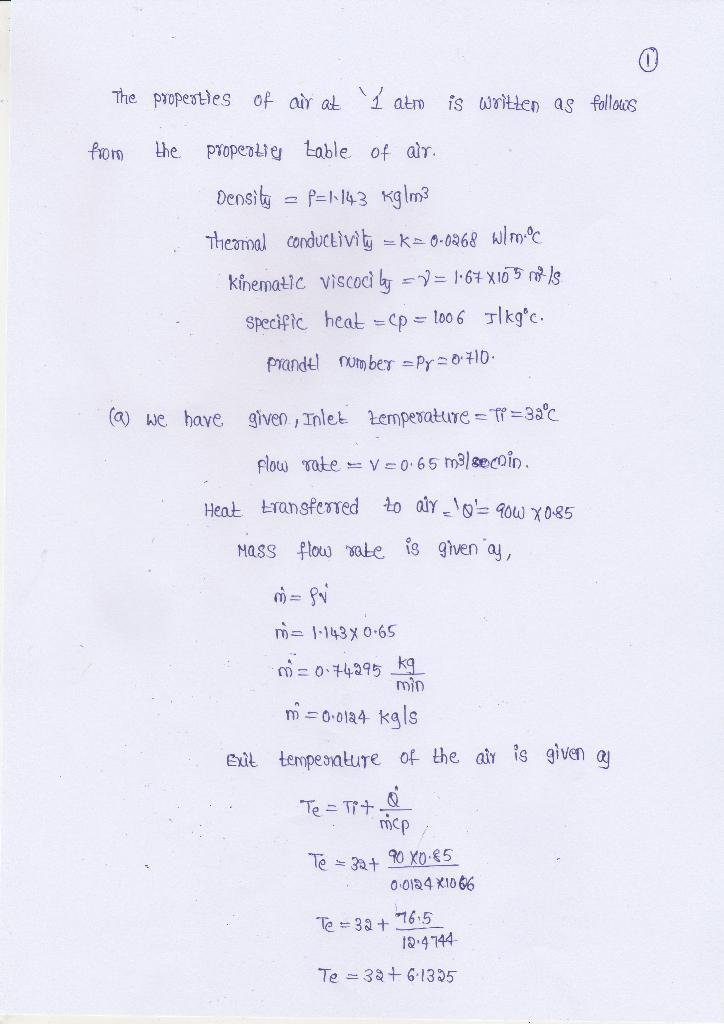
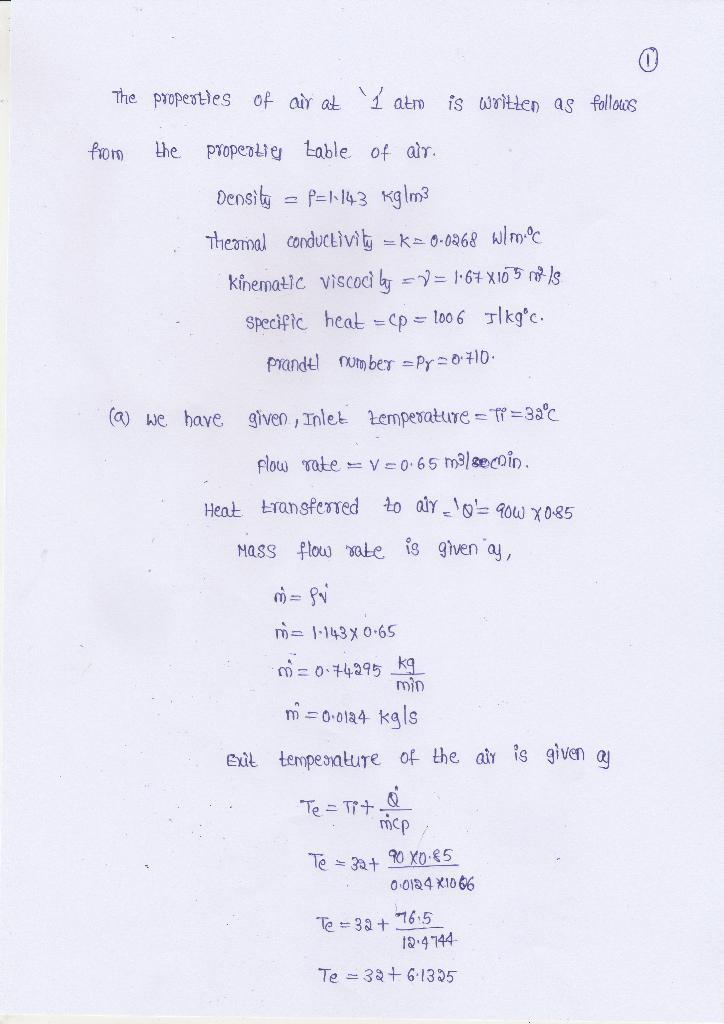
See the attached images for the solution.

Explanation:

Consult the attached pictures for a thorough breakdown of the explanation.

You might be interested in
Helium gas is compressed from 90 kPa and 30oC to 450 kPa in a reversible, adiabatic process. Determine the final temperature and
choli [298]

Answer:

T2 ( final temperature ) = 576.9 K

a) 853.4 kJ/kg

b) 1422.3 kJ / kg

Explanation:

given data:

pressure ( P1 ) = 90 kPa

Temperature ( T1 ) = 30°c + 273 = 303 k

P2 = 450 kPa

To determine final temperature in an Isentropic process

T2 = T1 (\frac{p2}{p1} )^{(k-1)/k} ----------- ( 1 )

T2 = 303 ( \frac{450}{90})^{(1.667- 1)/1.667} = 576.9K

The work performed in a piston-cylinder device is calculated using the subsequent formula

w_{in} = c_{v} ( T2 - T1 )    ------- ( 2 )

where: cv = 3.1156 kJ/kg.k for helium gas

             T2 = 576.9K,    T1 = 303 K

substituting values into equation 2

w_{in} = 853.4 kJ/kg

the work done in a steady flow compressor is determined using this

w_{in} = c_{p} ( T2 - T1 )

where: cp ( constant pressure of helium gas ) = 5.1926 kJ/kg.K

             T2 = 576.9 k, T1 = 303 K

plugging values back into equation 3

w_{in} = 1422.3 kJ / kg

4 0
2 months ago
Six years ago, an 80-kW diesel electric set cost $160,000. The cost index for this class of equipment six years ago was 187 and
grin007 [323]

Answer:

total expense for the new boiler = $229706.825

total expense for new boiler = $127512

Explanation:

provided information

initial power p1 = 80 kW

price C = $160000

cost index CI 1 = 187

cost index CI 2= 194

capacity factor f = 0.6

subsequent power p2 = 120 kW

present cost = $18000

to determine

total expense and cost for 40 kW

solution

we evaluate CN cost for the new boiler and CO cost for the existing boiler

where x represents the capacity of the new boiler

first we compute the current cost of the old boiler which is

current cost CO = C × \frac{CI 1 }{CI 2 }.............1

substituting the value here

current cost = 160000 × \frac{194 }{187 }

updated current cost = $165989.304

and

employing power sizing strategy for 124 kW

CN/CO = (\frac{p2}{p1} )^{f}...............2

insert value and calculate CN

CN/CO = (\frac{p2}{p1} )^{f}  

CN / 165989.304 = (\frac{120}{80} )^{0.6}  

CN = 211706.825

therefore the new expense = $211706.825

hence

total expense for the new boiler amounts to

total expense = new expense + current cost

total exp = 211706.825 + 18000

boiler expense total = $229706.825

and

concerning a 40 kW unit, the calculated new cost will be

applying equation 2

CN/CO = (\frac{p2}{p1} )^{f}

CN / 165989.304 = (\frac{40}{80} )^{0.6}  

CN = 109512

thus the new cost is $109512

therefore

total expense for the new boiler is

total exp = new cost + current cost

total expense = 109512 + 18000

total cost for the new boiler = $127512

7 0
2 months ago
Madison and Oxford are the same distance from the equator and they are both near the ocean. Use the information on the map to an
pantera1 [306]

Answer:

The air temperature should be similar in both regions.

Explanation:

Climate conditions differ globally. Additionally, factors such as distance from the ocean, landscape, and elevation influence these conditions.

If both areas are equidistant from the equator and close to the ocean, there is a high likelihood that they will have similar climate conditions, thus resulting in comparable temperature ranges.

4 0
1 month ago
For each of the following combinations of parameters, determine if the material is a low-loss dielectric, a quasi-conductor, or
choli [298]

Answer:

Glass: Low-Loss dielectric

  α = 8.42*10^-11 Np/m

  β = 468.3 rad/m

  λ = 1.34 cm

  up = 1.34*10^8 m/s

  ηc = 168.5 Ω

Tissue: Quasi-Conductor

  α = 9.75 Np/m

  β = 12.16 rad/m

  λ = 51.69 cm

  up = 0.52*10^8 m/s

  ηc = 39.54 + j 31.72 Ω        

Wood: Good conductor

  α = 6.3*10^-4 Np/m

  β = 6.3*10^-4 Np/m

  λ = 10 km

  up = 0.1*10^8 m/s

  ηc = 6.28*( 1 + j )

Explanation:

Given:

Glass with µr = 1, εr = 5, and σ = 10−12 S/m at 10 GHz

Animal tissue with µr = 1, εr = 12, and σ = 0.3 S/m at 100 MHz.

Wood with µr = 1, εr = 3, and σ = 10−4 S/m at 1 kHz

Find:

Determine if  the material is a low-loss dielectric, a quasi-conductor, or a good conductor, and then  calculate α, β, λ, up, and ηc:

Solution:

- We need to determine the loss tangent to classify the medium as follows:

                                σ / w*εr*εo

Where, w is the wave's angular frequency

            εo is the permittivity of free space = 10^-9 / 36*pi

- Now we categorize according to the following guidelines:

    Glass = \frac{10^-^1^2 }{2*\pi * 10*10^9 * \frac{5*10^-^9}{36\pi } } = 3.6*10^-^1^3\\\\Tissue = \frac{0.3 }{2*\pi * 100*10^6 * \frac{12*10^-^9}{36\pi } } = 4.5\\\\Wood = \frac{10^-^4 }{2*\pi * 1*10^3 * \frac{3*10^-^9}{36\pi } } = 600\\  

- For σ / w*εr*εo < 0.01 --- Low-Loss dielectric and σ / w*εr*εo > 100 --- Good conductor.

    Glass: Low-Loss dielectric

    Tissue: Quasi-Conductor

    Wood: Good conductor

- Next, we will apply the categorized material equations specified in Table 17-1 as follows:

     Glass: Low-Loss dielectric

          α = (σ / 2)*sqrt(u / εr*εo) = (10^-12 / 2)*sqrt( 4*pi*10^-7/5*8.85*10^-12)

          α = 8.42*10^-11 Np/m

          β = w*sqrt (u*εr*εo) = 2pi*10^10*sqrt (4*pi*10^-7*5*8.85*10^-12)

          β = 468.3 rad/m

          λ = 2*pi / β = 2*pi / 468.3

          λ = 1.34 cm

          up = λ*f = 0.0134*10^10

          up = 1.34*10^8 m/s

          ηc = sqrt ( u / εr*εo ) = sqrt( 4*pi*10^-7/12*8.85*10^-12)

          ηc = 168.5 Ω

     Tissue: Quasi-Conductor

          α = (σ / 2)*sqrt(u / εr*εo) = (0.3 / 2)*sqrt( 4*pi*10^-7/12*8.85*10^-12)

          α = 9.75 Np/m

          β = w*sqrt (u*εr*εo) = 2pi*100*10^6*sqrt (4*pi*10^-7*12*8.85*10^-12)

          β = 12.16 rad/m

          λ = 2*pi / β = 2*pi / 12.16

          λ = 51.69 cm

          up = λ*f = 0.5169*100*10^6

          up = 0.52*10^8 m/s

          ηc = sqrt ( u / εr*εo )*( 1 - j (σ / w*εr*εo))^-0.5

          ηc = sqrt (4*pi*10^-7*12*8.85*10^-12)*( 1 - j 4.5)^-0.5

          ηc = 39.54 + j 31.72 Ω

     Wood: Good conductor

          α = sqrt (pi*f*σ u) = sqrt( pi* 10^3 *4*pi* 10^-7 * 10^-4 )

          β = α = 6.3*10^-4 Np/m

          λ = 2*pi / β = 2*pi / 6.3*10^-4

          λ = 10 km

          up = λ*f = 10,000*1*10^3

          up = 0.1*10^8 m/s

          ηc = α*( 1 + j ) / б = 6.3*10^-4*( 1 + j ) / 10^-4

          ηc = 6.28*( 1 + j )
         

8 0
1 month ago
Other questions:
  • How does Accenture generate value for clients through Agile and DevOps?
    15·2 answers
  • Given num_rows and num_cols, print a list of all seats in a theater. Rows are numbered, columns lettered, as in 1A or 3E. Print
    14·1 answer
  • An 80-L vessel contains 4 kg of refrigerant-134a at a pressure of 160kPa. Determine (a) the temperature, (b) the quality, (c) th
    11·1 answer
  • . Were you able to observe ???? = 0 in the circuit you constructed during lab? Why or why not? Hint: What value of resistance wo
    6·1 answer
  • Gina is about to use a fire extinguisher on a small fire. What factor determines the type of extinguisher she should use
    9·2 answers
  • A sequential circuit has two inputs, w1and w2, and an output, z. Its function is to compare the input sequences on the two input
    9·1 answer
  • A pressurized 2-m-diameter tank of water has a 10-cm-diameter orifice at the bottom where water discharges to the atmosphere. Th
    12·1 answer
  • A 10-ft-long simply supported laminated wood beam consists of eight 1.5-in. by 6-in. planks glued together to form a section 6 i
    5·1 answer
  • A horizontal curve is to be designed for a two-lane road in mountainous terrain. The following data are known: Intersection angl
    7·1 answer
  • For a two-source network, if current produced by one source is in one direction, while the current produced by the other source
    14·1 answer
Add answer
Login
Not registered? Fast signup
Signup
Login Signup
Ask question!