answer.
Ask question
Login Signup
Ask question
All categories
  • English
  • Mathematics
  • Social Studies
  • Business
  • History
  • Health
  • Geography
  • Biology
  • Physics
  • Chemistry
  • Computers and Technology
  • Arts
  • World Languages
  • Spanish
  • French
  • German
  • Advanced Placement (AP)
  • SAT
  • Medicine
  • Law
  • Engineering
aleksklad
1 day ago
6

If the coefficient of static friction between a table and a uniform massive rope is μs, what fraction of the rope can hang over

the edge of the table without the rope sliding?

Physics
2 answers:
inna [987]1 day ago
8 0
Here's the procedure explained: Assume F represents the portion of the rope that is extending over the table. In this scenario, the frictional force that holds the rope on the table can be calculated using the formula: Ff = u*(1-f)*m*g. Additionally, it is important to determine the gravitational force that attempts to pull the rope off the table, Fg, calculated through: Fg = f*m*g. You then need to set these two equations equal to each other and resolve for f: f*m*g = u*(1-f)*m*g leads to f = u*(1-f) = u - uf. Simplifying gives f + uf = u, which results in f = u/(1+u) representing the fraction of the rope. This will lead you to the final answer.
kicyunya [1K]1 day ago
4 0

The fraction of the rope that can hang over the table edge without slipping is \boxed{\frac{{{\mu _s}}}{{\left( {1 + {\mu _s}} \right)}}}.

Further clarification:

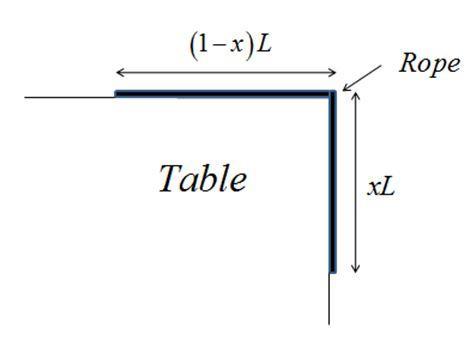
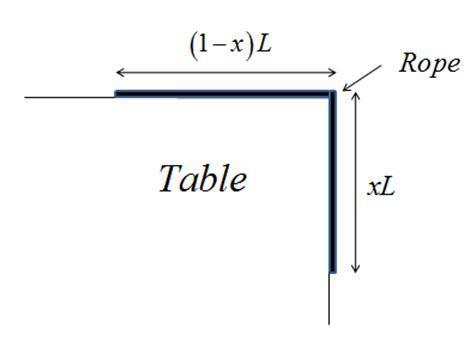
A rope with a consistent mass hangs over the edge of the table without sliding down.

Concept:

Let's analyze the problem:

The mass per unit length of the rope is \lambda.

Total length of the rope is L.

The overall mass of the rope is

M=\lambda L                                                                 …… (1)

Assume x represents the fraction of the rope's length that is hanging off the table.

The length of the rope that hangs over the table's edge is:

{l_1}=xL                                                                             …… (2)

The mass of the portion of the rope that hangs over the table is:

{m_1}=x{l_1}    

Now insert the value of {l_1} from equation (1) into this equation.

{m_1}=x\lambda L                                                                        …… (3)

The remaining mass of rope that lies on the table is:

{m_2}=M-{m_1}


Substitute the values of M from equation (1) and m_1 from equation (3) into the above equation.

{m_2}=\lambda L - x\lambda L    

Simplifying the expression above gives:

{m_2}=\left( {1 - x} \right)\lambda L                                              …… (4)

Based on the free body diagram for the hanging mass of the rope, the total forces acting on it, both horizontal and vertical, balance out to zero.

The balance condition for the horizontal force acting on the rope is:

\sum {F_x}=0

The balance condition for the vertical force on the rope is:

\sum {F_y}=0

Under equilibrium, the horizontal net force amounts to:

F-{m_1}g = 0    

Now simplify this equation,

\boxed{F={m_1}g}    

Insert the value of {m_1} from equation (3) into the above equation.

\boxed{F=x\lambda Lg}                                                                                          …… (5)

According to the free body diagram, the normal force acting on the rope is counterbalanced by the weight of the section resting on the table.

In equilibrium, the vertical net force is:

\boxed{N={m_2}g}    

Here, N signifies the normal force from the table, balanced out by the weight of the rope that is on the table.

Insert the value of {m_2} from equation (4) into this equation.

N=\left( {1 - x} \right)\lambda Lg                                                                …… (6)

The force due to friction acting on the rope is:

{F_r}={\mu _s}N


Where {\mu _s} is the coefficient of static friction.

Substituting the value of N from equation (6) provides:

{F_r}={\mu _s}\left( {1 - x} \right)\lambda Lg                                             …… (7)


Replace the value of {F_r} from equation (7) in the above equation.

\boxed{F={\mu _s}\left( {1 - x} \right)\lambda Lg}                                                                                                    …… (8)

By setting the equations (5) and (8) equal to one another,

x\lambda Lg={\mu _s}\left( {1 - x} \right)\lambda Lg

Rearranging and simplifying this expression we get.

\fbox{\begin\\x=\dfrac{{{\mu _s}}}{{\left( {1 + {\mu _s}} \right)}}\end{minispace}}

Therefore, the fraction of the rope that can extend down from the edge of the table without slipping is \boxed{\frac{{{\mu _s}}}{{\left( {1 + {\mu _s}} \right)}}}.    

Learn more:

1. Average translational kinetic energy:

2. Acceleration of body by considering friction:

3. Conservation of energy

Answer detail:

Grade: High school

Subject: Physics

Chapter: Friction

Keywords:

Rope on the table, fraction of rope, length, rope without slide, coefficient of friction, static friction, uniformly massive rope, weight, equilibrium condition, mu/1+mu, mu/(1+mu), mass per unit length.

You might be interested in
Consider the uniform electric field \vec{E} =(4000~\hat{j}+3000~\hat{k})~\text{N/C} ​E ​⃗ ​​ =(4000 ​j ​^ ​​ +3000 ​k ​^ ​​ ) N/
kicyunya [1011]

Answer:

Electric flux is calculated as \phi=31562.63\ Nm^2/C

Explanation:

We start with the given parameters:

The electric field impacting the circular surface is E=(4000j+3000k)\ N/C

Our objective is to ascertain the electric flux passing through a circular region with a radius of 1.83 m situated in the xy-plane. The area vector is oriented in the z direction. The formula for electric flux is expressed as:

\phi=E{\cdot}A

\phi=(4000j+3000k){\cdot}Ak

Applying properties of the dot product, we calculate the electric flux as:

\phi=3000\times Ak

\phi=3000\times \pi (1.83)^2

\phi=31562.63\ Nm^2/C

Consequently, the electric flux for the circular area is \phi=31562.63\ Nm^2/C. Thus, this represents the required answer.

4 0
1 day ago
A solid metal sphere of diameter D is spinning in a gravity-free region of space with an angular velocity of ωi. The sphere is s
ValentinkaMS [1144]

Answer:

0.6

Explanation:

The formula for the volume of a sphere is \frac{4}{3} \pi (\frac{D}{2})^3

Thus \pi * r^2 * (\frac{D}{2} ) = \frac{4}{3} \pi (\frac{D}{2})^3

The radius of the disk is 1.15(\frac{ D}{2} )

Applying angular momentum conservation;

The M_i of the sphere = \frac{2}{5} m \frac{D}{2}^2

M_i of the disk = m*\frac{ \frac{1.15*D}{2}^2 }{2}

\frac{wd}{ws} = \frac{\frac{2}{5}m * \frac{D}{2}^2}{ m * \frac{(\frac{`.`5*D}{2})^2 }{2} }

= 0.6

5 0
4 days ago
The muzzle velocity of a gun is the velocity of the bullet when it leaves the barrel. The muzzle velocity of one rifle with a sh
Keith_Richards [1021]

Answer: small barrel gun

Explanation:

It is noted that short barrel guns have a higher muzzle velocity for bullets compared to longer barrel guns.

Acceleration is determined by the change in velocity with respect to time.

a=\dfrac{\Delta v}{\Delta t}

For short barrel guns, the bullet reaches its muzzle velocity more quickly, leading to greater acceleration than that of bullets from long barrel guns.

7 0
11 days ago
An object is traveling at a constant velocity of 15 m/s when it experiences a constant acceleration of 3.5 m/s2 for a time of 11
serg [1189]

Vf=Vi+at=15m/s+(3.5m/s^2)(11s)=53.5m/s

7 0
8 days ago
Frank wrote several statements to summarize the relationship between the first and second laws of thermodynamics. 1 - Thermal en
Maru [1053]
According to the second law, heat, often called thermal energy, cannot be entirely turned into work.
The second statement is closely tied to this law.
We can conclude that some energy dissipates while some is used for work.
5 0
10 days ago
Read 2 more answers
Other questions:
  • State two advantages of a lead-acid accumulator over a leclanche cell​
    8·1 answer
  • A closed system of mass 10 kg undergoes a process during which there is energy transfer by work from the system of 0.147 kJ per
    15·1 answer
  • A scientist is creating a new synthetic material. The material’s density is 6.1 g/cm3. Which sentences describe how the scientis
    7·2 answers
  • Write a hypothesis about the effects of magnetic and electric fields. Use the format of "if . . . then . . . because . . ." and
    8·2 answers
  • A box of volume V has a movable partition separating it into two compartments. The left compartment contains 3000 particles, the
    15·1 answer
  • Three balls of equal mass are fired simultaneously with equal speeds from the same height h above the ground. Ball 1 is fired st
    7·1 answer
  • It's a snowy day and you're pulling a friend along a level road on a sled. You've both been taking physics, so she asks what you
    7·1 answer
  • What is the number N0 of 99mTc atoms that must be present to have an activity of 15mCi?
    11·1 answer
  • A straight wire 20 cm long, carrying a current of 4 A, is in a uniform magnetic field of 0.6 T. What is the force on the wire wh
    15·2 answers
  • Compressed air is used to fire a 60 g ball vertically upward from a 0.70-m-tall tube. The air exerts an upward force of 3.0 N on
    8·1 answer
Add answer
Login
Not registered? Fast signup
Signup
Login Signup
Ask question!