answer.
Ask question
Login Signup
Ask question
All categories
  • English
  • Mathematics
  • Social Studies
  • Business
  • History
  • Health
  • Geography
  • Biology
  • Physics
  • Chemistry
  • Computers and Technology
  • Arts
  • World Languages
  • Spanish
  • French
  • German
  • Advanced Placement (AP)
  • SAT
  • Medicine
  • Law
  • Engineering
Annette
2 months ago
15

A solid uniform disk of diameter 3.20 m and mass 42 kg rolls without slipping to the ) bottom of a hill, starting from rest. If

the angular speed of the disk is 4.27 rad/s at the bottom, how high did it start on the hill? A) 3.57mB) 4.28 mC) 3.14 mD) 2.68 m
Physics
1 answer:
kicyunya [3.2K]2 months ago
8 0

Answer:

(A) = 3.57 m

Explanation:

According to the question, the information provided is:

diameter (d) = 3.2 m

mass (m) = 42 kg

angular speed (ω) = 4.27 rad/s

Using the conservation of energy principle, we have

mgh = 0.5 mv² + 0.5Iω²...equation 1

where

Inertia (I) = 0.5mr²

ω = v/r

Revising equation 1, it turns into

mgh = 0.5 mv² + 0.5(0.5mr²)(v/r)²

resulting in gh = 0.5 v² + 0.5(0.5)v²

This simplifies to 4gh = 2v² + v²

thus h = 3v² ÷ 4g... equation 2

Given ω = v/r, we find v = ωr = 4.27 × (3.2 ÷ 2)

which yields v = 6.8 m/s

Next, substituting the value of v into equation 2 gives us

h = 3v² ÷ 4g

h = 3 × (6.8)² ÷ (4 × 9.8)

h = 3.57 m

You might be interested in
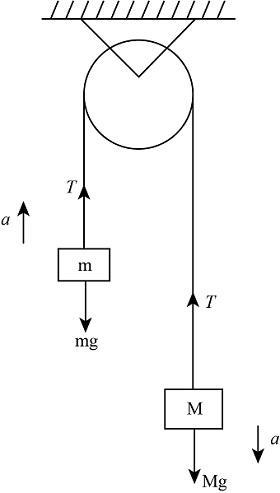
Two blocks are attached to opposite ends of a massless rope that goes over a massless, frictionless, stationary pulley. One of t
Softa [3030]

Answer:

1/7 kg

Explanation:

Refer to the attached diagram for enhanced clarity regarding the question.

One of the blocks weighs 1.0 kg and accelerates downward at 3/4g.

g denotes the acceleration due to gravity.

Let M represent the block with known mass, while 'm' signifies the mass of the other block and 'a' refers to the acceleration of body M.

Given M = 1.0 kg and a = 3/4g.

By applying Newton's second law; \sum fy = ma_y

For the body with mass m;

T - mg = ma... (1)

For the body with mass M;

Mg - T = Ma... (2)

Combining equations 1 and 2 gives;

+Mg -mg = ma + Ma

Ma-Mg = -mg-ma

M(a-g) = -m(a+g)

Substituting M = 1.0 kg and a = 3/4g into this equation leads to;

3/4 g-g = -m(3/4 g+g)

3/4 g-g = -m(7/4 g)

-g/4 = -m(7/4 g)

1/4 = 7m/4

Multiplying gives: 28m = 4

m = 1/7 kg

Hence, the mass of the other box is 1/7 kg

3 0
2 months ago
An object has kinetic energy of 324 J. If it’s speed is 9m/s, what is it’s mass?
ValentinkaMS [3465]
It is 8 kilograms. I had to provide more text, so here it is.
6 0
1 month ago
Read 2 more answers
Select the areas that would receive snowfall because of the lake effect.
Keith_Richards [3271]

Result:

- Grand Marais

- Two Harbors

- Duluth

Explanation:

The locations likely to receive snowfall due to lake effect include Grand Marais, Two Harbors, and Duluth. These areas are situated directly along the shores of Lake Superior, one of the world’s largest lakes. Its substantial water volume significantly influences the local climate, generating a lot of humidity in the air and considerable evaporation, both of which lead to cloud formation and, when temperatures drop adequately, result in significant snowfall rather than rain.

8 0
2 months ago
Albert presses a book against a wall with his hand. As Albert gets tired, he exerts less force, but the book remains in the same
Maru [3345]

Answer:

the maximum static friction force of the wall acting on the book (Increasing)

the normal force of the wall acting on the book (Decreasing)

the weight of the book (Constant)

Explanation:

According to Newton's third law of motion:

"Every action has an equal and opposite reaction"

In the scenario provided, Albert is pressing the book against the wall and subsequently decreases the force applied against the wall.

Let's evaluate all forces influencing the book in this situation.

1. Weight of the book acting downwards (y-axis)

2. Friction from the book against the wall acting upwards (y-axis)

3. Albert’s force exerted on the book against the wall (x-axis)

4. Normal force of the wall reacting to Albert’s applied force (x-axis)

As Albert eases off his force, the new scenario reads:

1. The weight remains constant as represented by W = mg

Since neither mass nor gravitational acceleration has changed, the weight exerted on the book remains the same.

2. As Albert reduces his force, the wall’s normal reaction force decreases correspondingly, following Newton's third law of motion.

3. Friction operates in response to the force applied to it. With a box resting on the floor, no friction acts upon it until it is dragged, at which point friction begins to manifest and rise until it reaches its maximum. Therefore, when Albert diminishes his force, the weight's pull will influence the book and the maximum static friction will rise to resist the book’s downward movement.

It should be noted that the maximum static friction is working to prevent movement of the book. With Albert's force reduced, but the weight of the book unchanged, maximum static friction increases to prevent downward movement.


7 0
2 months ago
What happens to the particles of a liquid when energy is removed from them?
Softa [3030]

Response:

D: The distance among the particles diminishes

Clarification:

Removing energy reduces the activity of molecules, similar to how one slows down in cold temperatures (I believe).

3 0
3 months ago
Other questions:
  • A shell is launched with a velocity of 100 m/s at an angle of 30.0° above horizontal from a point on a cliff 50.0 m above a leve
    13·1 answer
  • You are conducting an experiment inside a train car that may move along level rail tracks. A load is hung from the ceiling on a
    5·1 answer
  • A sinusoidal electromagnetic wave of frequency 6.10×10¹⁴hz travels in vacuum in the +x direction. the magnetic field is parallel
    7·1 answer
  • An organ pipe open at both ends has a radius of 4.0 cm and a length of 6.0 m. what is the frequency (in hz) of the third harmoni
    14·1 answer
  • A 20.00-kg lead sphere is hanging from a hook by a thin wire 2.80 m long and is free to swing in a complete circle. Suddenly it
    6·1 answer
  • The ends of a cylindrical steel rod are maintained at two different temperatures. The rod conducts heat from one end to the othe
    12·1 answer
  • Two tiny, spherical water drops, with identical charges of -6.19 × 10⁻¹⁶ C, have a center-to-center separation of 1.22 cm. (a) W
    8·1 answer
  • Floor lamps usually have a base with large inertia, while the long body and top have much less inertia. Part A If you want to sh
    6·1 answer
  • Two astronauts, each having a mass of 75.0 kg, are connected by a 10.0-m rope of negligible mass. They are isolated in space, or
    12·1 answer
  • 3. A 75kg man sits at one end of a uniform seesaw pivoted at its center, and his 24kg son sits at the
    11·1 answer
Add answer
Login
Not registered? Fast signup
Signup
Login Signup
Ask question!