answer.
Ask question
Login Signup
Ask question
All categories
  • English
  • Mathematics
  • Social Studies
  • Business
  • History
  • Health
  • Geography
  • Biology
  • Physics
  • Chemistry
  • Computers and Technology
  • Arts
  • World Languages
  • Spanish
  • French
  • German
  • Advanced Placement (AP)
  • SAT
  • Medicine
  • Law
  • Engineering
solmaris
1 month ago
6

Oxygen gas, generated by the reaction 2KClO3(s)---2KCl(s)+3O2(g), is collected over water at 27•C in 3.72L vassel at a total pre

ssure of 730 torr.(The vapor pressure of H2O at 27•C is 26.0 torr). How many moles of KClO3 were consumed in the reaction?
Oxygen gas, generated by the reaction 2KClO3(s)---2KCl(s)+3O2(g), is collected over water at 27•C in a 1.16L vessel at a total pressure of 1.00 atm ( The vapor pressure of H2O at 27•C is 26.0 torr) How many moles of KClO3 were consumed in the reaction?
Chemistry
1 answer:
KiRa [2.8K]1 month ago
6 0

Answer:

moles = 0.093 moles

Explanation:

Here, we analyze a reaction occurring in a vessel with a total pressure of 730 torr.

The total pressure can be expressed as:

Pt = Pwater + PO2

We need to ascertain the pressure of O2 since it will allow us to find the moles of KClO3 through stoichiometry.

The oxygen pressure is:

PO2 = 730 - 26 = 704 Torr

Next, we need to convert this pressure from Torr to Atm:

704 Torr divided by 760 Torr equals 0.9263 atm

Now, using the ideal gas equation:

PV = nRT

We can calculate the moles of O2, and consequently the moles of KClO3:

n = PV/RT

R equals 0.082 L atm /K mol

P equals 0.9263 atm

V equals 3.72 L

T equals 27 + 273 equals 300 K

Plugging in the values:

n = 0.9263 * 3.72 / 300 * 0.082

n = 0.14 moles

Finally, using stoichiometry, since 2 moles of KClO3 yield 3 moles of O2, we have:

moles of KClO3 = 0.14 * 2/3 = 0.093 moles of KClO3

You might be interested in
If a reaction occurs, what will be the products of the unbalanced reaction below?Cu(s) + Ni(NO3)2(aq) 
Alekssandra [2933]
Cu(NO3)2 --> MM187.5558 NiNO3 *COEF2* --> 120.6983
3 0
14 days ago
1. Bailey wants to find out which frozen solid melts the fastest: soda, gatorade, or orange juice. She pours each of the three l
VMariaS [2875]

First scenario:

IV: soda, gatorade, orange juice, and water

DV: state of the liquids listed above

Control: freezer and ice tray

Second scenario:

IV: laundry detergent, water

DV: cleanliness of the squares post-wash

Control: chocolate, cloth type, cloth squares

Third scenario:

IV: type of water used, pea plant

DV: growth of the pea plant

Control: pots and daily water amount for the plant

4 0
1 month ago
Read 2 more answers
(a) The original value of the reaction quotient, Qc, for the reaction of H2(g) and I2(g) to form HI(g) (before any reactions tak
KiRa [2867]

Response:

Here's my calculation

Clarification:

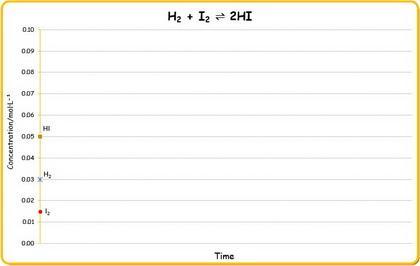
Assume the starting concentrations of H₂ and I₂ are 0.030 and 0.015 mol·L⁻¹, respectively.

We need to determine the initial concentration of HI.

1. We will need a chemical equation with concentrations, so let's compile all the information in one location.

H₂ + I₂ ⇌ 2HI

I/mol·L⁻¹: 0.30 0.15 x

2. Calculate the concentration of HI

Q_{\text{c}} = \dfrac{\text{[HI]}^{2}} {\text{[H$_{2}$][I$_{2}$]}} =\dfrac{x^{2}}{0.30 \times 0.15} =  5.56\\\\x^{2} = 0.30 \times 0.15 \times 5.56 = 0.250\\x = \sqrt{0.250} = \textbf{0.50 mol/L}\\\text{The initial concentration of HI is $\large \boxed{\textbf{0.50 mol/L}}$}

3. Plot the initial values

The graph below visualizes the initial concentrations as plotted on the vertical axis.

7 0
1 month ago
A covalent chemical bond is one in which _____. a covalent chemical bond is one in which _____. outer-shell electrons of two ato
Tems11 [2675]

Response:

            A covalent bond is formed when the outer electrons of two atoms are shared, enabling them to adequately fill their orbitals.

Clarification:

                   Covalent bonds occur between atoms with an electronegativity difference below 1.7. In this bonding type, one atom's valence electrons create a molecular bond with the other atom's valence electrons, leading to mutual sharing of electrons.

                   Covalent bonds can be non-polar, as seen in hydrogen and carbon bonding.

                   Conversely, covalent bonds can also be polar, such as the bond between hydrogen and chlorine, where the chlorine atom is more electronegative and draws electrons towards itself, resulting in a lower electron density on the hydrogen atom.

5 0
26 days ago
Read 2 more answers
What volume of gold would be equal in mass to a piece of copper with a volume of 141 ml? the density of gold is 19.3 g/ml; the d
alisha [2899]

We need to calculate the volume of Gold, assuming its mass matches that of copper.

Given information:

Density of Copper = 8.96 g/ml.
Volume of Copper = 141 ml.
Mass of Gold = Mass of Copper.
Density of Gold = 19.3 g/ml.

To find copper's mass, we use the density equation:
Density = mass/volume.

To find mass of copper:
Mass of copper = Density of Copper * Volume of Copper.
Mass of copper = 8.96 g/ml * 141 ml = 1263.36 g.
Thus,
Mass of gold = Mass of copper = 1263.36 g.
Now, using the density formula for gold to get its volume:
Volume of gold = Mass of gold / Density of gold.
Volume of gold = 1263.36 g / 19.3 g/ml = 65.46 mL.

Consequently, the volume of gold required to match the mass of copper is 65.46 mL.

8 0
1 month ago
Other questions:
  • Explain why CaCl2 is likely to have properties similar to those of CaBr2
    11·1 answer
  • Clayton will mix xxx milliliters of a 10\%10%10, percent by mass saline solution with yyy milliliters of a 20\%20%20, percent by
    7·1 answer
  • Which of the following does not describe elements?
    8·2 answers
  • A buffer is prepared by mixing hypochlorous acid ( HClO ) and sodium hypochlorite ( NaClO ) . If a strong base, such as NaOH , i
    10·1 answer
  • Your town is at sea level, and it is a comfortable room-
    12·1 answer
  • For each case below, identify the most likely value for x: a. BHx b. CHx c. NHx d. CH2Clx
    7·1 answer
  • Limes have a [H3O+] of 1.3 x 10⁻² mol/L. Their pOH is​
    12·1 answer
  • When the following equation is balanced, the coefficients are __________. Al(NO3)3 + Na2S → Al2S3 + Na(NO3)
    11·1 answer
  • Explain why groups 14 and 15 are better representatives of mixed groups than groups 13 and 16
    6·1 answer
  • A laser produces red light of wavelength 632.8 nm. Calculate the energy,
    9·1 answer
Add answer
Login
Not registered? Fast signup
Signup
Login Signup
Ask question!