Answer:

Explanation:
Friction Force
Friction forces arise when items come into contact with each other or a rough surface, especially when there is an attempt to move one against the other. Friction operates in the reverse direction of the intended motion: pushing to the right results in a friction force directed left.
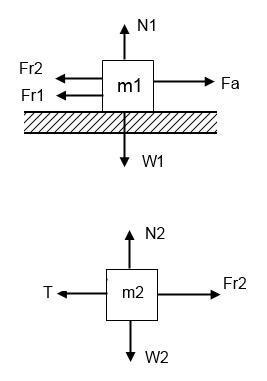
In this scenario, we have two blocks: a 400 kg block on the ground and a 100 kg block positioned atop, secured to a vertical wall via a string. When we attempt to push the bottom block, it will not move freely because two friction forces come into play: one from the surface and the other from the contact between the two blocks, denoted as Fr1 and Fr2. The second block, constrained by the wall, cannot simply slide along with the first one.
The provided figure displays the free body diagrams.
The equilibrium condition for the first mass is given as

The mass m1 is subjected to an applied force Fa, such that slipping with mass m2 just begins, indicating no overall movement (a=0). We can solve for Fa using:
![\displaystyle F_a=F_{r1}+F_{r2}.....[1]](https://tex.z-dn.net/?f=%5Cdisplaystyle%20F_a%3DF_%7Br1%7D%2BF_%7Br2%7D.....%5B1%5D)
The second mass experiences an attempt to move rightward due to the friction force Fr2 while the string maintains its position through tension T. The horizontal axis equation can be outlined as follows:

The friction forces are calculated as


It is important to note that N1 signifies the reaction force from the surface acting on mass m1, which corresponds to the cumulative mass of m1+m2.
Substituting into [1]

Upon simplifying

Finally, entering the numerical values will yield:
![\displaystyle F_{a}=0.25(9.8)[400+2(100)]](https://tex.z-dn.net/?f=%5Cdisplaystyle%20F_%7Ba%7D%3D0.25%289.8%29%5B400%2B2%28100%29%5D)