answer.
Ask question
Login Signup
Ask question
All categories
  • English
  • Mathematics
  • Social Studies
  • Business
  • History
  • Health
  • Geography
  • Biology
  • Physics
  • Chemistry
  • Computers and Technology
  • Arts
  • World Languages
  • Spanish
  • French
  • German
  • Advanced Placement (AP)
  • SAT
  • Medicine
  • Law
  • Engineering
Fofino
3 months ago
6

To visit your favorite ice cream shop, you must travel 490 m west on Main Street and then 920 m south on Division Street. Suppos

e you take 49 s to complete the 490-m displacement and 75 s to complete the 920-m displacement.
a. What is the magnitude of your average velocity during this 121-second period of time?
b. What is the direction of your average velocity during this 121-second period of time?
c. What is your average speed during the trip?
Physics
1 answer:
Yuliya22 [3.3K]3 months ago
5 0

Answer:

a) Your average velocity's magnitude over the course of 121 seconds is 8.61 m/s.

b) The average velocity's direction is at an angle of 61.9° south from west.

c) During this journey, your average speed calculates to be 11.7 m/s.

Explanation:

Hello!

a) Average velocity (a.v) is determined by dividing the total displacement by the time taken to achieve it.

Displacement is the difference between the starting and ending positions:

Displacement = Δ(x,y) = final position - initial position

If we assume the starting location is the origin of our reference frame with west and south as positive directions (+x and +y, respectively), the displacement vector can be represented as:

Δ(x,y) = final position - initial position

Δ(x,y) = (490, 920) m - (0, 0) m = (490, 920) m

The calculation for average velocity will be:

a.v = Δ(x,y) / t

a.v = (490, 920) m / 121 s

a.v = (4.05, 7.60) m/s

To find the magnitude of the average velocity:

The magnitude of your average velocity over the 121 seconds is 8.61 m/s.

b) To find the average velocity's direction, trigonometric principles involving right triangles are necessary. Notice that the x and y components of average velocity (vx and vy), along with the average velocity vector (v, magnitude 8.61 m/s), create a triangle (refer to the figure).

Notice that v acts as the triangle's hypotenuse, vx is the adjacent side to the angle θ, and vy is the opposite side to θ.

Using trigonometric identities, we can derive the angle θ:

cos θ = adjacent side / hypotenuse

cos θ = vx / v

cos θ = 4.05 m/s / 8.61 m/s

θ = 61.9°

The average velocity points at 61.9° south of west.

c) The average speed (a.s) is determined by the total distance (d) traveled divided by the duration (t) it took to traverse that distance. You covered a total distance of (490 m + 920 m) which equals 1410 m in 121 seconds. Therefore, the average speed computation is:

a.s = d/t

a.s = 1410 m / 121 s

a.s = 11.7 m/s

Your average speed for the trip is 11.7 m/s

You might be interested in
1. Use Coulomb’s Law (equation below) to calculate the approximate force felt by an electron at point A in the schematic below.
Keith_Richards [3271]

Answer:

Explanation:

The data indicates that point A is located midway between two charges.

To calculate the electric field at point A, we begin with the field produced by charge -Q ( 6e⁻ ) at A:

= 9 x 10⁹ x 6 x 1.6 x 10⁻¹⁹ / (2.5)² x 10⁻⁴

= 13.82 x 10⁻⁶ N/C

This field points towards Q⁻.

A similar field will arise from the charge Q⁺, but it will direct away from Q⁺ toward Q⁻.

To find the resultant field, we add these contributions:

= 2 x 13.82 x 10⁻⁶

= 27.64 x 10⁻⁶ N/C

For the force acting on an electron placed at A:

= charge x field

= 1.6 x 10⁻¹⁹ x 27.64 x 10⁻⁶

= 44.22 x 10⁻²⁵ N

8 0
2 months ago
Considering the activity series given for nonmetals, what is the result of the below reaction? Use the activity series provided.
ValentinkaMS [3465]

Response: The result would be no reaction.

Clarification:

7 0
2 months ago
Read 2 more answers
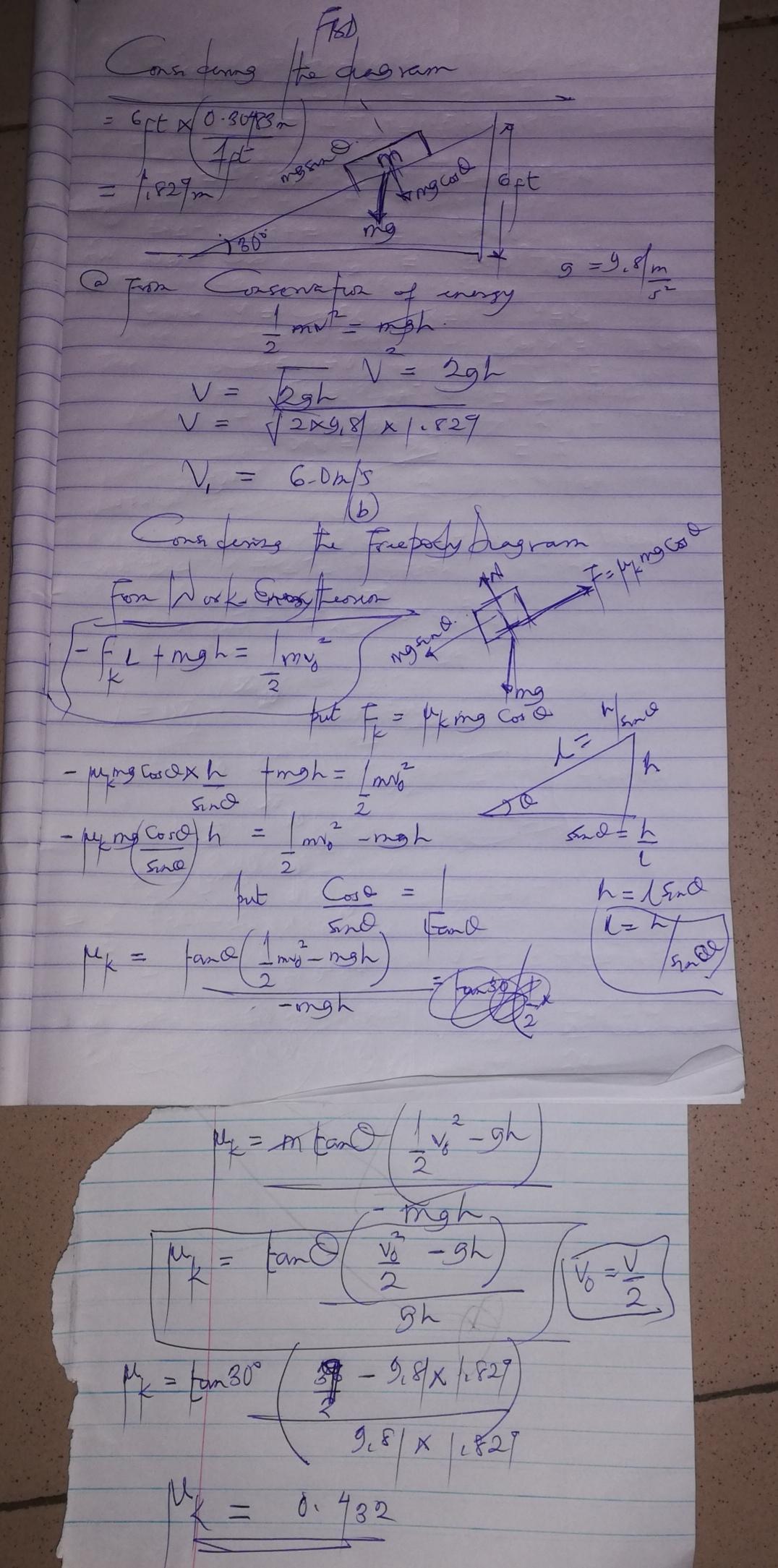
The height of a typical playground slide is about 6 ft and it rises at an angle of 30 ∘ above the horizontal.
Maru [3345]

Answer:

The coefficient of kinetic friction is found to be 0.432.

Explanation:

Comprehensive steps and derivations with necessary substitutions are detailed in the attached document.

6 0
3 months ago
A small object slides along the frictionless loop-the-loop with a diameter of 3 m. what minimum speed must it have at the top of
ValentinkaMS [3465]
<span>3.834 m/s. To solve this problem, we must ensure that the centripetal force equals or exceeds the gravitational force acting on the object. The formula for centripetal force is F = mv^2/r while the equation for gravitational force is F = ma. Since the mass (m) cancels out in both equations, we can equate them, leading to a = v^2/r. Now, inserting the given values (where the radius is half the diameter) allows us to find v: 9.8 m/s^2 <= v^2/1.5 m, which simplifies to 14.7 m^2/s^2 <= v^2. Therefore, we find that the minimum velocity required is 3.834057903 m/s <= v. Thus, the necessary speed is 3.834 m/s.</span>
4 0
2 months ago
How do electromagnetism and gravitation differ from the strong and weak nuclear forces?
ValentinkaMS [3465]
Electromagnetism, which deals with interactions between charged particles, has a considerable range and can create forces that repel like charges while attracting opposites. In contrast, the weak nuclear force is very short-ranged and isn't classified as a force.
5 0
1 month ago
Other questions:
  • Two planets having equal masses are in circular orbit around a star. Planet A has a smaller orbital radius than planet B. Which
    7·1 answer
  • The parasailing system shown uses a winch to pull the rider in towards the boat, which is traveling with a constant velocity. Du
    9·1 answer
  • A particle with mass 1.81×10⁻³ kg and a charge of 1.22×10⁻⁸ C has, at a given instant, a velocity v⃗ =(3.00×10⁴m/s)j^. What are
    6·2 answers
  • If a woman weighs 125 lb, her mass expressed in kilograms is x kg, where x is
    9·2 answers
  • Write a conclusion to this lab in which you discuss when a person on a roller coaster ride would have sensations of weightlessne
    9·1 answer
  • Point charge A with a charge of +4.00 μC is located at the origin. Point charge B with a charge of +7.00 μC is located on the x
    12·2 answers
  • An ant travels 2.78 cm (West) and then turns and travels 6.25 cm (South 40 degrees East). What is the ant's total displacement?
    12·1 answer
  • In a demonstration, a 4.00 cm2 square coil with 10 000 turns enters a larger square region with a uniform 1.50 T magnetic field
    9·1 answer
  • Three cars are tested in a 16 m/s frontal crash. The results of the crash tests are shown below, with data indicating how much t
    10·1 answer
  • A particle of mass m moves in the xy plane with a velocity of v = vxî + vyĵ. Determine the angular momentum of the particle abou
    6·1 answer
Add answer
Login
Not registered? Fast signup
Signup
Login Signup
Ask question!