answer.
Ask question
Login Signup
Ask question
All categories
  • English
  • Mathematics
  • Social Studies
  • Business
  • History
  • Health
  • Geography
  • Biology
  • Physics
  • Chemistry
  • Computers and Technology
  • Arts
  • World Languages
  • Spanish
  • French
  • German
  • Advanced Placement (AP)
  • SAT
  • Medicine
  • Law
  • Engineering
VladimirAG
1 month ago
8

Diatomic hydrogen gas and diatomic nitrogen gas react spontaneously to form a gaseous product. Give the balanced chemical equati

on (including phases) that describes this reaction

Chemistry
2 answers:
castortr0y [2.9K]1 month ago
5 0

The balanced chemical equation (including phases) representing the reaction between diatomic hydrogen gas and diatomic nitrogen gas:

\large{\boxed{\bold{3H_2(g)+N_2(g)\:\rightleftharpoons\:2NH_3(g)\:+heat}}}

Further explanation

Stoichiometry in chemistry focuses on the quantitative aspects of chemical reactions, such as calculating volume, mass, and quantities related to the actions of molecules and elements.

In chemical computations, the reaction can be quantified in terms of mass, volume, moles, or a chemical formula, for instance, the molecular formula or the substance level of hydrates.

The reaction equation outlines the chemical formulas of the reactants and products.

A reaction coefficient is a numerical value in the chemical formula representing substances involved in the reaction equation, helping in balancing the reagents and products.

This equation also signifies the states of the substances involved: gas (g), liquid (l), solid (s), and aqueous (aq).

The reaction between hydrogen and nitrogen proceeds as follows:

H₂ (g) + N (g) ⇔ NH3 (g) + heat

The reaction coefficients are balanced by assigning variables to each compound:

aN₂ + bH₂ -> cNH₃

By setting a = 1, we derive:

N: 2a -> c ---> 2 = c

H: 2b -> 3c ---> 2b = 3.2 ---> 2b = 6 -> b = 3

Thus,

b = 3

c = 2

Transforming the equation yields:

N₂ + 3H₂ -> 2NH₃

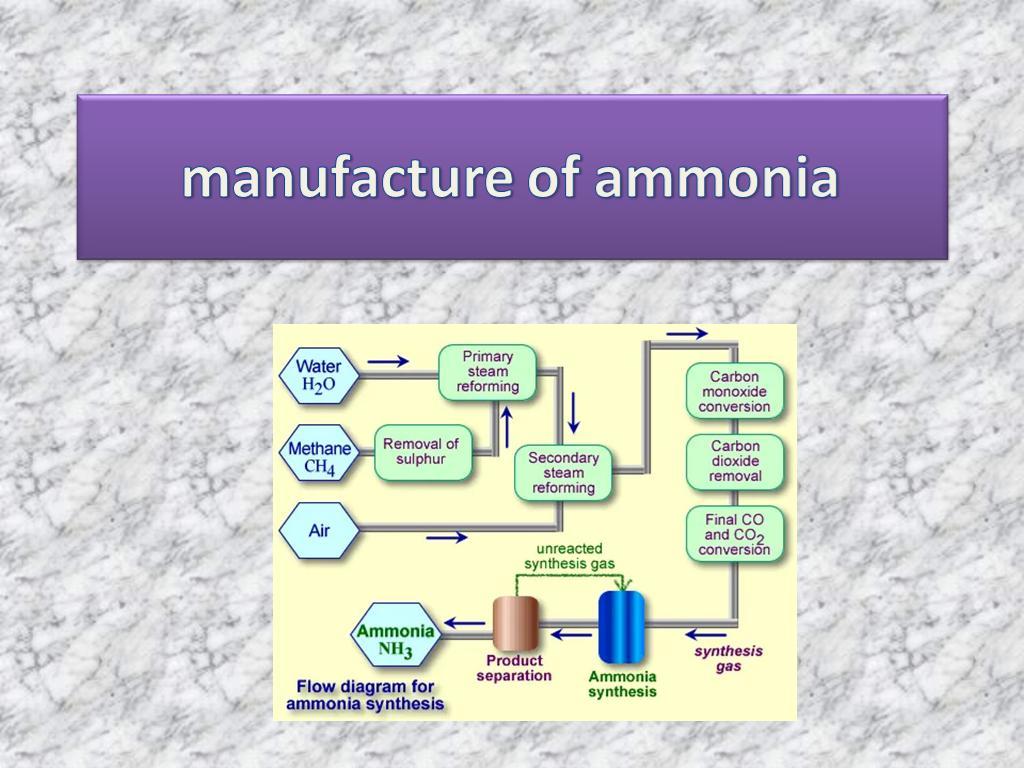
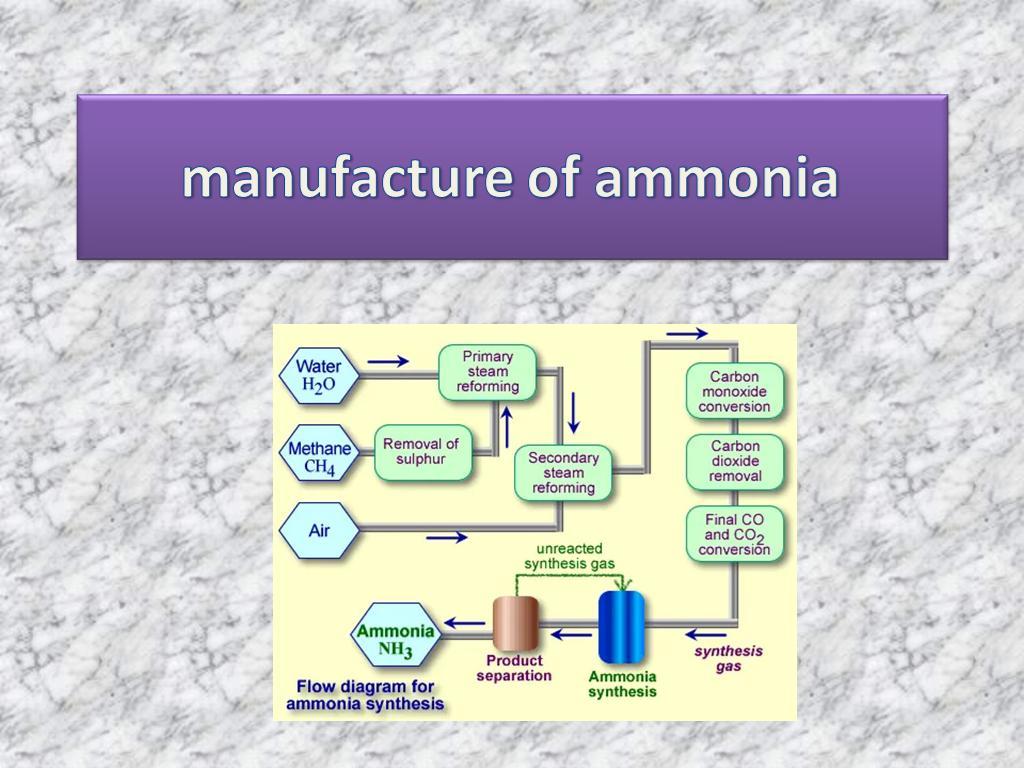
The synthesis of ammonia is known as the Haber-Bosch process. Hydrogen is acquired through the conversion of natural gas containing propane or butane hydrocarbons, which is then reacted with nitrogen from the air to produce ammonia.

Learn more

The mass of one mole of raindrops

moles of NaOH

moles of water you can produce

Keywords: ammonia production, hydrogen, nitrogen
Alekssandra [2.8K]1 month ago
5 0

Answer: NH_{3}

Explanation: When diatomic hydrogen and diatomic nitrogen gases react spontaneously, ammonia gas is produced as the outcome.

<pthe reactions="" are="" as="" follows="" since="" all="" substances="" involved="" in="" the="" gas="" phase="" notation="" is="" applied="" to="" molecules.="">

H_{2}_{(g)} + N_{2}_{(g)} ----> NH_{3}_{(g)}

However, this equation is unbalanced, as the right side has 2 hydrogen and 2 nitrogen atoms, which leads to a product containing one nitrogen and three hydrogen atoms.

Thus, upon balancing the equation, we derive:

3H_{2}_{(g)} + N_{2}_{(g)} ----> 2NH_{3}_{(g)}

We doubled the amount of diatomic hydrogen, resulting in the generation of 2 moles of ammonia as a product.

Therefore, the fully balanced equation is:

3H_{2}_{(g)} + N_{2}_{(g)} ----> 2NH_{3}_{(g)}

</pthe>
You might be interested in
When double-stranded DNA is heated at neutral pH, which change does not occur?
KiRa [2853]

Answer:

Option B) The N-glycosidic bond that forms between the base and the pentose breaks

Explanation:

When the forces that hold the two strands of DNA together are compromised, they separate. This process is identified as denaturation.

The critical forces maintaining the dual strands of DNA are the hydrogen bonds (physical forces) linking base pairs (Adenine with Thymine, and Guanine with Cytosine).

Denaturation is a phenomenon that can be induced by various factors: alterations in pH, introduction of salt, heating, and others.

When a DNA solution undergoes heating, the denaturation process can be monitored through UV absorption (typically at a wavelength of 260 nm): UV light absorption is minimal when the DNA (double-stranded) is in its native state, as the nitrogenous bases are stacked like coins, resulting in less light absorption.

As the DNA double helix unwinds during denaturation, these bases become exposed, leading to an increase in UV absorption.

Additionally, viscosity is another method to observe DNA denaturation: in a double-stranded DNA solution, viscosity is high due to the stiffness of the double chain; however, once the strands separate, the viscosity decreases (as time progresses with heating).

Ultimately, during the heating process, only physical forces are disrupted (i.e., hydrogen bonds), while chemical bonds (such as covalent bonds) remain intact, which would require extreme conditions for disruption.

7 0
14 days ago
Arrange the steps of glycogen degradation in their proper order. Hormonal signals trigger glycogen breakdown. Glucose 6‑phosphat
VMariaS [2860]

Answer: Please see answer below

Explanation:

The sequence for glycogen degradation is as follows:[

---> Hormonal signals initiate the breakdown of glycogen.

1. Glycogen undergoes debranching through the hydrolysis of α‑1,6 linkages.

2. Blocks of three glucosyl units are relocated by remodeling α‑1,4 linkages.

3. Glucose 1‑phosphate is derived from the non-reducing ends of glycogen and is transformed into glucose 6‑phosphate.

---> Glucose 6‑phosphate enters further metabolic pathways

Glycogen degradation consists of three stages:

(1) the release of glucose 1-phosphate from glycogen,

(2) transforming the glycogen structure for continued breakdown, and

(3) converting glucose 1-phosphate into glucose 6-phosphate for subsequent metabolism.

(https://www.ncbi.nlm.nih.gov/books/NBK21190)[[TAG_34]][[TAG_35]][[TAG_36]]

4 0
10 days ago
Heavy nuclides with too few neutrons to be in the band of stability are most likely to decay by what mode?
Anarel [2728]

Answer:

Positron emission

Explanation:

In positron emission, a proton transforms into a neutron. This alteration results in a daughter nucleus with its mass number increased by 1, while the atomic number remains unchanged. The formation of a new neutron boosts the neutron count in the daughter nucleus, thus enhancing the N/P ratio.

Concurrently, a positron is emitted along with an anti-neutrino to ensure spin conservation.

6 0
4 days ago
What is the percentage by mass of solution formed by dissolving 36.0 grams of HCl in 98.0 grams of water?
eduard [2645]
Convert HCl and H2O to moles.

36.0 g of HCl = 0.987 moles HCl

98.0 g of H2O = 5.44 moles H2O

Based on the stoichiometric ratio for HCl,
there are 0.987 moles of H and 0.987 moles of Cl.

For H₂O, according to the stoichiometric ratio, you have 10.88 moles of H and 5.44 moles of O.

Combining them:
11.867 moles H
0.987 moles Cl
5.44 moles O

Revert the moles back to grams, then divide by the total mass and multiply by 100 for the percentage by mass.

11.867 moles H = 11.96 g H
0.987 moles Cl = 34.99 g Cl
5.44 moles O = 87.03 g O

11.96/(36.0+98.0)(100) = 8.93% for H
34.99/(36.0+98.0)(100) = 26.11% for Cl
87.03/(36.0+98.0)(100) = 64.96% for O.
4 0
29 days ago
Read 2 more answers
A compound composed of only carbon and chlorine is 85.5% chlorine by mass. propose a lewis structure for the lightest of the pos
lions [2782]

The visual representation is displayed in the following image.

For calculations, consider 100 grams of the compound:

ω(Cl) = 85.5% ÷ 100%.

ω(Cl) = 0.855; signifying the mass percentage of chlorine in the compound.

m(Cl) = 0.855 · 100 g.

m(Cl) = 85.5 g; this represents the mass of chlorine.

m(C) = 100 g - 85.5 g.

m(C) = 14.5 g; indicating the mass of carbon.

n(Cl) = m(Cl) ÷ M(Cl).

n(Cl) = 85.5 g ÷ 35.45 g/mol.

n(Cl) = 2.41 mol; this is the quantity of chlorine.

n(C) = 14.5 g ÷ 12 g/mol.

n(C) = 1.21 mol; this is the quantity of carbon.

n(Cl): n(C) = 2.41 mol: 1.21 mol = 2: 1.

The compound in question is identified as dichlorocarbene CCl₂.

4 0
1 month ago
Read 2 more answers
Other questions:
  • Phosphine, ph3(g), combusts in oxygen gas to form water vapor and solid tetraphosphorus decaoxide. express your answer as a bala
    10·1 answer
  • Common additives to drinking water include elemental chlorine, chloride ions, and phosphate ions. Recently, reports of elevated
    8·1 answer
  • If 75.0% of the isotopes of an element have a mass of 35.0 amu and 25.0% of the isotopes have a mass of 37.0amu what is the atom
    10·2 answers
  • According to the VSEPR model, the arrangement of electron pairs around NH3 and CH4 is A. the same, because in each case there ar
    8·1 answer
  • The enthalpy change for converting 1.00 mol of ice at -50.0 ∘c to water at 60.0∘c is ________ kj. the specific heats of ice, wat
    11·1 answer
  • Match each set of quantum numbers to the correct subshell description by typing in the correct number.
    12·2 answers
  • A solution is prepared by diluting 50.00 ml of 2.575 m solution of hno3 to 250.0 ml. what is the molarity of the resulting solut
    13·2 answers
  • Aluminum has a specific heat of 0.902 j/gC. How much heat is lost when a piece of aluminum with a mass of 23.984 g cools from a
    6·1 answer
  • A pure titanium cube has an edge length of 2.78 in. How many titanium atoms does it contain? Titanium has a density of 4.50g/cm3
    5·1 answer
  • Be sure to answer all parts. Predict the effect of decreasing the temperature on the amounts of reactants in the following react
    12·1 answer
Add answer
Login
Not registered? Fast signup
Signup
Login Signup
Ask question!